
Camping games for adults: around the campfire and at the campsite
Good camping games for adults need almost nothing you didn't already pack. The ones here are sorted by where you play them: by the fire after dark, around the site in daylight, inside the tent when it rains, with a big group, and with no gear at all. Each game says what you need from home, how it works and about how long a round takes.
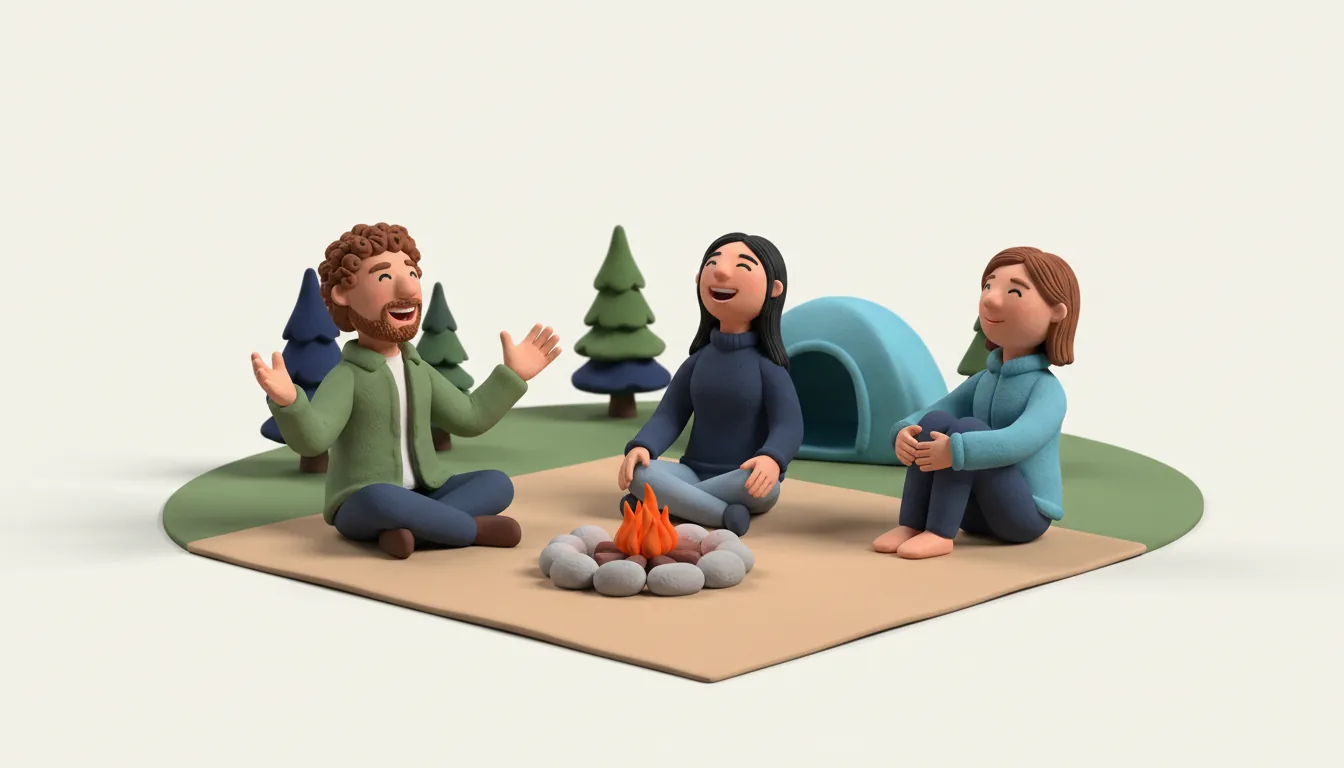
An example: on the first night at the lake, Tomas made one rule before the fire had properly caught. Tell the worst night you've ever spent outside, and the next person has to top it. He went first, both hands up, with the story of a tent that filled with rain at three in the morning. Priya laughed so hard she had to brace her hands on her knees. Then Ruth, hugging her knees on the far side of the fire, said she had once woken up with a goat in her tent. Nobody could beat it. The small fire in its circle of stones burned low while they tried.
Campfire games for adults that are mostly talk
Once the fire is going, many people want to sit still and talk. These adult campfire games give the talk a little structure.
- Top that. You need nothing. One person tells a short true story about a night outdoors that went wrong, and the next has to top it with a worse one. When nobody can, the group votes for the best story of the round. About 15 minutes for five people.
- Rose, bud, thorn. You need nothing. Each person names the best moment of the day (the rose), something they're looking forward to tomorrow (the bud) and the low point (the thorn). Everyone else may ask one question before the next person goes. About 2 minutes a person.
- Same first line. You need nothing. One person says the opening line of a story, like "The tent was already wet when we got there." Then each person around the fire tells their own one-minute story from that same line, and the group picks the ending it liked best. About 10 minutes a round.
Campsite games for the daylight hours
In the morning, the people who sat still by the fire want to move. These outdoor games for camping use what's already lying around the site.
- Firewood skittles. You need nothing from home, only five pieces of firewood and a short, heavy stick. Stand the logs on end in a row, step back eight big paces and throw the stick to knock over as many as you can. Each player gets three throws, and the logs go back up after every turn. About 15 minutes for four players.
- Find your tree. You need a scarf or a bandana to cover someone's eyes. Lead your blindfolded partner by the arm to a tree, let them feel the bark and the roots for a minute, then walk them back the long way around. With the scarf off, they have to find their tree. About 10 minutes a pair.
- Pinecone golf. You need nothing but one pinecone each. Agree on five trees as the holes and a starting spot for each one. Throw your pinecone until it hits the trunk, count every throw, and the lowest total after five holes wins. About 20 minutes.
Tent games for when it rains
Rain on the roof turns a small tent into a game room. These fit in the space between the sleeping bags.
- Shadow guess. You need a flashlight. One player points the beam at the tent wall and makes a shadow animal with their hands, and the others guess what it is. Whoever guesses right makes the next shadow. About 10 minutes.
- Pig. You need one die. On your turn, roll as many times as you like and add up the numbers, but a one wipes out everything from that turn, so stop when you want to keep your points. The first player to reach 100 wins. About 20 minutes.
- I doubt it. You need a deck of cards and at least three players. Deal the whole deck, then take turns laying cards face down and naming them in order (aces, then twos, and so on), lying when you have to. Anyone can say "I doubt it," and a caught liar takes the whole pile, but so does a wrong doubter. About 20 minutes.
If the rain never stops and the trip ends a day early, the same group can carry on indoors with what to do with friends at home.
Campfire games for large groups
With ten or more people around one fire, half the circle can't hear a story told on the other side. These keep everyone in one game.
- Categories on the beat. You need nothing. The whole circle pats their knees twice and claps twice in a slow beat, and on each clap the next person names something in a category, like things you'd find in a tent. Miss the beat or repeat an answer and you're out, and the beat gets faster each round. About 10 minutes.
- The secret packing rule. You need nothing. One player picks a secret rule, like "only things that begin with your own initial," and says, "I'm going camping, and I'm bringing a lantern." The others take turns saying what they'd bring, and the player says yes or no until everyone has worked out the rule. About 10 minutes a rule.
In daylight, firewood skittles and pinecone golf also work for a big group if you split into teams of three or four.
Camping games with no gear at all
Some of the best games to play while camping need only the people who came.
- The night sound count. You need nothing. After dark, everyone closes their eyes and stays quiet for one minute, counting each different sound they hear. Then each person names their sounds, and a sound only counts if someone else heard it too. About 5 minutes a round.
- The slow race. You need nothing. Everyone lines up and walks to a tree about twenty steps away as slowly as they can, and anyone who stops moving or steps back is out. The last person to reach the tree wins. About 5 minutes a race.
- Match it. You need nothing. One player holds up something found at the site, like a leaf, a stone or a feather. Everyone gets two minutes to find the closest match, and the player who found the first thing picks the winner. About 10 minutes.
The drive out counts as part of the trip. Road trip games for adults has word games for the car, and the driver can play most of them. If a night by the fire is on your list for this summer, summer bucket list ideas has more to plan with friends.
Who wants a story and who wants a score
By the second night, many camping groups split in two. Some people want to sit by the fire and hear one more story. Others want a contest at the campsite and a rematch after lunch. Here's how seven of the 16 types often lean:
- Ideator invents a secret packing rule nobody can crack, then changes it halfway through.
- Harmonizer keeps the fire going and the blanket warm, and likes rose, bud, thorn because everyone gets a turn.
- Vitalizer starts top that and laughs loudest at every worse story.
- Commander wants a score at the campsite and asks for one more round of firewood skittles.
- Dreamer waits for the right moment to tell a story, once the fire burns low.
- Strategist plays pig with a plan and knows exactly when to stop rolling.
- Craftsman makes the best shadow animals in the tent and finds the tree on the first try.
These are patterns from type theory. Your own group may not fit them, and they aren't advice about anyone at your fire.
See how your camping friends get along
Two friends at the same fire can want very different nights. Typeza looks at how two people get along, like who needs the quiet and who needs the game, and where the two of you meet. Take the free friendship compatibility test and send the link from your result to the friend you camp with most. Then compare what you each get back.
Questions people ask
What games can adults play around a campfire?
Talking games work best by the fire, like top that, rose, bud, thorn and same first line. For ten or more people, try categories on the beat or the secret packing rule.
Written by Virko Kask, founder of Typeza
Written with the help of AI tools.
One question for two, every week
A question to ask your partner, friend or family, and how different types tend to answer it.
Free. Unsubscribe any time.