
How to be best friends with your spouse
Being best friends with your spouse means you enjoy each other's company for its own sake, on top of running a home and a life together. For many couples it rests on three things: jokes you share, a small world that belongs to the two of you, and the freedom to be honest without starting a fight.
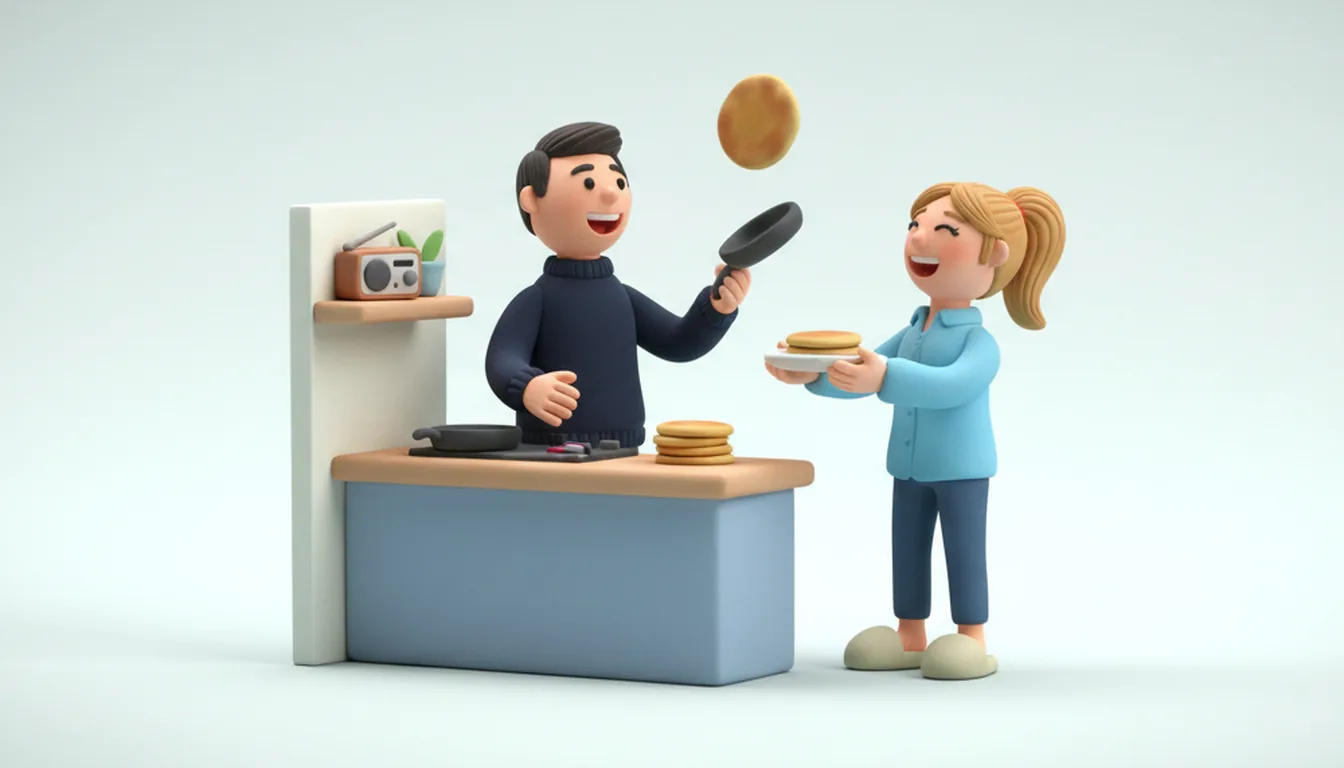
An example: every Saturday since their first tiny apartment, Omar makes pancakes and Ruth keeps score. He flips each one higher than he needs to, and she stands by the counter in her slippers with a plate in both hands, laughing before it even lands. The old radio on the shelf plays the same morning show it has played for eleven years. Once a pancake hit the ceiling light, and Ruth gave it a nine "for courage." A neighbor asks how they still seem to like each other so much. Ruth thinks about it for a second. "He's the person I'd want to have breakfast with even if I weren't married to him."
What makes a husband or wife a best friend
Love and friendship overlap in a marriage, but they aren't the same thing. You can love someone deeply and still feel like roommates on a busy Tuesday. Friendship is the part that makes an ordinary evening fun.
A spouse who is also your best friend usually:
- is the first person you want to tell, about good news and about silly things alike;
- knows your stories and still lets you tell them at dinner parties;
- laughs at you and with you, and you can tell the difference;
- takes your side in public and tells you the truth in private;
- would pick you for a long drive or a slow morning, even with other options.
When people say they married their best friend, they usually mean the friendship came first or grew so strong that it now holds everything else up. Some couples feel more like a team on a mission, which is the spirit of a partner in crime. Friendship is quieter than that and shows up mostly in the small minutes.
The jokes nobody else gets
Shared humor is a clear sign of friendship between spouses. Ruth's scores for each flip started as a joke on their second Saturday and never stopped. Nobody else would find it funny, which is exactly why it matters.
Private jokes do a few quiet jobs. They remind you of your history, they soften a tense moment, and they let you say "we're fine" with one look across a crowded room. Couples with many years behind them often collect dozens: a word your toddler once got wrong, an impression of a rude waiter, a song that always gets turned up in the car.
You can't force inside jokes, but you can make room for them. Do new things together now and then, since new things create stories. And when your partner makes a joke, laugh or groan out loud, because a joke that lands gets told again. Come February, the best ones can go in a funny Valentine's card.
A small world that belongs to you two
Best friends have a culture of their own, and so do married friends. It's made of rituals and references more than big events. Saturday pancakes, a running list of places you want to visit someday, the same seats at the cinema. These little things build a world only the two of you live in.
That world needs a bit of protection. A few ways couples keep it:
- They have at least one ritual that never gets canceled for chores.
- They keep some memories just between them and don't post everything.
- They go back to old places now and then, like the first restaurant or the street where they met.
- They talk about things other than kids, money and logistics.
If you want to mark this kind of bond, National Spouses Day in January is a good excuse for a small gesture.
Telling the truth without a fight
Friends tell each other when there's spinach in their teeth. They also say harder things. The trouble in many marriages is that honesty and conflict get tangled, so people stop saying small truths to keep the peace. Over the years that adds up to distance.
Spouses who are friends find a way to be honest that doesn't feel like an attack. A few things help.
- Pick the moment. Not when either of you is hungry, rushing out the door or half asleep.
- Start with what you saw. "You seemed quiet at your mom's" goes over better than "You were rude to my mom."
- Stick to one thing. Old complaints can wait for another day, or forever.
- Ask for their side and listen to the whole answer. You may learn something you didn't know.
- End warm. A hug, a joke or "thanks for hearing me" closes the talk as friends.
Ruth once told Omar that his pancake commentary was louder than the radio and she couldn't hear the news. He laughed, and now he goes quiet for the weather report.
Closeness also grows from talks that go below the surface. Emotional intimacy is a good next read if you'd like your conversations to go deeper.
How each type builds friendship with a partner
People bring their own style of friendship into a marriage, and Typeza sees personality type as part of that style. What feels like friendship to one spouse can feel like ordinary life to the other. Six of the 16 types show the range:
- Mentor builds friendship through feelings shared out loud. Late talks about what a day meant, a movie that made them both cry, a story told with feeling.
- Inspector builds it through being dependable. Keeping promises, showing up when they said and remembering the ritual are their way of saying "you're my person."
- Diplomat builds it out in the world. Dinners with friends, trips, a dance at a wedding. They want a spouse who joins in and enjoys the moment with them.
- Entrepreneur builds it through shared projects. Fixing up a house, planning a big trip or starting something new together makes them feel closest.
- Counselor builds it through quiet understanding. A long walk where nothing has to be explained can mean more to them than any party.
- Encourager builds it through curiosity. They see what you could become, tell you so and pull you into new ideas.
When two people build friendship in different ways, each can miss what the other is offering. An Inspector may feel they show friendship every single Saturday, while a Diplomat spouse waits for a night out with friends that never comes. Naming your own style to each other can help clear that up.
Habits that keep married friends close
Friendship in a marriage rarely fades in a dramatic way. It fades through busy weeks. These habits are small enough to keep:
- Ask one real question a day. "What made you laugh today?" beats "How was work?"
- Text something that made you think of them, with no task attached.
- Have one meal a week with no phones and no planning talk.
- Learn about their hobby, even if you never take it up.
- Say thank you for ordinary things like coffee made or bins taken out.
- Keep your own friends too. A spouse can be your best friend without being your only one.
See what kind of friends you and your spouse are
Some couples are easy friends from the first breakfast and others have to work at it, and type is often part of that gap. The couples compatibility test is free. Then pass the result link to your husband or wife. Once they finish, your relationship type tells where a married pair like you tends to click and where you could misread each other.
Questions people ask
Can your spouse be your best friend?
Yes. Many couples call each other best friends. One study of British survey data found that the well-being boost from marriage was about twice as large for people whose spouse was also their best friend.
Is it normal not to be best friends with your spouse?
Yes. Some couples feel more like a strong team or deep partners than best friends, and that can work well. Friendship tends to grow over time with shared rituals and honest talk.
Should my spouse be my only best friend?
No. Friends outside the marriage give you support and fresh air, and they take some weight off your spouse.
Sources
- Shawn Grover and John F. Helliwell, "How's Life at Home? New Evidence on Marriage and the Set Point for Happiness" (NBER Working Paper 20794, December 2014). Based on UK survey data, the well-being effects of marriage were about twice as large for people whose spouse was also their best friend.
Written by Virko Kask, founder of Typeza
Written with the help of AI tools.
One question for two, every week
A question to ask your partner, friend or family, and how different types tend to answer it.
Free. Unsubscribe any time.