
Love vs lust: how to tell them apart, and how each type feels the pull
Lust is a strong physical pull toward someone. Infatuation is the rush of the first weeks or months, when you think about the person all day and they seem close to perfect. Love is what's still there once you know their faults, have seen them tired and grumpy, and keep choosing them anyway. Lust and infatuation arrive fast and loud. Love grows slowly, and you often notice it only when you look back.
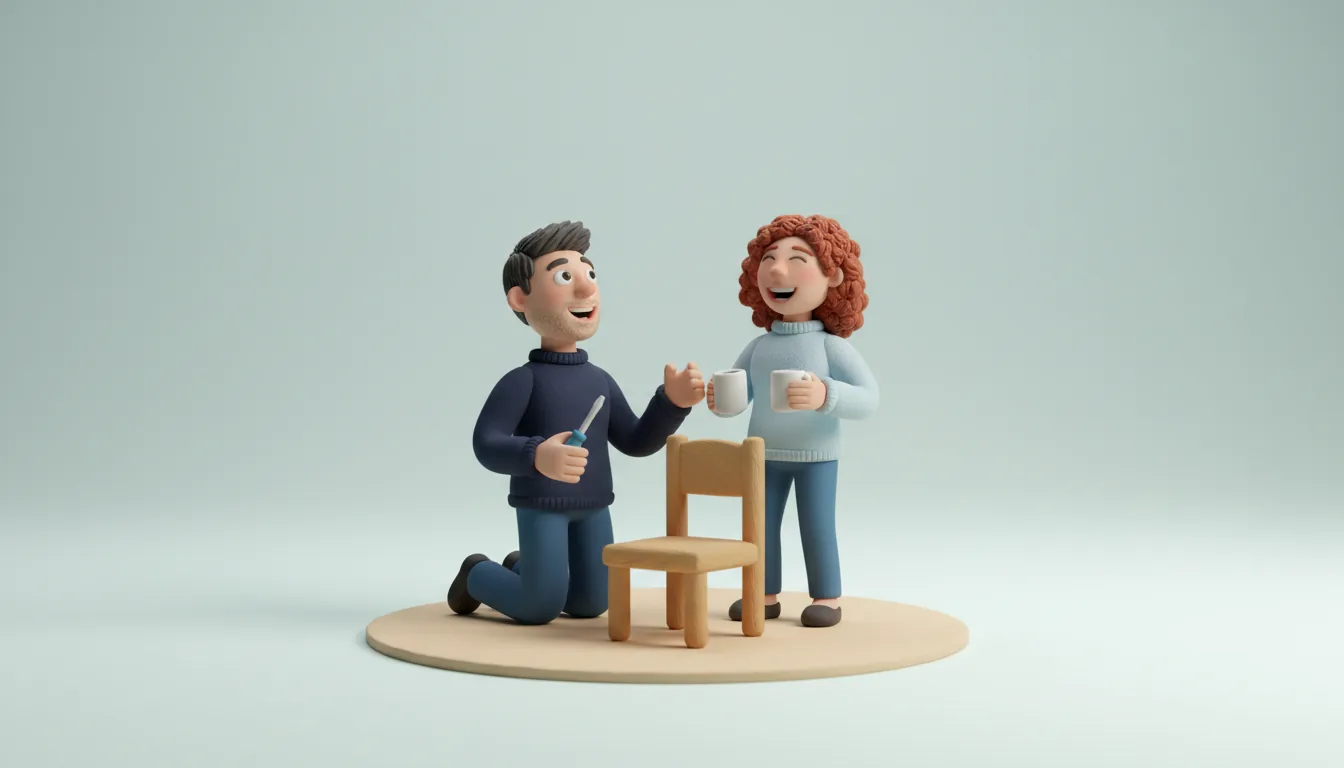
An example: Simone and Cole met at a friend's birthday picnic four years ago. For the first three months she crossed town twice a week for a twenty-minute lunch with him, and after six weeks she told her sister he was the kindest man in the city. Last Sunday she watched him kneel on the kitchen floor with a screwdriver, fixing the chair that had wobbled since spring. He was humming the same three notes he always hums, slightly off, and saying "nearly there" long before anything was nearly there. When the chair finally stood straight, he looked up, pleased with himself, and she laughed with a coffee mug in each hand. She doesn't cross town for lunch anymore. She wouldn't swap these four years for the rush, either.
Lust, infatuation and love in plain words
People use the three words loosely, so it helps to say what each one means.
- Lust is strong physical attraction to someone. It can show up in a second, before you know anything about them.
- Infatuation is the early rush of feeling. You want to be near the person, you think about them constantly, and you see them as nearly flawless. It feeds on what you don't know yet.
- Love is steady care for a real person with real faults. It shows in what you do on ordinary days more than in how fast your heart beats.
The three often overlap. Plenty of couples start with a pull and a dizzy first month, and love grows underneath. Trouble starts when a few heady weeks get treated as proof that you've found the person you'll grow old with.
What the first months feel like
Infatuation is easy to spot from the outside and hard to see from the inside. A few signs that you're in it:
- You check your phone for their name dozens of times a day.
- You rearrange your whole week to see them, even for twenty minutes.
- Their small habits seem charming, even ones you'd find annoying in anyone else.
- You feel sure about a shared future with someone you've known for a few weeks.
None of this is a mistake. The rush is how many lasting couples begin. The honeymoon phase piece looks at how long that stretch usually lasts and what comes after it.
Love shows up once you know their faults
Love starts to show when the picture of a perfect person fades and a real one takes its place. You know he's late to everything except the airport, or that she goes quiet for an hour after a hard call with her mother. You've had a proper argument and made up, and you still want to be there.
Some signs the feeling has become love:
- You like them on their dull days as well as their bright ones.
- You can name what annoys you about them, and it doesn't change your plans for next year.
- Their good news makes you happy even when it costs you something, like a busy month or a move.
- You care how they're doing as much as how they make you feel.
The piece on knowing whether you love someone has more everyday clues.
Is it love or lust? A few honest questions
When a feeling is strong and you can't tell what it is, a few questions help more than waiting for a sign.
- Do you want to hear about their week, or mostly to see them?
- Can you name one thing about them you don't like? If you can't find a single fault, you probably don't know them well yet.
- Would you like this person as a friend?
- Can you picture them on a rainy Saturday of errands, or at your sister's birthday?
- After time together, do you feel calmer, or only more restless?
If most answers are about how they look and how you feel near them, it's probably attraction, maybe with some infatuation mixed in. If they're about who the person is, you're likely on your way to love. Early on, many honest answers are a bit of both.
Can infatuation turn into love?
Yes, and it often does. A lot of long marriages began with a strong pull or a giddy first month, because the rush brings two people together often enough to find out whether they actually like each other. Infatuation turns into love when what you learn about the real person makes you want to stay. It fades when the real person keeps failing to match the picture you had.
The first rush fades in time, often within two or three years, and that's no sign of trouble. The quieter feeling that follows is what carries a couple through a move or a long winter. A strong spark and a good fit are also two separate questions, which chemistry vs compatibility explains.
Why some types fall fast and others warm up slowly
How quickly someone falls has something to do with personality. Some people feel it on the first evening and say so. Others need months of small proofs before a feeling can grow, and then it holds. Simone and Cole sit at two ends of that range, and eight of the 16 types show the rest of it.
- Vitalizer warms up quickly and shows it with calls and plans, and hopes to get the same warmth back just as openly.
- Analyst is slow to trust a feeling they can't explain. They may seem cool for months, then turn out to be steady for years.
- Mentor falls hard and with drama, and needs a partner who isn't scared off by that intensity.
- Inspector watches for reliability first. Love grows every time you do what you said you'd do.
- Dreamer can fall quietly, in their head, long before saying a word, and build a whole future out of a few meetings.
- Diplomat feels attraction quickly and acts on it. For them the chase is part of the fun.
- Guardian is careful about who gets close and tests loyalty before committing. Once they love someone, it's for a long time.
- Encourager gets excited about who a new person could become, and can fall for that promise before knowing the person well.
Simone is a Mentor and fell in a week. Cole is an Inspector and took most of a year to say the word, because he wanted to be sure. That worried her at the time, and now she takes it as proof that he meant it.
When one of you fell first
In many couples one partner falls fast and the other slowly. The fast one wonders what the other is holding back, while the slow one feels rushed. A few things help:
- Talk about speed without turning it into a test. "I tend to fall fast" and "I need time before I trust a feeling" are useful sentences.
- Watch what your partner does as well as what they say. A slow faller often shows love in actions months before putting it into words.
- Let the rush settle before big decisions like moving in together. How fast it started says very little about how long it lasts.
If you'd like names for the different kinds of love people feel, types of love has the four classic ones.
Learn how fast each of you falls
Some people say "I love you" after a few weeks and others need most of a year, and type explains part of that pace. Whichever pace is yours, start with the free couples compatibility test. Then text your result's link to your partner. Once they have done it, you each get your relationship type, with the parts that flow and the places where your pace may clash.
Questions people ask
Is it love or lust?
If you mostly want to be near them and know little about who they are, it's likely attraction. If you know their faults, care about their days and still want to stay, it's love.
How long does infatuation last?
It varies. One well-known estimate puts the intense early stage at 18 months to three years, though it can be much shorter. As you get to know the real person, either love grows in its place or the interest fades.
Can you feel love and lust for the same person?
Yes. Many couples who love each other still feel a strong pull toward each other. It only becomes a problem when attraction is all there is.
What does love over lust mean?
It means choosing steady, caring love over a passing physical pull, such as a partner you trust over someone who is simply exciting.
Is being in love the same as loving someone?
They overlap. Being in love usually means the intense early feelings. Loving someone is the calmer care that can last for decades, with or without the dizzy part.
Sources
- Wikipedia, "Limerence": Dorothy Tennov's estimate that the intense early stage most often lasts 18 months to 3 years.
Written by Virko Kask, founder of Typeza
Written with the help of AI tools.
One question for two, every week
A question to ask your partner, friend or family, and how different types tend to answer it.
Free. Unsubscribe any time.