
Retirement hobbies: ideas by what work used to give you
The best retirement hobbies give you back what work used to give you. For some people that's the rhythm of a day. For others it's the people, a skill to get better at or the feeling of being needed. Work out which one you miss most, then pick a hobby that brings it back.
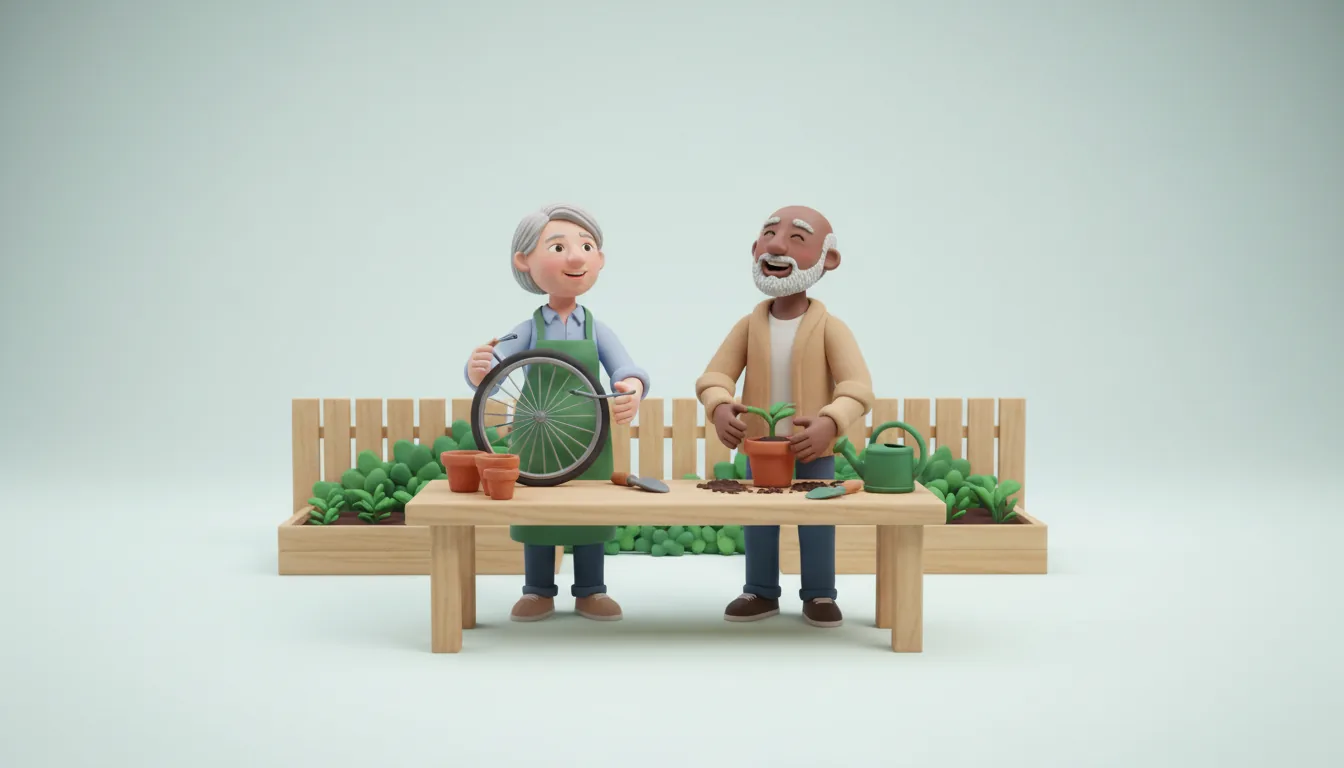
An example: Elena drives a city bus for thirty-one years. On her first Monday of retirement she is dressed and ready by six, with nowhere to go. By Wednesday she is cleaning cabinets that are already clean. Her neighbor Walter, who left his job at the library three years before, leans over the fence and offers her half of his potting bench. Now they stand side by side in his garden most weekday mornings. Walter repots seedlings while Elena rebuilds an old bicycle one wheel at a time, tightening each spoke until the rim runs straight. She talks the whole time, and Walter laughs at most of it. The bench gives back what she missed most about the bus: a reason to be somewhere at nine.
Retirement hobbies sorted by what work gave you
Many people miss one of these four things more than the rest. If you can't tell which one you miss, how to find a hobby walks you through a few questions first.
If you miss the rhythm of a workday
- Keep a weather diary. Read a rain gauge and a thermometer at the same hour every morning and write the numbers in a notebook. After a year you'll know your own street's weather better than any forecast does.
- Keep a few hens. Hens need letting out in the morning and shutting in at dusk, every day. Three are plenty for a small yard, and they make each day start and end on time.
- Walk a neighbor's dog. Offer to take a neighbor's dog out at the same times each day. A dog is very good at reminding you when it's time.
If you miss the people
- Join a mahjong table. Four players meet on the same afternoon every week, with plenty of talk between rounds.
- Join a community orchard group. In some towns, people look after a shared orchard. They prune in winter, mow in summer and pick fruit in the fall, and there's always a job for one more pair of hands.
- Help at a fix-it session. Some towns hold a monthly session where neighbors bring broken lamps, chairs and coats, and volunteers mend them on the spot. You don't need to be an expert to hold the light or sort the screws.
If you miss getting better at something
- Learn letterpress printing. Some print studios open their old presses to members and teach you to set type by hand, one metal letter at a time.
- Learn to weave. A floor loom looks hard, but you learn it a little at a time. Start with a scarf, and within a year you could be weaving cloth for a chair seat.
- Graft a fruit tree. Cut a twig from a tree you love, join it to a young rootstock and wrap the join. If it takes, you'll pick fruit from it in a few years.
If you miss being needed
- Help an adult learn to read. Some libraries pair volunteers with adults who are learning to read. You meet the same person for an hour each week, and you both see the progress.
- Give tours of a museum or an old house. Museums and historic houses often train volunteers to take visitors around. You learn the stories, then tell them to new people every week.
- Start a seed library. Save seeds from your own beans, tomatoes and flowers, label them in envelopes and leave them in a box by the gate for neighbors. Next spring your plants come up in other people's gardens.
- Write the story of your street. Find out who lived in each house and what stood there before. Old maps at the library and long talks with neighbors fill a notebook fast.
Hobbies for retired men and retired women
Retired men and women ask the same question when work ends, and the answer works the same way for both.
For retired men, start from what work gave you. A man who misses his crew might love a weaving class or the mahjong table, and one who misses solving problems might take to grafting or the seed library. There are more ideas in hobbies for men.
For retired women, start from what work gave you. A woman who misses her crew might love the fix-it session or the orchard group, and one who misses solving problems might take to blacksmithing or amateur radio. There are more ideas in hobbies for women.
Typeza sees type as part of which hobby sticks, often more than being a man or a woman.
The first year after work
Much of what to do when you retire comes down to the shape of a day. Work gave your days a start, a middle and an end without you thinking about it. In the first year, build that shape again on purpose.
- Give the morning an anchor. One fixed thing before nine, like the weather diary or the hens, gets you dressed and outside.
- Put people in the middle of the week. One regular afternoon with the same group keeps Wednesday from slipping away.
- Try more than you keep. Sample four or five hobbies in the first three months, then keep the two you look forward to.
- Leave one weekday open. You worked for years to have a free Tuesday, so keep one.
If the last day at work is still ahead, retirement party ideas has ways to mark it.
Outdoor hobbies to try in retirement
These keep you active and outdoors on a weekday.
- Dry stone walling. Weekend courses teach you to build a wall from stones with no mortar, fitting each piece by eye. The work is slow, and a good wall can stand for a hundred years.
- Beekeeping. A hive needs regular checks from spring to late summer, and you learn to move slowly and stay calm around thousands of bees.
- Geocaching. People hide small boxes in parks and woods and share where they are online, and you go and find them with a phone. It gives any walk a goal.
- Kite building. Make a kite from thin sticks, string and fabric from an old shirt, then fly it from a windy hill.
Unusual hobbies for retirement
- Amateur radio. Pass a license exam and you can talk to people across the country from a radio in a spare room. On a good day you may reach someone across an ocean.
- Blacksmithing. A beginner's day at a forge teaches you to heat, bend and hammer steel into a hook for your coat. It's loud and hot.
- Metal detecting. Ask a farmer for permission and walk a plowed field slowly, listening for the beep. Most finds are old nails, but now and then you may dig up an old buckle.
- Lichen spotting. With a hand lens and a field guide, every old wall and tree trunk turns into a small forest. Some patches grow so slowly that they're older than your house.
What each type misses most after work
Work gave many people two things at once: a shape for the day and people to share it with. Typeza sees personality type as part of which one you miss first. Seven of the 16 types:
- Vitalizer misses the people first, the noise and jokes of a busy place. A fix-it session or a mahjong table brings that back fast.
- Analyst misses a problem worth thinking about. A weather diary with neat columns or the history of a street suits them.
- Mentor misses real talk about what matters. An hour a week with an adult learning to read gives them that.
- Inspector misses the timetable. Hens that need letting out at seven and a hive to check every Saturday give the week its edges back.
- Guardian misses the colleagues they trusted more than the job itself. An orchard group where everyone turns up when they said they would suits them.
- Encourager gets restless when every day looks the same. A new hobby each season, with a friend who helps them finish one, suits them.
- Craftsman misses using their hands well. Stone walls, a forge or a floor loom give them a skill to master.
These leanings come from type theory and won't hold for everyone. Use them to find ideas for yourself, never as advice about someone else.
Find the hobby your type will keep
Typeza shows what your type needs from a day and how you get on with the people who share it, from a partner to an old friend from work. Type is often part of which hobby you keep. Take the free personality test, then ask the person you spend your mornings with to take it too.
Questions people ask
What are the best hobbies for retirees?
The ones that give back what work used to give. Try a weather diary or hens for rhythm, a mahjong table or an orchard group for people, weaving or grafting for a skill and helping an adult learn to read for purpose.
Sources
- Wikipedia, "Dry stone". Many dry stone walls in Europe are centuries old.
- Wikipedia, "Lichen". Many lichens grow less than a millimeter a year.
- Wikipedia, "Amateur radio". Operators need a license granted after an exam and can reach stations worldwide.
Written by Virko Kask, founder of Typeza
Written with the help of AI tools.
One question for two, every week
A question to ask your partner, friend or family, and how different types tend to answer it.
Free. Unsubscribe any time.