
Scavenger hunt ideas for adults: lists for home, outside and a party
A scavenger hunt is a game where players race to find everything on a list before the time runs out. The best scavenger hunt ideas for adults are things that cost nothing, are close by and are a little hard to spot, so the team laughs when someone finally holds one up. Here are lists for a hunt at home, outside, around the neighborhood, with a phone camera, at a party, for a big group and for two, plus plain written clues and how to set the whole thing up.
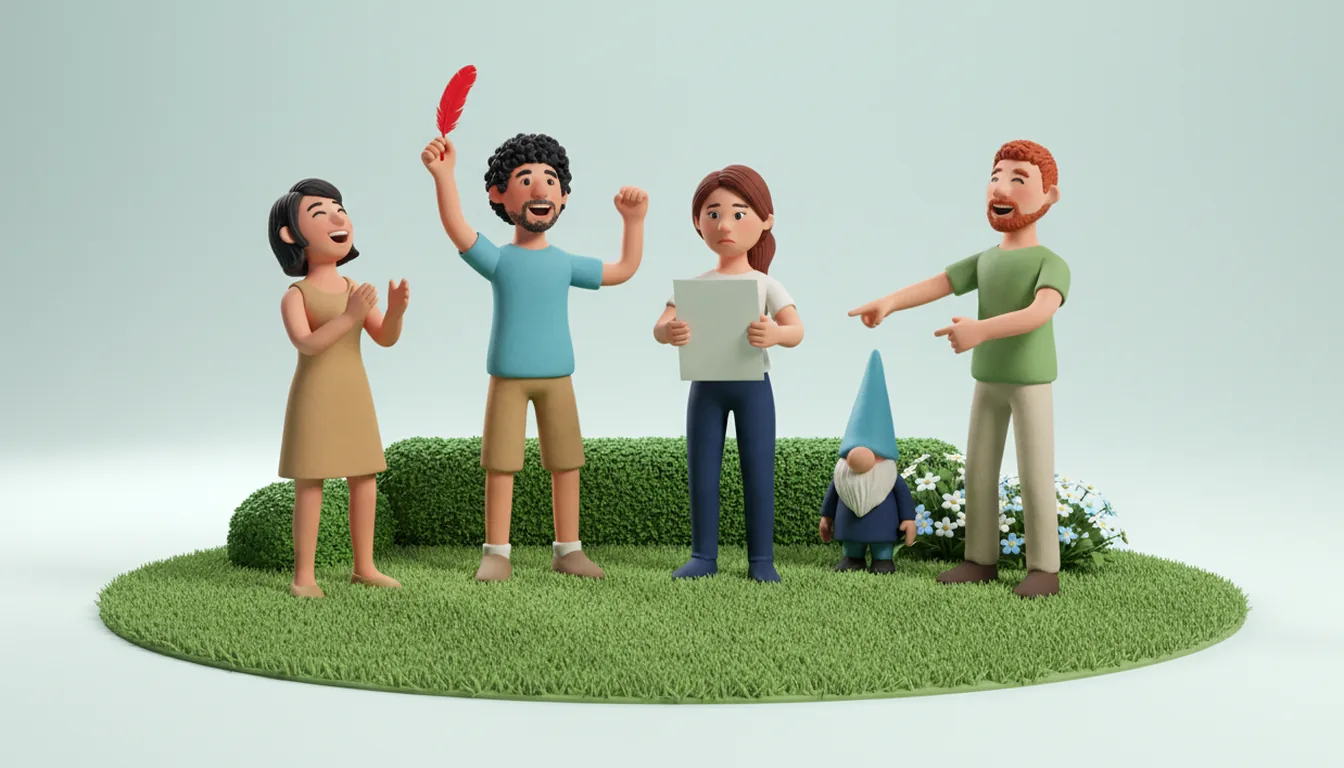
An example: Four friends play in Theo's backyard on a sunny Saturday, with one list between them and twenty minutes on the kitchen timer. Priya holds the list and reads each line twice before she moves. Jonah doesn't wait. At "a feather" he is already on his knees by the hedge, and a minute later he holds up a red one and cheers. Hana claps for him. Priya reads the next line slowly: "Something wearing a hat." Theo laughs and points at the garden gnome that has stood in his flower bed all afternoon, right in front of them.
How to set up a scavenger hunt
You need a list, at least two players and somewhere to look. Settle five things before anyone starts.
- Write the list. Fifteen to twenty-five items is enough. Mix easy finds with a few hard ones, and word each item so a judge can say yes or no to it. "Something round" starts arguments, and "something round that rolls" ends them.
- Make teams. Two to four players a team works best. Put friends who know each other well with ones who don't, and give each team its own copy of the list.
- Set a time limit. Thirty to forty-five minutes is right for a house or a yard, and an hour for the streets around it. Name the place to meet at the end, and take a point off for every minute a team is late.
- Pick a judge. One person who doesn't play checks every find and has the last word on every close call. The host is often the best choice.
- Agree on points. One point for an easy item, three for a hard one, and one bonus point the judge gives for the best story behind a find.
Two rules are worth saying out loud. Nobody buys anything, because the fun is in finding it. And every find goes back to its place when the game ends. The winners don't need a prize, either. Let them pick the next game or the music for the rest of the night.
Scavenger hunt ideas at home
An indoor hunt suits a rainy afternoon or a winter night. Nothing needs hiding, since most homes already have these things somewhere. Ask the host which rooms are open before you start.
- A shoelace that isn't in a shoe
- A key nobody can match to a lock
- A coin from another country
- A candle that has never been lit
- A spoon that doesn't match the others
- A button that came off something
- A pen that doesn't write
- A single puzzle piece
- A clock that has stopped
- A rubber band, a paper clip and a safety pin, all brought back at once
- A picture of an animal that isn't a photo
- Something shaped like a star
Outdoor scavenger hunt ideas for adults
These work in a backyard, a park or a campsite. Take only what is already loose on the ground, and leave every flower growing where it is.
- A leaf bigger than your hand
- A stone with a stripe across it
- A pine cone or any other seed pod
- A clover with four leaves, worth five points
- An empty snail shell
- A stick shaped like a letter of the alphabet
- A seed that flies, like a maple seed or a dandelion clock
- A stone with a hole through it
- A petal that has already fallen
- A piece of bark that came off on its own
- A spider web with dew on it, as a photo
- A cloud shaped like an animal, as a photo, if the whole team agrees which animal
Neighborhood scavenger hunt ideas
Walk, don't drive, and take every photo from the sidewalk. Stay out of people's yards. If a neighbor asks what you're doing, tell them. Some will join in.
- A front door painted red
- A cat sitting in a window
- A house number whose digits add up to ten
- A wind chime you hear before you see it
- A bicycle with a basket
- A door knocker shaped like an animal
- A garden statue that isn't a gnome
- A chalk drawing on the sidewalk
- A tree taller than the houses around it
- A mailbox that doesn't look like a mailbox
- A car the same color as one player's shirt
- A neighbor who says hello first
Photo scavenger hunt ideas
Each team needs one phone camera. At the end the judge goes through every team's photos in front of the whole group, and that part is often the best of the day.
- The whole team standing inside one shadow
- A player holding up the sun, with the angle just right
- Something that looks like a face, like a car from the front or a house with two windows and a door
- The first letter of the host's name, made by the team's arms
- A shot that could be an album cover
- The team's reflection in one puddle or one window
- A dog who lets you take its picture, with the owner's yes
- A team photo where nobody's face shows
- Two hands making a frame around something beautiful
- The whole team copying the pose of a garden statue
- A small thing that looks huge in the picture
Scavenger hunt ideas for a party
At a party, the hunt stays in the room, and what you're looking for are people and small moments. It gets guests talking who would never have met otherwise.
- A guest born in the same month as you
- Someone who can teach you one word in a language you don't speak
- Two guests who have never met, introduced to each other by you
- The guest who came the longest way to be here tonight
- Three guests who each tell you one story about the host
- Someone who can whistle a whole song
- A guest who will teach you one dance step
- The guest who has known the host the longest
- Someone whose favorite film is the same as yours
- A guest who has been to the place you most want to see
Some events come with a hunt of their own. Family reunion games has one built around relatives and their stories, and there is one for a yard full of guests among the Fourth of July games. There is a hunt for the bride's friends in bridal shower games, and two for colleagues in office Christmas party ideas.
A scavenger hunt for a big group
With fifteen or more players, a hunt needs a little more order, or every team ends up following the fastest one.
- Teams of four to six, each with a captain who holds the list and the phone.
- The same items in a different order for every team, so nobody can trail the team ahead.
- One judge for every three or four teams, and one table where all the finds go.
- An end signal everyone can hear, like a whistle or a pot banged with a spoon.
Add a few tasks that need the whole team at once:
- The whole team sitting on one bench
- Five different leaves, one held up by each player
- A circle of the whole team, arms linked, around one tree
- The team in a line by first name, from A to Z
- A short video of the whole team singing the same song
A scavenger hunt for two
For a couple or two close friends, make the list personal. Each of you writes ten things for the other to find, and every item is something only the two of you would understand.
- Something from the day you met
- The mug they always reach for first
- Something of theirs you still have and should give back
- The song they hum while they cook, played out loud
- A thing you both said you'd fix one day
- The spot where they always lose their keys
- A present one of you made for the other
- The first thing they'd save from the house
Swap lists and race each other, or trade them at breakfast and compare finds at dinner.
Written clues for a scavenger hunt
In a clue hunt, often called a treasure hunt, each clue says where to find the next one, and the last clue leads to the end, like a picnic or a note. Plain clues work better than riddles. The players keep moving, and nobody stands stuck in the hall for ten minutes.
- Pick the end first, then walk the route backward and choose a hiding place for each clue.
- Write every clue on its own card and number it on the back.
- Keep a master list of where each card is hidden.
- Walk the route once yourself before the players arrive.
Plain clues for inside the house:
- Look under the mat by the back door.
- Open the second kitchen drawer from the top.
- Check the pocket of the blue coat in the hall.
- Lift the plant pot on the kitchen windowsill.
- Look inside the lid of the biggest saucepan.
- Look behind the clock in the living room.
- Check the top shelf of the freezer.
Plain clues for the yard:
- Walk to the tallest tree and look at its roots.
- Take ten steps from the back door toward the hedge and look down.
- Check under the left end of the bench.
- Look inside the watering can.
- Turn over the third flower pot from the gate.
Who reads the clue twice and who is already out the door
Every team has someone who reads each line twice and someone who left at the first word. Which one you are has something to do with personality type. Here are six of the 16 Typeza types:
- Ideator is gone at the first word and comes back with something nobody expected, plus a strong case for why it counts.
- Harmonizer reads the list slowly, then strolls, and finds the things everyone else ran past.
- Inspector reads the whole list before anyone moves and plans a route, so nobody walks the same path twice.
- Diplomat is out the door at the first idea and goes straight for the three-point items.
- Encourager sees what each teammate is good at and says so. The one with sharp eyes gets the hard items and believes they'll find them.
- Craftsman reads the clue twice, says little and walks straight to where a lost thing would really be.
Encourager and Craftsman have the relationship Typeza calls Duality, and when they're close friends on one team, it shows. One sees what each player can do, the other knows where to look, and each covers what the other can't. Type shows how people often play. It can't tell you how a given friend will, so keep it light.
See why your team clicks
A hunt shows fast who leads and who runs. Typeza shows how any two people fit together. Do the free friendship compatibility test yourself first, then pass your invite link around the team. Every teammate who answers gets your relationship type, the easy parts first and then the spots where you two might misread each other.
Questions people ask
What is a scavenger hunt?
A game where players, usually in small teams, race to find everything on a list. Nobody buys the items, and in a photo hunt the players take a picture of each one instead of bringing it back. It grew out of old folk games and became a party game for adults nearly a hundred years ago.
How do you make a scavenger hunt with clues?
Start where the prize waits and plan the trail in reverse, so each hiding place leads to the next. Write each clue on its own card, say plainly where the next one is, and number the cards. Keep a master list and walk the route once before the game.
What are good scavenger hunt ideas for adults?
Things that are free, nearby and a little hard to spot, like a coin from another country, a door knocker shaped like an animal or the whole team inside one shadow. Mix easy and hard items, and give the hard ones more points.
How long should a scavenger hunt last?
Thirty to forty-five minutes at home or in a yard, and about an hour around the neighborhood. Much longer than that, and the slower teams stop having fun.
What is the difference between a scavenger hunt and a treasure hunt?
The two names are often used for the same game. When people do tell them apart, a scavenger hunt is a list of things to find in any order, and a treasure hunt is a trail of clues followed in order to one thing at the end.
Sources
- Wikipedia, "Scavenger hunt". The game as a list of items found without buying them, the treasure hunt as clues followed in order, photo versions and small teams, the roots in old folk games and Elsa Maxwell's parties that made the hunt a party game for adults nearly a hundred years ago.
Written by Virko Kask, founder of Typeza
Written with the help of AI tools.
One question for two, every week
A question to ask your partner, friend or family, and how different types tend to answer it.
Free. Unsubscribe any time.