
Family reunion games for adults that mix the generations
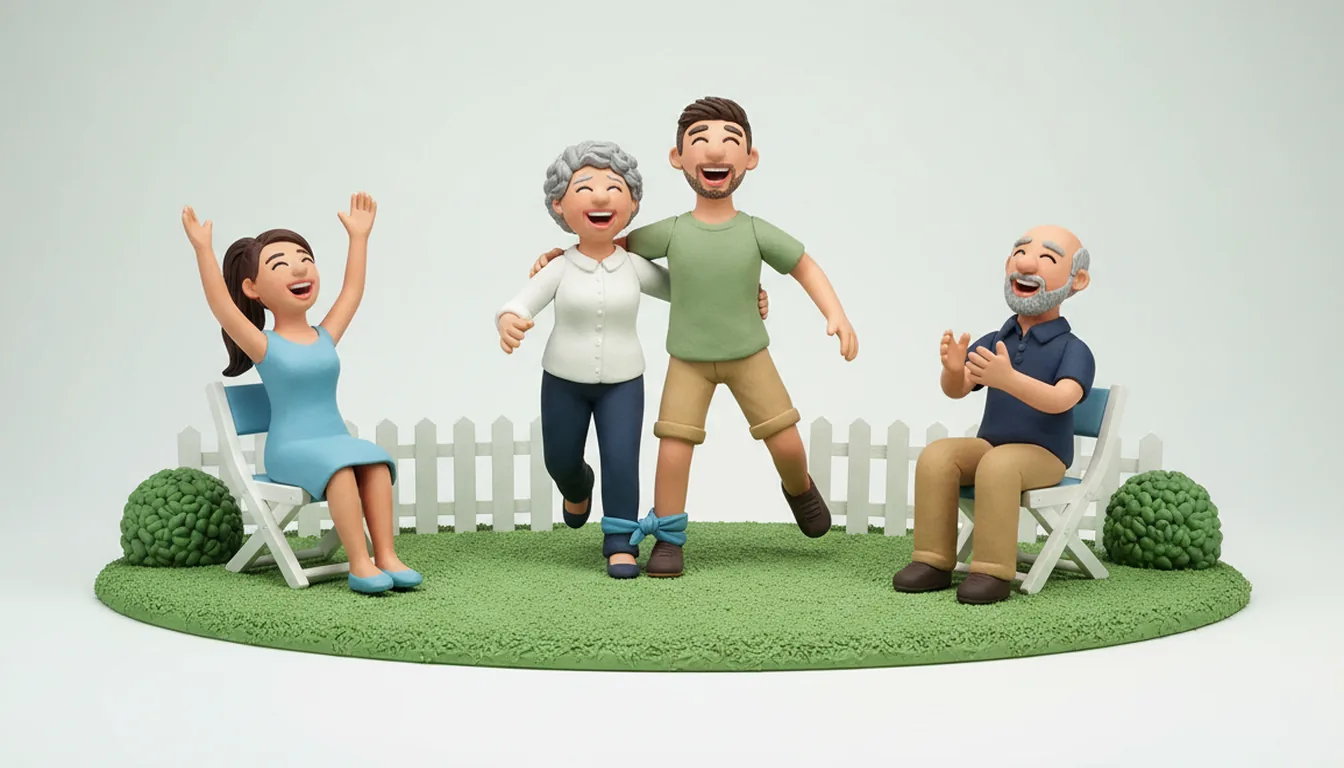
Good family reunion games for adults put a grandmother and her grown grandson on the same side, the rules fit in one breath, and anyone who would rather cheer still has a seat. Below are team games for every generation, outdoor games, a family trivia round, a scavenger hunt and a few things to do that aren't games at all. With each game you get the things to bring from home, the rules and about how long a round takes.
An example: Theo pulls his grandmother's name out of the hat and groans for show. Helen tells him to save his breath for the race. She takes the sky blue scarf from her neck and ties her right ankle to his left one herself. "Inside feet first," she says. "On three." They make it about six steps across the lawn before Theo takes a long step and Helen takes a short one, and they finish the race leaning on each other, laughing too hard to run. From the folding chairs at the side, Aunt Nina has both arms in the air, and Uncle Frank claps and shouts "Go, Mom!" as if the two of them were winning. They come in last of five pairs.
For the planning itself, from picking a date to keeping old arguments out of the day, see how to plan a family reunion.
How to split relatives into mixed teams
Left alone, relatives sort themselves by age. The cousins end up on the lawn and the grandparents in the shade. A rule for picking teams fixes that before the first game starts.
- Two hats. Put the names of everyone fifty and over in one hat and everyone younger in another. Each pair draws one name from each hat, which is how Theo got Helen.
- Birth months. Make teams by birth month, January to March, April to June and so on. Every team gets a random mix of ages, and nobody has to pick sides.
- Count off down the line. Line everyone up from oldest to youngest, then count off one to four along the line. All the ones are a team, all the twos are a team, and each team gets someone from every part of the line.
If new partners are meeting the family for the first time, a game from icebreaker games for adults helps before the teams form.
Team games that put every generation on one side
These work best with pairs or small teams where the oldest and the youngest adults need each other to score.
- Old word, new word. You need two bowls and paper slips. Older relatives fill one bowl with words from when they were young, like "party line," "icebox" or "carbon paper." Younger relatives fill the other with new words, like "group chat," "ghosting" or "screenshot." Each partner draws from their own generation's bowl and explains the word without saying it, and the other partner guesses. A minute a turn, and about 15 minutes for a full round.
- Name five. You need a list of family categories and a watch. The host reads one, like "five dishes that always show up at family dinners," "five relatives born in winter" or "five jobs people in this family have had." The team has thirty seconds to name five out loud, and a full five scores a point. Six rounds take each team about 3 to 4 minutes, with the reading.
- Paper boat race. You need sheets of paper, a baking tray of water and a straw for each pair. The older partner shows the younger one how to fold a paper boat, the way they learned it long ago. Then the pair takes turns blowing through the straw to race the boat from one end of the tray to the other. About 15 minutes, and most of it is the folding.
Outdoor family reunion games
These need a lawn or a yard. They work best in the late afternoon, once the meal has settled.
- Three-legged race. You need one scarf per pair. Each pair is one older and one younger relative, and the older partner sets the pace by calling "in, out" for every step while the younger one follows. Race to a mark about twenty steps away and back. Walking pairs are welcome, since the funniest finish often comes last. About 10 minutes for five pairs.
- Tug of war. You need a long, thick rope with a scarf tied around the middle. Mark a line on the grass, and make two teams with the same number of people over sixty on each side. The oldest relative who isn't pulling judges and starts each pull with one loud clap. Best of three takes about 10 minutes.
- Egg and spoon relay. You need a spoon and a hard-boiled egg for each team. Teams line up with the oldest player first. Each player carries the egg on the spoon to a mark and back, then hands the spoon on. Everyone may walk, and a dropped egg goes back on the spoon where it fell. About 10 minutes.
- Closest to the lemon. You need one lemon and two oranges per pair, each orange marked with a pen so you know whose it is. Roll the lemon onto the lawn, then take turns rolling the oranges toward it. The closest orange scores a point for its pair. It's gentle enough for anyone who can stand, and a game to five points takes about 15 minutes.
For a smaller group on a blanket in the shade, picnic games for adults has games that need even less room.
Family trivia about your own family
Every question here is about the people at the reunion, so the youngest adults can't look anything up and the oldest finally get to be the experts. One relative collects the answers by phone in the weeks before and keeps them secret. On the day, mixed teams write their answers on paper, and each older player may give their own team one hint per round. Twelve questions take about 20 minutes. A few to start from:
- Who was the first person in the family to fly on a plane?
- Which couple in the family has been married the longest?
- How did Grandma and Grandpa get to their first date?
- Whose middle name comes from a great-grandparent?
- Which relative has the most brothers and sisters?
- What did Grandpa do for work before he turned twenty?
- Which two relatives share a birthday?
- Who in the family can still speak a little of the old language?
Ask the older relatives first, using questions to ask your parents and grandparents for ideas.
A family reunion scavenger hunt
This hunt sends teams to find people and stories instead of objects. Give every mixed team the same list and forty minutes. Each task scores one point, and a task that needs three generations scores three.
- A photo of three generations of the family doing the same pose.
- One word in the family's old language, plus the name of the relative who taught it to you.
- Two relatives who laugh exactly the same way.
- The relative who was born farthest from where you're standing.
- Someone who met a great-great-grandparent, and three words they would use to describe that person.
- The oldest thing anyone brought in a pocket or a bag.
- A relative who can still do a cartwheel or a headstand.
- One story about a family holiday that went wrong, told by someone who was there.
For a hunt with things to find instead of people, scavenger hunt ideas has lists for the house, the yard and the streets nearby.
Games for the relatives who'd rather sit and talk
Some relatives came to sit down with people they haven't seen in years. These games happen at the table, and the talking is the point.
- How did it end? You need paper and pens. An older relative tells a true family story and stops just before the ending. Everyone writes down how they think it ended, and the closest guess scores a point once the teller finishes. About 10 minutes a story.
- How old was I? You need nothing. One player tells a short true moment from their life, like the first time they took a train alone or the night the power went out, without saying how old they were. Everyone guesses an age, and the closest guess wins the round. About 5 minutes a turn, and the oldest players are often the hardest to guess.
Two truths and a lie fits this table too, and it gets better when a grandparent plays.
Family reunion activities that aren't games
Not every good hour at a reunion has a winner. These give relatives of different ages a reason to spend time together.
- A skill swap. Older relatives each teach one thing with their hands, like a knot that holds or a seam that doesn't show. The younger ones teach something back, like how to send a voice message.
- The slow lap. After the meal, pair one older relative with one younger one and send them on a slow walk around the block, with one question to ask on the way. Many pairs come back with a story nobody else has heard.
- The signed tablecloth. Lay a plain white cloth on the main table and leave a fabric marker next to it. Everyone writes their name and one line during the day, and the cloth comes out again at the next reunion.
- The generation breakfast. At a weekend reunion, the youngest adults cook breakfast for everyone the next morning, and the grandparents sit and get served for once.
Cousins who want to stay close between reunions will find ideas in National Cousins Day.
Who wants a scoreboard and who wants a chair in the shade
At every reunion one relative asks who is keeping score, and another asks where the good chair is. Most games above have a part for each. Typeza sees personality type as part of that. Eight of the 16 types:
- Mentor would rather sit and talk, and in "How did it end?" tells the family story with real feeling and watches each face change.
- Inspector keeps the score and checks that nobody holds the egg on the spoon with a thumb.
- Commander wants teams and a score, takes the back end of the rope in the tug of war and asks for best of five.
- Dreamer goes for "The slow lap", where they can walk at their own pace and ask the question at the right moment.
- Entrepreneur plays the scavenger hunt for points and works out which tasks are worth three before anyone else.
- Guardian checks that every trivia answer is true, and that no story gets told without its owner's okay.
- Encourager loves the new words in "Old word, new word", and tells the pair that comes last how good they could get with one more try.
- Craftsman teaches the best knot in the skill swap and quietly wins "Closest to the lemon."
Type theory describes leanings like these, and any relative can surprise you. None of it is advice about anyone you know. Use it to give the day a game for the scorekeepers and one for the talkers.
Find out how you and a relative get along
A three-legged race shows who leads and who follows, and type is often part of why. Typeza shows two relatives their relationship type, including the easy parts and the spots where you keep tripping. Take the free family compatibility test yourself. Then send it to the relative you were tied to.
Questions people ask
What are good family reunion games for adults?
"Old word, new word" and family trivia work at the table, and a three-legged race or a tug of war works on the lawn. Pick games where an older and a younger relative play on the same side.
Written by Virko Kask, founder of Typeza
Written with the help of AI tools.
One question for two, every week
A question to ask your partner, friend or family, and how different types tend to answer it.
Free. Unsubscribe any time.