
Questions to ask your mom, dad and grandparents about their lives
The questions that work best with parents and grandparents ask for a story. "Where did you grow up?" gets a place name. "What did your street smell like in summer?" can get ten minutes. Good questions for your mom, dad, grandma or grandpa come in a few kinds: childhood, growing up, love, the big choices and the advice they would pass on. A few light ones help when the mood needs lifting.
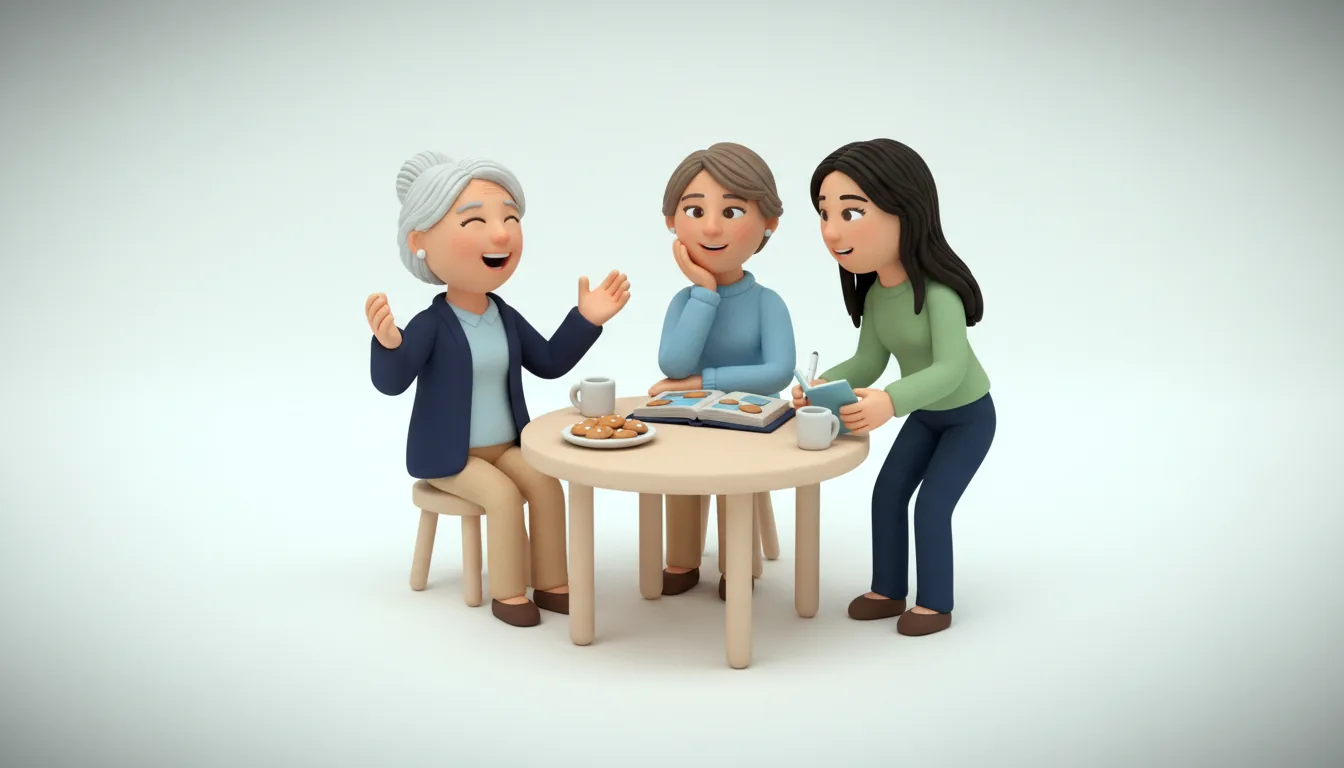
An example: Jess is 28 and thought she had heard all of her grandmother's stories. One Sunday, over coffee and a plate of cookies at June's round kitchen table, she asked one she had somehow never asked: "How did you and Grandpa actually meet?" June threw up her hands and laughed. "At a dance I wasn't allowed to go to." Jess's mother, Karen, put her chin in her hand and said, "Mom, you always told me it was at church." Jess went to find a notebook. The photo album came out next, and nobody looked at the clock for two hours.
Questions to ask about their childhood
Start here. Early memories are easy to share and rarely touch a sore spot.
- What is the first thing you remember?
- What did your house look like, and which room was yours?
- What did you do on a summer day with no plans?
- Who was your best friend, and what trouble did the two of you get into?
- What did your family eat on Sundays or holidays?
- What were your own parents like when you were small?
- Which of your grandparents did you know, and what were they like?
- What scared you as a kid?
Questions about growing up and leaving home
The teenage years are where many of the best stories hide, partly because parents spent decades not telling them.
- What did you and your friends do on a Friday night at seventeen?
- What music did you play too loud?
- What did your parents forbid that you did anyway?
- What did you spend your first paycheck on?
- When did you first feel like a grown-up?
- What was it like the first time you lived away from home?
- At my age, what did you think your life would look like at 50?
How did you two meet? Questions about love
Grandchildren often love these. Hearing how your grandparents fell in love is like finding the first page of your own family story.
- How did you meet, and what did you think of each other at first?
- What was your first date?
- Who said "I love you" first?
- How did the proposal happen, or did you simply decide together?
- What was your wedding day like, and what went wrong?
- Was there anyone before Grandpa, or before Mom?
- What got the two of you through the hardest year?
Their wedding anniversary is a good day to ask these, and the answers can turn into an anniversary gift for your parents.
If your parents split up, these can still work. Ask about the good years first, or skip this group and come back to it another day.
Questions about the choices they made
Big decisions show you what a person valued, even when they never said it out loud.
- What is the best decision you ever made?
- Is there a road you didn't take that you still think about?
- Why did you move to this town?
- How did you choose my name, or Mom's?
- What was it like when your first child was born?
- What did you do differently from your own parents, on purpose?
- What are you proudest of?
Questions that ask for their advice
Many people like being asked what they know. It tells them their experience counts.
- What do you know now that you wish you had known at my age?
- What keeps a friendship going for fifty years?
- What do I worry about that isn't worth it?
- How do you make up after a fight?
- What did you learn about money the hard way?
- Which family habit or recipe do you hope we keep?
Funny questions to ask your mom or dad
A few light questions keep the talk from turning into an interview. They also tend to bring out the stories nobody planned to tell.
- What was your worst haircut?
- What did you think of my first boyfriend or girlfriend, honestly?
- What did I do as a kid that you never told me you saw?
- What was your most embarrassing date?
- Which of your brothers and sisters was the troublemaker?
- What song do you secretly love?
- What fashion are you glad never came back?
Getting a parent or grandparent to open up
Some parents will talk for hours. Others answer in one sentence and change the subject. A few habits help with both.
- Ask one question at a time. Then follow up with "and then what happened?" The follow-up is where the story is.
- Start with something you can hold. A photo album, an old recipe card, a ring or a postcard gives the memory a way in. A family reunion with a table of old albums lets you try this with several relatives at once.
- Talk side by side. Many people open up more in the car, at the stove, on a walk or on a Father's Day fishing trip than face to face across a table.
- Ask for small details. What they wore, what the radio played, what the kitchen smelled like. Details pull the rest of the memory along.
- Let the story change. June's version had a dance and Karen's had a church. Karen let it go, and June kept talking.
- Write it down or record it, with their okay. Jess's notebook now has six pages.
- Let them skip. Some questions open old hurts. A question you drop today can come back next month.
It's worth asking the same question to two people. Karen and June remember the same summer in very different ways, and both versions are true. Karen said afterward that she learned more about her own mother in one afternoon than in years of phone calls, and a talk like that can do a lot for any mother and daughter relationship. The same habits also work with friends, and there is a whole list of deep questions to ask friends if you want to try them there.
Every type tells a story differently
How a person answers depends partly on personality. Here are six of the 16 types:
- Vitalizer: tells it big, with voices and sound effects, and usually starts laughing before the ending.
- Mentor: tells it with a lesson attached, and wants to know what it means to you.
- Inspector: remembers the exact year, the street address and what the first car cost, and gently corrects anyone who gets it wrong.
- Dreamer: tells it quietly and slows down at the moment things were about to change, like the look on someone's face before the news came.
- Guardian: opens up slowly and only to people they trust. Once they do, they tell you who everyone in the story really was.
- Craftsman: would rather show than tell. Ask how they built the shed or kept the old car running, and the stories come along with it.
So if your dad answers in one sentence, he may not be holding anything back. Some people just need a different kind of question, or something to do with their hands while they talk.
Hear their story, then see where you fit
Some parents and grandparents open up at the first question and others need just the right one, and type is part of that. A grandparent can do the free family compatibility test as easily as you can. Send your mom, dad, grandma or grandpa the link from your result. As each of them finishes, you and that person get your relationship type, with what flows easily between you and what needs patience.
Questions people ask
What questions should I ask my grandparents?
Pick a few from each group above and ask for stories, not facts. A visit on Grandparents Day, in September in the US, is a good place to start.
What questions can I ask my mom on Mother's Day?
Ask about her own life, like what she loved doing at twenty, the best advice her mother gave her or which day she'd live again. Pick one or two for lunch. A long list can feel like a quiz. If lunch turns playful, our Mother's Day games make a game out of questions about her.
What are good "who knows Dad best" questions?
Pick things a grown child could know, like his usual diner order, the first car he owned, the song he hums while cooking and what he says when he loses his keys. Have him write his answers first. Whoever comes closest wins. For a whole afternoon of it, our Father's Day games add a trivia round and a treasure map.
Written by Virko Kask, founder of Typeza
Written with the help of AI tools.
One question for two, every week
A question to ask your partner, friend or family, and how different types tend to answer it.
Free. Unsubscribe any time.