
Picnic games for adults, from the blanket to the open grass
Good picnic games for adults use what you'd carry to the park anyway: a blanket, a few odds and ends from home and the people sitting on it. Here is the I'm going on a picnic game with its rules, then word games for the blanket, park games with things from home, games for a large group and calm games for two. Every game lists the things to pack, the rules and roughly how many minutes a round lasts.
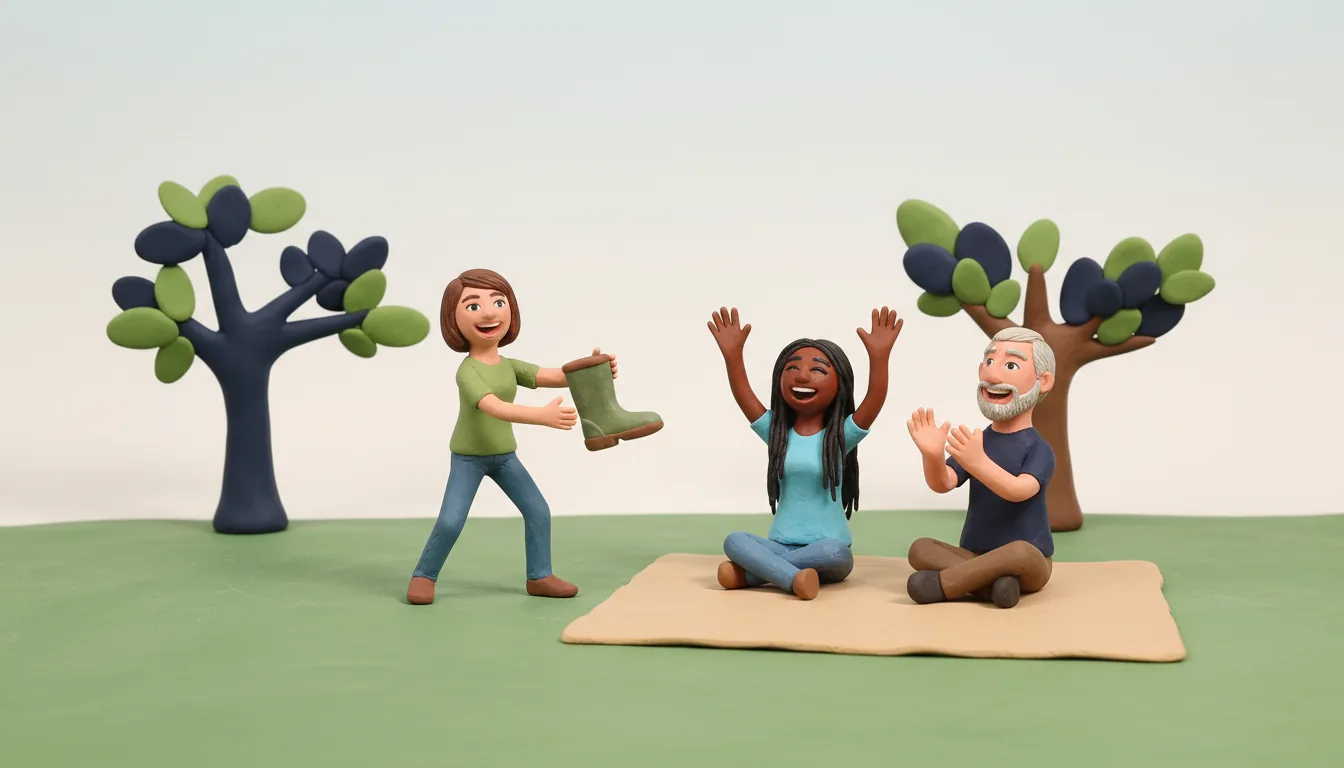
An example: Nora brings the old green rain boot as a joke. It has a crack in the heel and has stood by her back door for two winters. Now she holds it by the top at the edge of the blanket and picks a line toward the far tree. Imani sits cross-legged on the blanket with both hands in the air, cheering a throw that hasn't happened yet. Glen claps and calls it the boot of the year. Nobody planned a game when they spread the blanket out twenty minutes earlier.
How to play the I'm going on a picnic game
This memory game needs nothing but the group. It works for three players or for twelve sitting in a circle on the grass.
- The first player says, "I'm going on a picnic, and I'm bringing an armchair," or anything else that starts with A.
- The next player repeats the whole line and adds something that starts with B: "I'm going on a picnic, and I'm bringing an armchair and a banjo."
- Play goes around the circle, and each player says the full list in order before adding the next letter.
- Anyone who leaves out an item or mixes up the order is out. The last player who can say the whole list wins.
With six players, a game from A to Z takes about 15 minutes. Skip X if the group wants to, since few things start with it.
Once everyone knows the basic game, change one rule for the next round:
- Each new item has to be bigger than the one before it.
- Each item gets a small gesture, and everyone repeats the gestures along with the words.
- Only things nobody could ever carry count, like a lighthouse or a thunderstorm.
- Play in pairs, with partners taking turns on the list and whispering help to each other.
For the version where one player keeps a secret rule and the others have to work it out, see camping games for adults.
Word games for the picnic blanket
These are for the part of the afternoon when nobody wants to stand up.
- Hink pink. You need nothing. One player gives a clue for two rhyming words, like "an unhappy father" for "sad dad," and says how many syllables each word has. The others race to answer, and whoever solves it gives the next clue. About 15 minutes.
- Spell it backward. You need nothing. One player names a word, and the next player has to spell it backward out loud without stopping. A slip puts you out, the words get longer each round, and the last speller left wins. About 10 minutes.
Park games with things from home
Pack these the night before. Each one fits in the car next to the blanket, and none of them needs anything new.
- Boot toss. You need one old rain boot. Mark a throwing line with a jacket, then take turns swinging the boot by its top and letting it fly across the grass, away from people. Everyone gets three throws, and the longest one wins. About 15 minutes.
- Towel ball. You need two beach towels and a pair of rolled-up socks. Two players hold each towel by the corners and use it to fling the socks to the other pair, who have to catch them in their own towel. Every catch scores a point, and no hands may touch the socks. About 15 minutes.
Picnic games for a large group
With ten or more people and some open grass, split into two teams.
- Capture the flag. You need two dish towels and a few jackets to mark the middle line. Each team hides its towel somewhere in its own half, and anyone tagged in the other team's half has to stand still until a teammate tags them free. The first team to carry the other towel back across the line wins. About 30 minutes.
- Pass the squeeze. You need one coin and one shoe. Two teams sit side by side in two lines holding hands, with the shoe on the grass at the far end, and one person flips the coin where only the first player of each line can see it. On heads, that player squeezes the next hand, the squeeze runs down the line, and the first end player to grab the shoe wins the point. About 15 minutes.
- Body letters. You need nothing. One team picks a short word and lies down on the grass to spell it, one letter per person, while the other team reads it from a few steps away. A right guess scores, and then the teams swap. About 15 minutes.
If the picnic is really a family reunion, these games for a family reunion put grandparents and their grown grandchildren on one team.
Calm picnic games for two
When the rest of the group heads off for a walk, two people on the blanket can play these.
- Three men's morris. You need six pebbles, three light and three dark, and a scrap of paper with a three-by-three grid of points joined by straight lines. Take turns placing one pebble on an empty point, and once all six are down, take turns sliding one along a line to the empty point next to it. The first to get three in a row wins. About 5 minutes a game.
- Twig pick-up. You need about twenty thin twigs from the grass under the trees. Hold them upright in a bundle and let go so they fall in a heap, then take turns lifting one twig at a time without moving any other. If another twig moves, your turn ends, and the most twigs at the end wins. About 10 minutes.
If the picnic is for two, daytime date ideas has picnic dates and more to do in the sun. On a day when the games stay at home by mistake, games with no equipment needs only the people there.
Who leads the games and who stays on the blanket
Some friends stand up as soon as the blanket is down and start picking teams. Others settle in and watch. Typeza sees personality type as part of that. Seven of the 16 types:
- Ideator makes up a new rule for the picnic game every round and forgets the last one.
- Mentor notices first when a friend has gone quiet on the blanket, and asks what's up.
- Inspector draws the morris grid with a straight edge and keeps the twig count honest.
- Diplomat is first on the grass and has the teams for capture the flag picked in a minute.
- Strategist stays on the blanket, watches everything and wins twig pick-up without a word.
- Organizer packed the towels, the socks and the boot the night before, all in one place by the door.
- Counselor stays on the blanket for the word games and goes quiet when a round turns into laughing at someone.
Type theory sketches how people often lean, and your own friends may surprise you. Take it as a game too, not advice about anyone on your blanket.
The friend who picks the teams and the friend who watches
The friend who runs every game and the friend who'd rather watch from the blanket can be very good company for each other. Typeza shows how two people get along, including the part each one plays and where they clash. Type is often part of which friend you are. Try the free friendship compatibility test, then ask the friend who brings the games to take it too.
Questions people ask
How do you play the I'm going on a picnic game?
Players sit in a circle, and each one says "I'm going on a picnic, and I'm bringing..." with the full list so far, then adds an item for the next letter of the alphabet. Anyone who forgets an item or the order is out, and the last player left wins.
Written by Virko Kask, founder of Typeza
Written with the help of AI tools.
One question for two, every week
A question to ask your partner, friend or family, and how different types tend to answer it.
Free. Unsubscribe any time.