
Goals for the new year: ideas for habits, people and skills
Goals for the new year last longest when they're small enough to start in the first week and clear enough that you'd notice if you stopped. Many good ones fall into three areas: your daily habits, the people in your life and the skills you'd like to have. Here are new year goal ideas for all three, a way to set them on paper, and two lighter options for anyone who dislikes lists: a single word for the year, or an intention. For the bigger things you want from your whole life, life goals goes further.
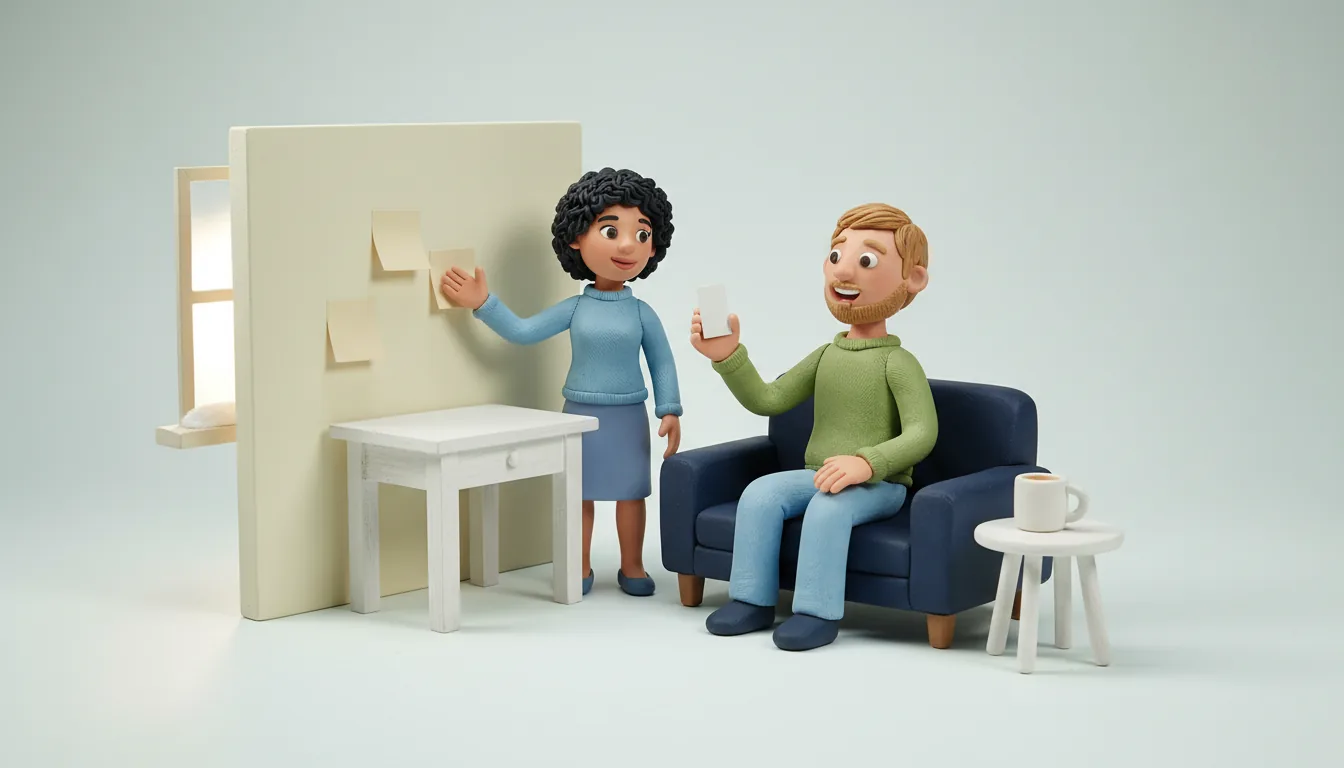
An example: Elif presses a third square note onto the wall above her small white desk, next to the other two. All three are still blank. She has settled on three goals for the year and wants to see them on the wall before she writes a word, so a fourth can't sneak in. Her friend Arlo sits in the navy armchair beside her, his tea going cold on the little round table. He holds up a single blank card and smiles. "This is my whole list," he says. "One word. I'll know it when I find it."
New year goal ideas for your daily habits
A habit goal is something small you do on most days. Pick one, or two at most.
- Write one line about each day. Keep a small notebook by the bed and add a single sentence before you turn off the light. By December the whole year fits on a few pages.
- Put one thing away every time you leave a room. A cup, a book, the coat on the chair. The house stays in order without a big cleaning day.
- Mail one handwritten card a month. It can go to a cousin, an old neighbor or a friend who just moved. Few people expect post now, which is why it lands.
- Keep a list of what people recommend to you. A film, a book, a walk, a song. Try one each month and tell the person what you thought.
- Learn one thing a week about where you live. Who the street is named after, how old the bridge is, why the park has that odd shape.
New year goals for the people in your life
People goals are about the ones you already have and the ones you haven't met yet.
- Learn the names of the people you see every week, like the person at the bakery counter or the neighbor with the big gray dog. Then use them when you say hello.
- Introduce two friends who would get along. You know them both, and they would never meet without you.
- Keep a short list of what's coming up for your friends, like a move or a first week somewhere new, and ask about each one afterward.
- Have one neighbor over for tea each season. Start with the one you only know by their car.
- Thank one person from your past who helped you more than they know, like an old teacher or a neighbor who looked out for you. Write it down and send it.
Skills to learn in the new year
A skill goal gives the year something to show at the end. Pick one you can practice a little most weeks.
- Type without looking at the keys. Practice a little each day until you stop looking down.
- Drive a car with a manual gearbox. Ask a friend who has one, and find an empty parking lot on a Sunday morning.
- Iron a shirt properly, collar first, so it looks like someone else did it.
- Learn the names of the clouds and what each one tells you about the next few hours of weather.
- Build a fire that lights on the first match, in a fireplace or a fire pit, without a pile of paper to help it along.
- Do your own bike repairs, from fixing a flat to setting the brakes so they stop when you need them to.
What makes a good goal for the new year
Good goals for the new year tend to have three things in common:
- You can picture the first time you'll do it. "Learn the clouds" is vague. "Borrow a cloud book from the library on Saturday" is a start.
- You'd notice if you stopped. A goal you can't check is closer to a wish.
- It depends on you. "Make three new friends" depends on other people. "Invite someone new along once a month" depends only on you.
Resolutions meant only for laughing have their own home in New Year's jokes.
How to set goals for the new year
All you need is paper and a pen.
- Write fast first. Put every idea on one sheet without judging any of them. Your answers to end of year reflection questions are a good place to find the first few.
- Cut to three. One habit, one person and one skill make a good mix.
- Write the first step next to each one. Make it something you can do in the first week.
- Put the page where you'll see it. The wall above your desk, the inside of the front door or the first page of the notebook you use most.
- Look at it on the first of each month. Keep each goal, change it or cross it out.
If you want to see in a year how it all went, write the goals into a letter you open next December.
Pick a word of the year
A word of the year is one word you choose to guide the next twelve months, in place of a list. It suits people who find goals heavy but still want the year to point somewhere. You carry it in your head, and on a hard day you can ask which choice fits the word.
Some word of the year ideas:
- Closer, for a year of fewer, deeper friendships.
- Outside, for more time out of the house in every season.
- Finish, for the half-done projects in the cupboard.
- Ask, for someone who never asks for help or for directions.
- Slower, for a year with fewer rushed mornings.
- Practice, for getting better at one thing, a little at a time.
- Home, for making the place you live feel like yours.
To find yours, read what you wrote about the past year and circle any word that keeps coming back. Say "This year is about..." out loud with each one. Keep the word that sounds like you on a normal Tuesday, then write it on a card and put it where you'll see it.
New year intentions, for people who dislike lists
An intention is about how you want to be, and a goal is about what you'll do. "Be more curious about people" is an intention. "Learn the names of the people I see every week" is a goal that makes it real. Intentions for the new year suit people who find checklists stiff, and they work best with one small goal underneath, so you can tell by March whether anything has changed.
New year's resolutions for couples
Two people can set a few goals as a pair, next to their own.
- Take each other to one place in town the other has never seen, like a café you love or a bench with a good view.
- Settle one small, old argument with a rule and keep the rule all year. Who chooses the music on long drives is a good place to start.
- Spend a proper evening with each other's oldest friend, not just a quick hello at a party.
- Learn the other's favorite game and play it until you win once.
For the bigger picture of what you want as a couple, relationship goals has more ideas. And if one of you writes ten goals while the other writes none, the free personality test shows your two types and how they tend to fit together.
Ten goals, one word or a promise out loud, by type
People meet the new year in different ways. Some write ten goals and number them, and some pick a single word. Others only make a promise out loud to a friend, because then they have to keep it. Typeza sees personality type as part of that. Eight of the 16 types:
- Vitalizer writes nothing down. They promise one thing out loud to the friend standing next to them, and from then on they have to do it.
- Analyst writes ten goals, numbers them and adds a note on how each one will be checked in December.
- Commander writes three, tells everyone they know about all three and has started the first by the second of January.
- Diplomat picks a goal about people, like introducing two friends who would get along, since they already know who matters to whom.
- Entrepreneur writes ten goals on the first morning of the year and has started four of them by lunch.
- Organizer keeps a short list on the wall and goes over it once a month with a pencil in hand.
- Counselor picks a quiet, kind goal, like thanking an old teacher, and tells only one close friend.
- Craftsman picks a skill, tells nobody and turns up in March able to do it.
Type theory only sketches rough leanings here, and lots of people write ten goals one year and a single word the next. Take the list as a friendly guess, not as advice about you or anyone you know.
Find out what kind of goal setter you are
You write ten goals and a friend writes none. Type is often part of why. Typeza shows your type and how it tends to get along with the people around you, like the friend you'd make that promise to. It all begins with the free personality test. After that, invite that friend and see the relationship type between you two.
Questions people ask
What are good goals for the new year?
Small goals about habits, people and skills tend to last, like mailing one handwritten card a month, introducing two friends who would get along or learning the names of the clouds. Pick one from each area instead of ten from one.
Written by Virko Kask, founder of Typeza
Written with the help of AI tools.
One question for two, every week
A question to ask your partner, friend or family, and how different types tend to answer it.
Free. Unsubscribe any time.