
Parallel play for couples: why doing your own thing side by side counts
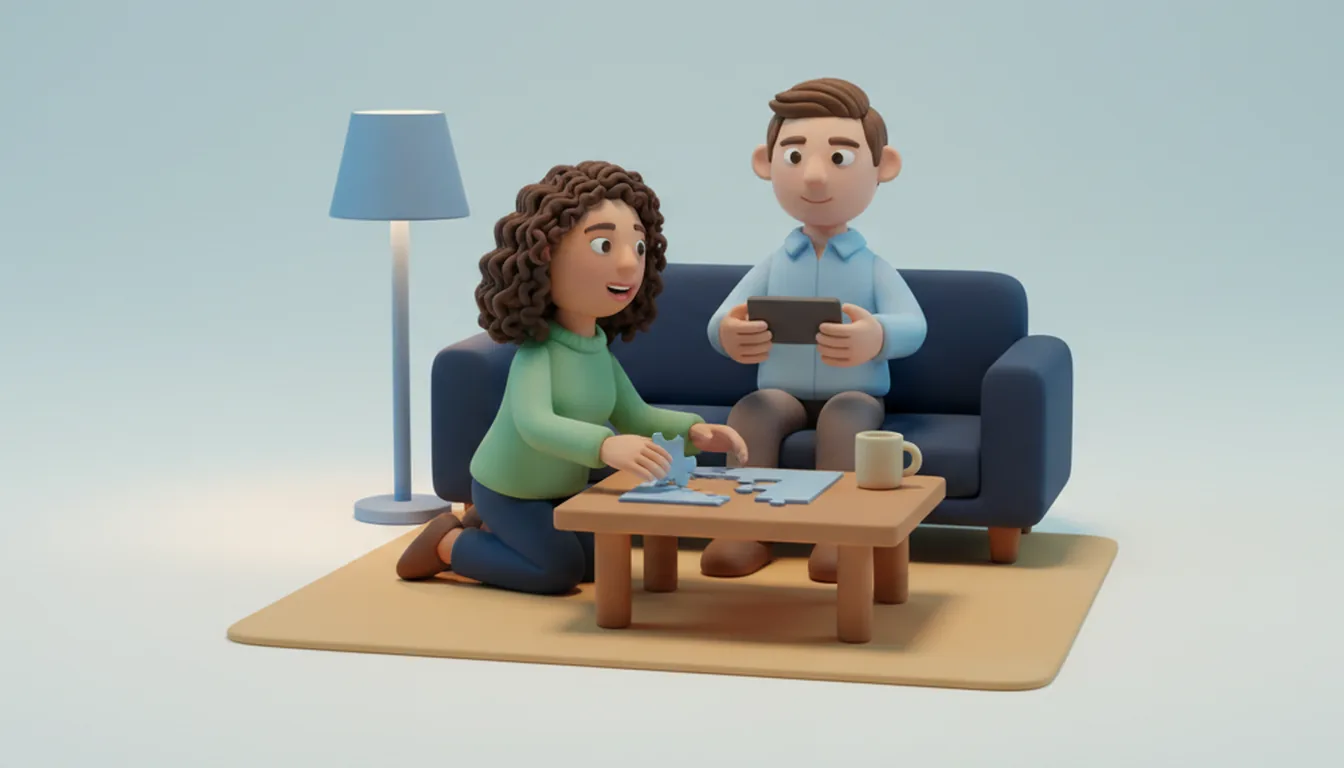
For adults, parallel play means being in the same room as your partner while each of you does your own thing, and enjoying it. You aren't talking or working on anything together. You're simply near each other, and that counts for more than it sounds. The term first described small children who play next to each other with their own toys before they learn to play together.
An example: on Sunday evenings Ivy kneels on the rug at the coffee table with a thousand-piece puzzle of a pale blue sea, and Rafael sits on the sofa behind her with his handheld game. The floor lamp is on, her tea goes cold in its cream mug, and for an hour or so neither of them says much. Every now and then Rafael mutters "Finally" at a level he has been stuck on for days, or Ivy holds up a piece and says "Corner." Her sister once watched this and asked whether they'd run out of things to say. Ivy laughed, because it's her favorite part of the week.
What parallel play looks like at home
Many couples already do it without having a name for it. A few everyday versions:
- one of you reads on the sofa while the other plays a game;
- one fits puzzle pieces while the other answers email on a laptop;
- one cooks with a podcast on while the other sits at the counter sketching;
- both read in bed with separate lamps and separate books;
- one weeds the garden while the other dozes in a chair nearby.
What makes it parallel play is the mood more than the activity. Nobody is waiting for the other to finish, and nobody feels ignored. There's room for small check-ins, a laugh at something on a screen or a "come look at this," and then you both drift back to what you were doing.
Why it counts as time together
After a full day of talking, deciding and looking after other people, many adults want company without effort. Parallel play gives you that. You know your partner is right there, you can reach them with one word, and nobody has to make conversation.
It also takes a lot of pressure off. Couples sometimes feel every shared hour should be a date or a deep talk. That's a lot to ask of a Tuesday. A quiet evening of separate hobbies in the same room keeps you close on the days when you have nothing big to say.
It doesn't replace focused time, though. Talking face to face, going out and doing things together all still matter, and quality time in a relationship looks at how couples make room for that. Parallel play is the easy layer underneath, the one that fills the ordinary evenings in between.
Restful for one of you, lonely for the other
Here's where many couples get stuck. One partner finds side by side time the best kind of rest. The other sits through the same evening and feels alone. Personality type can be part of that gap. Six of the 16 types as examples:
- Vitalizer likes an evening with feeling in it. A whole night of quiet hobbies can leave them wondering whether their partner is upset, so a few warm words now and then make all the difference.
- Analyst often finds this the ideal evening. They can sink into a book or a problem and still enjoy knowing their partner is in the room.
- Inspector likes a calm room where each person gets on with their own task. Sorting photos while a partner reads feels like a good night to them.
- Dreamer loves quiet company with a soft mood, like music low and a lamp on. They feel close when nobody asks them to explain what they're thinking about.
- Diplomat wants things to happen and people to share them with. After an hour of separate screens they may suggest a walk, a game for two or a call to friends.
- Craftsman relaxes best with their hands busy. Fixing a lamp at the table while a partner plays a game is about as good as an evening gets.
If you're a homebody, side by side evenings may already be your favorite thing. If your partner is more social, the same evening can feel like a missed chance to go out. Neither of you is doing it wrong.
Talking about it before anyone feels ignored
Trouble often starts when one partner assumes the other feels the same about quiet evenings. A short, friendly talk helps a lot. You might say: "I love our Sunday nights when we're each doing our own thing. Does it feel the same for you, or would you like more time where we actually talk?"
A few questions make the talk easier:
- How many evenings a week feel good like this, and how many feel like too many?
- What would make side by side time feel warmer for you? Sitting closer, a shared snack, a few words in between?
- Which nights should be for doing something together?
Keep it light and specific. If one of you needs a lot more time on your own, independence in a relationship has more on finding a balance you both like.
Small ways to make side by side time feel shared
A few small touches can turn two separate hobbies into a shared evening:
- Sit within reach. The same sofa feels very different from opposite ends of the house.
- Share a snack or a pot of tea. Passing a bowl back and forth is a quiet way of being together.
- Trade one "look at this." Show each other one thing from your game, book or project.
- End with ten minutes of talk. Put things down and ask how the evening was.
- Rotate with together nights. Puzzle Sunday works best when Friday is for going out.
Ivy and Rafael have their own version. When she finishes a section of the puzzle, he pauses his game to look, and she always asks which level he's on, even though she doesn't really follow.
When side by side starts to feel apart
Parallel play is good for a couple as long as it isn't the only kind of time you share. Watch for these signs:
- You can't remember your last real conversation.
- Every evening is screens, and neither of you looks up.
- One partner suggests a plan every week and keeps hearing "maybe later."
If that sounds familiar, you don't have to give up your quiet evenings. Add one evening a week that's for the two of you together, and keep the rest as they are.
See why side by side time feels different to each of you
Do the free couples compatibility test before the puzzle comes out. Then pass your result's link to your partner. Once your partner has answered, the relationship type you share describes where you get along easily and where a quiet evening might mean something different to each of you.
Questions people ask
What is parallel play in adults?
Two adults sharing a space, each busy with their own activity, and glad to be near each other. Children do it first, around age two.
What is parallel play in a relationship?
Reading and gaming on the same sofa, a puzzle next to a laptop, two books in bed. Each partner does something different in the same room.
Is parallel play good for couples?
For many couples, yes. It gives rest and company at once, as long as it isn't the only time you share.
Does parallel play count as quality time?
It counts as time together. Many couples also want some focused time with full attention on each other.
How much parallel play is too much?
There's no fixed number. If both of you are happy and you still talk and go out together, it's fine. If one partner often feels alone, it's time to talk.
Sources
- Wikipedia, "Parallel play": Mildred Parten's 1932 study of children aged two to five, where parallel play is an early stage, and the note that parallel play in adults is little studied.
Written by Virko Kask, founder of Typeza
Written with the help of AI tools.
One question for two, every week
A question to ask your partner, friend or family, and how different types tend to answer it.
Free. Unsubscribe any time.