
Philosophy questions to ask your friends or partner on a long evening
Philosophy questions are the big ones you can't look up: what makes a life good, when a lie is fine, what makes you you. Among friends or with a partner they turn into a game. Each answer shows a little of how that person thinks, and the fun is hearing a view you'd never have reached on your own.
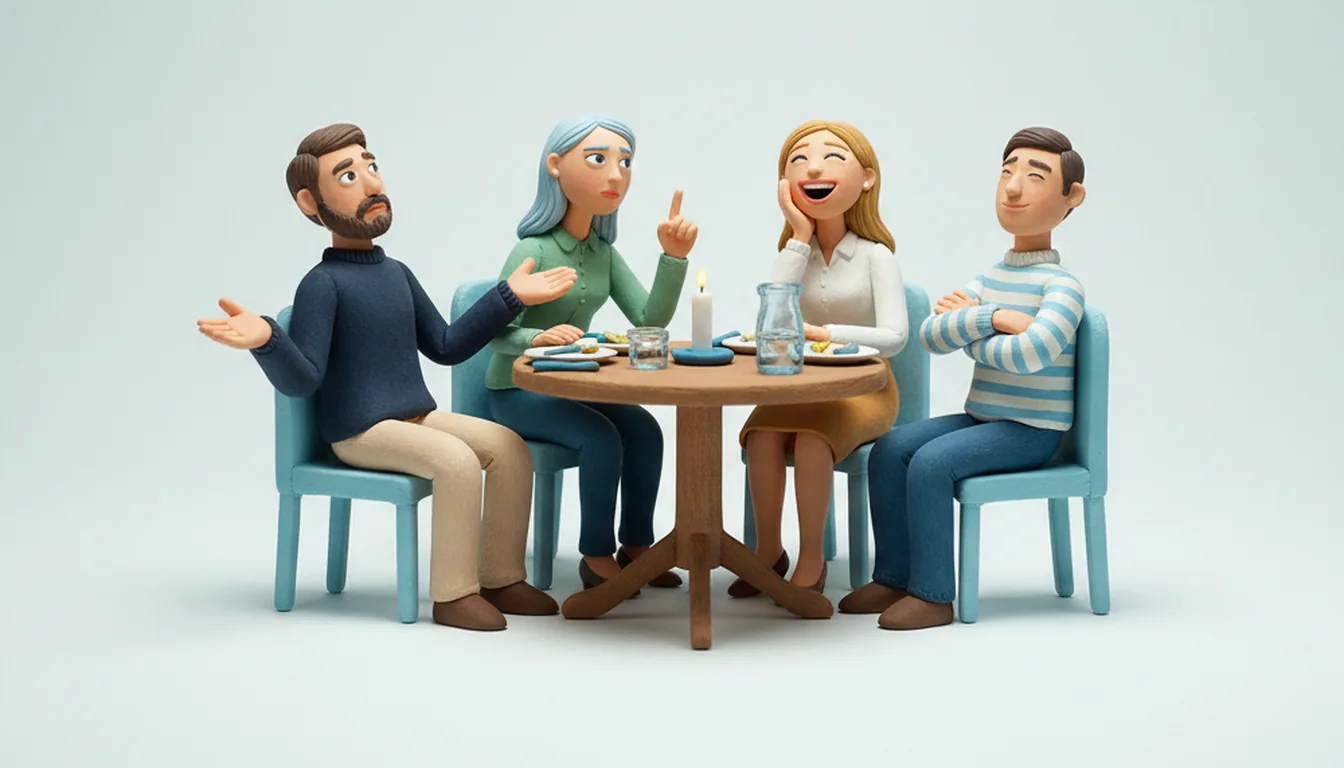
An example: Ruth had been saving the question all week. Dessert was gone, the candle had burned low, and her friend Ben had just told the table that he'd now replaced every single part of his old pickup truck, one bolt at a time, over six years. "So," Ruth asked, "is it still the same truck?"
Ben said yes before she'd finished. His wife, Ana, said no, it was a new truck with an old name. Leo wanted to know which part went in last, because that part decided it. At one in the morning the four of them were still at the table, and not one phone had come out. The puzzle is old: philosophers in ancient Greece argued about the same question with a ship.
What turns a question into a philosophy question
Usually three things. You can't check the answer anywhere. Thoughtful people disagree about it. And whatever you answer says something about you. "What's the capital of Peru?" fails on every count. "Would you rather be loved or respected?" passes all three, and you can ask it over pasta.
Questions about life and what it means
- Does a life need a purpose to be a good one?
- If you could live forever, would anything still feel urgent?
- Is a small, quiet life as good as a big, famous one?
- Is happiness something you find or something you make?
- What would you need to see, looking back at eighty, to call it worth it?
Questions about right and wrong
- Is it ever right to break a promise?
- A cashier hands you twenty dollars too much and nobody would ever know. Do you give it back?
- Is a lie that spares a friend's feelings still a lie?
- Should we judge people by what they meant to do or by what actually happened?
- Is it fair to judge people from two hundred years ago by today's rules?
These are the ones most likely to tip into an argument, since people feel strongly about right and wrong. Keep your tone curious. "Why do you see it that way?" keeps a table friendly far longer than "That's just wrong."
Questions about the self
- If you lost every memory you have, would you still be you?
- Are you the same person you were at fifteen, or someone new with the same name?
- If a perfect copy of you walked in right now, which one of you gets to keep your life?
- Were you born with your personality, or did you build it?
- Do you choose what you like, or does it choose you?
Questions about time, luck and chance
- Does everything happen for a reason, or do some things just happen?
- Would you want to know how your life turns out if you couldn't change any of it?
- Do some people have more luck, or do they just notice it more?
- If you could undo one choice but lose everything that came after it, would you?
- Does the past still exist somewhere, or is it simply gone?
Abstract questions nobody can settle
Abstract philosophical questions are the puzzle kind. There's no way to win them, which makes them perfect for people who like to think out loud.
- If a tree falls in an empty forest, does it make a sound?
- Is the blue you see the same blue I see?
- Did people invent numbers, or did they find them?
- Could this whole evening be a dream, and how would you know?
- Can you step into the same river twice if the water is always new?
Funny philosophical questions
When the table needs a laugh, these sound like jokes and still start a real debate.
- Is cereal a soup?
- If you're waiting for the waiter, doesn't that make you the waiter?
- Does a dog know it's a dog?
- If you cloned yourself, which of you would have to do the dishes?
- Is a hot dog a sandwich?
- If two mind readers read each other's minds, whose mind are they reading?
Philosophical questions to ask your partner
A long drive is the best place for these. Nobody has to make eye contact, and a long pause while one of you thinks feels normal. For the more personal kind, see the deep questions to ask your partner. These are bigger and a little less about the two of you.
- Is love a feeling, or a choice you keep making?
- Is there one right person for everyone, or many people you could be happy with?
- Should couples tell each other everything, or is some privacy good for them?
- Is jealousy ever a sign of love?
- If we could read each other's minds for one day, would you want to?
Who loves a big question, type by type
At Ruth's table, Ben answered in a second, Ana built a case and Leo hunted for the loophole. Personality type can explain part of that. Some people come alive with one big question and could stay on it for hours. Others find it tiring to argue about something nobody can settle. Here are eight of the 16 types:
- Ideator: loves the strange ones and will argue the other side just to see where it goes.
- Analyst: wants the terms pinned down first. What counts as "the same truck"? Then comes the most careful answer at the table.
- Mentor: turns any big question into one about people and what they feel, and is often the one who makes the talk personal.
- Dreamer: at home with questions about time, fate and where things are heading, and likes to answer slowly.
- Diplomat: gets restless when a puzzle stays up in the air. Ask what they would actually do, tonight, and they're all in.
- Guardian: takes right and wrong seriously and may not enjoy someone defending a side just for fun.
- Organizer: likes a question with a use. The broken promise gets a thoughtful answer, and the tree in the empty forest gets a shrug.
- Craftsman: gives short, concrete answers and notices at once when the talk has started going in circles.
How to disagree and still have a good night
- Agree that nobody has to win. Say it at the start, half as a joke.
- Ask for the reason. "What makes you say that?" is the best follow up there is.
- Swap sides for one round. Argue the view you disagree with. It's harder than it sounds, and funnier.
- Watch the quietest person. If someone hasn't spoken in ten minutes, ask them by name, gently, or pick a lighter what-if question.
- Stop while it's still fun. End on a strong answer, before the talk turns into a lecture.
- Leave out the sore spots. A friend's faith, a recent loss or a family fight can wait for another night.
For a quieter evening with one close friend, deep questions to ask friends are more about your lives and your friendship.
Find out why your friends split the same way every time
Personality type can explain part of who answers fast, who digs for the truth and who hunts for the loophole. The free friendship compatibility test will name your type. Your result then carries a link for the friends around your table, who take the same test. Every friend who joins in gets a relationship type with you, showing where friends like you agree without trying and where you rub each other the wrong way.
Questions people ask
What are good philosophy questions to ask?
Questions in plain words that have no answer you can look up and that people disagree on. "Is it ever right to break a promise?" and "Would you want to know your future?" work at almost any table.
What is a philosophical question?
A question about life, right and wrong, the self or what is real that facts can't settle. Two thoughtful people can give different answers, and both can have good reasons.
What are some funny philosophical questions?
"Is cereal a soup?", "Does a dog know it's a dog?" and "If you're waiting for the waiter, aren't you the waiter?" They sound silly and still get a real debate going.
What are philosophical questions to ask friends?
Start with a light puzzle like the truck that had every part replaced, then move to right and wrong once everyone has warmed up.
How do you start a philosophical conversation?
Tell a short story that holds the question, like Ben's truck, and then ask what everyone thinks. A story feels like a chat, and a cold question out of nowhere can feel like a test.
What is a hypothetical question?
A question about an imagined situation, such as "If you could live in any century, which would you pick?" Many philosophy questions work this way, because a made-up case shows what someone values.
What are some questions about human nature?
Are people mostly kind, or mostly careful? Would most of us share if no rule made us? Is anyone ever fully selfless? Each asks what people are like underneath.
Sources
- Wikipedia, "Ship of Theseus": Plutarch's account of the ship that "became a standing example among the philosophers".
Written by Virko Kask, founder of Typeza
Written with the help of AI tools.
One question for two, every week
A question to ask your partner, friend or family, and how different types tend to answer it.
Free. Unsubscribe any time.