
Where there's a will, there's a way: meaning and how people push through
Where there's a will, there's a way means that if you want something badly enough, you'll find a way to get it done.
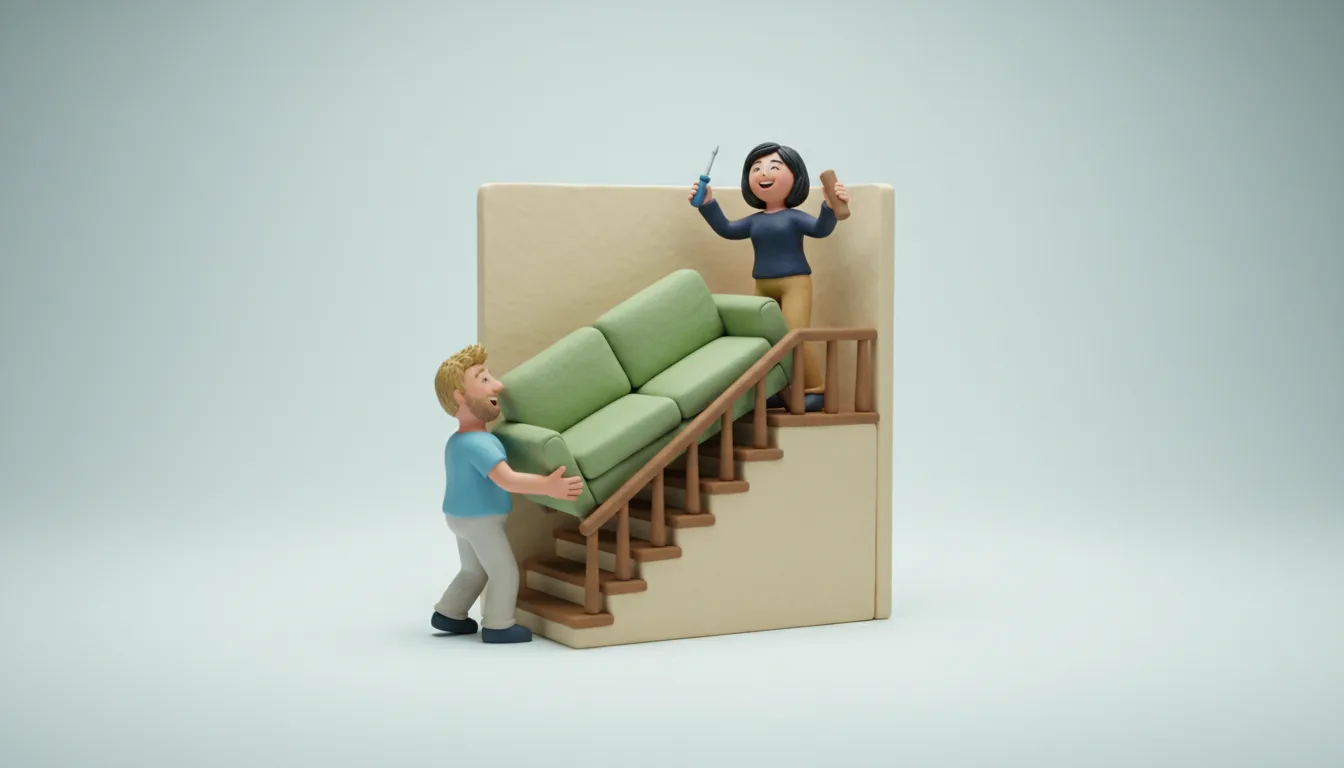
An example: Marek and Hana got the green sofa as far as the turn in the stairs, and there it stopped. Marek stood at the bottom end with both hands under the arm of it, red in the face and laughing. "Where there's a will, there's a way," he said, and pushed again. The sofa didn't move an inch. Hana squeezed past it to the top of the stairs, looked at it for a minute and went to find the toolbox. When she came back, she held up a screwdriver in one hand and a sofa leg in the other. "There's a screwdriver, too," she said. Without its legs, the sofa slid round the turn on the next push.
Both of them were right, in their own way. Marek brought the will. Hana found the way.
Will and way: what each half asks of you
The first half is about wanting. "Will" here means a strong wish or resolve, the same sense as in "willpower" or "against her will." The second half is about the route. A way can be the obvious path, or a side door nobody noticed.
Many people who quote the saying lean on the first half. They mean "keep going, don't give up," and that's a fine thing to hear on a hard day. The second half gets less attention, though it carries just as much weight. Wanting gets you to the bottom of the stairs. Finding a way gets the sofa round the corner. People who hear the proverb as "push harder" and people who hear it as "think differently" are often quoting the same line at each other.
An idea older than the wording
The idea is older than the modern wording. Proverb books often trace it to a collection printed in 1640 under the name of the poet George Herbert, a few years after his death. They give its English as:
> "To him that will, ways are not wanting."
In plain words, a person who truly wants something won't run short of ways to do it.
The modern wording was in print by 1724, when a London book used "where there is a Will, there is a Way." The short form with "there's" turns up in The New Monthly Magazine in 1840. Dutch has nearly the same proverb, "waar een wil is, is een weg," which means where there is a will, there is a way.
Pushers and detour finders, by type
When something gets stuck, some people push harder and others step back to look for another route. Neither is better, and a pair with one of each often gets the sofa up fastest. Part of it follows personality type. Here are eight of the 16 types:
- Ideator tries five new angles before anyone else has finished the first one, and enjoys the puzzle more than the result.
- Analyst stops to work out why it's stuck, measures the turn and comes back with a reason and a plan.
- Inspector keeps going with steady discipline, one step at a time, and doesn't quit halfway.
- Commander pushes through on sheer will, like Marek, and often does get it moving.
- Diplomat gets other people pushing too, and turns a stuck job into a team effort with a few jokes.
- Strategist waits for the right moment and saves strength for the push that counts.
- Entrepreneur looks for the quicker route or the right tool, and drops a plan fast when it isn't working.
- Craftsman finds the practical fix with the least effort, like Hana and her screwdriver.
If you're a pusher, a detour finder can save you a sore back. If you're the detour type, a pusher can get you over the last few steps when your clever idea has run out.
When wanting it isn't enough
The saying has a weak spot. Sometimes there's plenty of will and still no way, and that isn't anybody's fault.
The rent goes up faster than your pay. The job you want goes to someone with ten more years of experience. A friend you'd like to make up with doesn't want to talk yet. Time runs out on a plan that needed another month. None of these give way to more wanting, because the thing in the way isn't inside you.
Think back to Marek and Hana. If their stairwell had been a few inches narrower, no screwdriver would have got that sofa round the turn. They'd have needed a rope and a window, or a smaller sofa. The stairs set the limit there, and no amount of wanting makes a stairwell wider.
So be careful with the flip side of the proverb. If will always found a way, then everyone who didn't get there simply didn't want it enough, and that's plainly not true. Plans break for reasons nobody controls, as the old line about the best-laid plans says. Sometimes the wisest thing is to wait, which takes a kind of strength the patience proverb knows well. And sometimes the way you find leads somewhere a little different from where you started.
Hearing it from someone else
Said at the right moment, the line is a cheer. Said to someone who has already tried everything, it can sound like "you didn't try hard enough." The difference is mostly timing, and whether the person saying it is about to help.
If a friend is stuck, a question often works better than the proverb. Here are a few lines to use instead:
- "What's in the way right now?"
- "Do you want a hand, or a fresh pair of eyes?"
- "You've clearly got the will. Want to look for another way together?"
- "Maybe this route is closed. What else could get you there?"
- "Is this still the thing you want, or has it changed since you started?"
- "What would make the next step a bit smaller?"
And if someone says it to you while you're stuck, you're allowed to answer the way Hana did.
Three questions before you push harder
Next time you catch yourself pushing at something that won't budge, try asking:
- Is it really stuck, or am I pushing from the same side every time?
- What would I try if pushing harder weren't an option?
- Who else could look at this, someone who thinks differently from me?
The answers won't always open a way. They do tell you whether more will is what's missing, or something else. If what's missing is the push itself, there's more on getting motivated when you don't feel like it. And if you've tried twice and wonder about a third go, third time's a charm helps you decide.
See whether you lead with will or with a way
Some people meet a problem with more push, and others reach for a new route, and two people who work differently can get a lot further together. Typeza shows you your type and the relationship type you make with someone close, like the person on the other end of the sofa. It starts with the free personality test.
Questions people ask
What does "where there's a will, there's a way" mean?
It means that if you want something strongly enough, you'll find a way to make it happen, even when it looks hard.
Who first wrote it down?
The idea is often traced to "To him that will, ways are not wanting," from a book of proverbs printed in 1640 under George Herbert's name. The modern wording was in print by 1724.
Is the saying always true?
No. Wanting something helps you look harder for a way, but some things depend on time, money or other people's choices.
How do you use it in a sentence?
Usually as a nudge when something looks hard: "They said the part takes six weeks, but where there's a will, there's a way. Let's ask around." It works best when you're offering to help find that way.
What is the joke "where there's a will, there's a relative"?
It plays on the other meaning of will, the legal paper that says who inherits a person's things.
Do other languages have this proverb?
Yes. Dutch says "waar een wil is, is een weg," which is almost word for word the same.
Sources
- Wiktionary, "where there's a will, there's a way". The meaning, the 1724 and 1840 quotations and the Dutch "waar een wil is, is een weg."
- Wikipedia, "George Herbert". His death in 1633 and the proverb collection published in 1640.
Written by Virko Kask, founder of Typeza
Written with the help of AI tools.
One question for two, every week
A question to ask your partner, friend or family, and how different types tend to answer it.
Free. Unsubscribe any time.