
Work friends: how a colleague becomes a friend, and why some never do
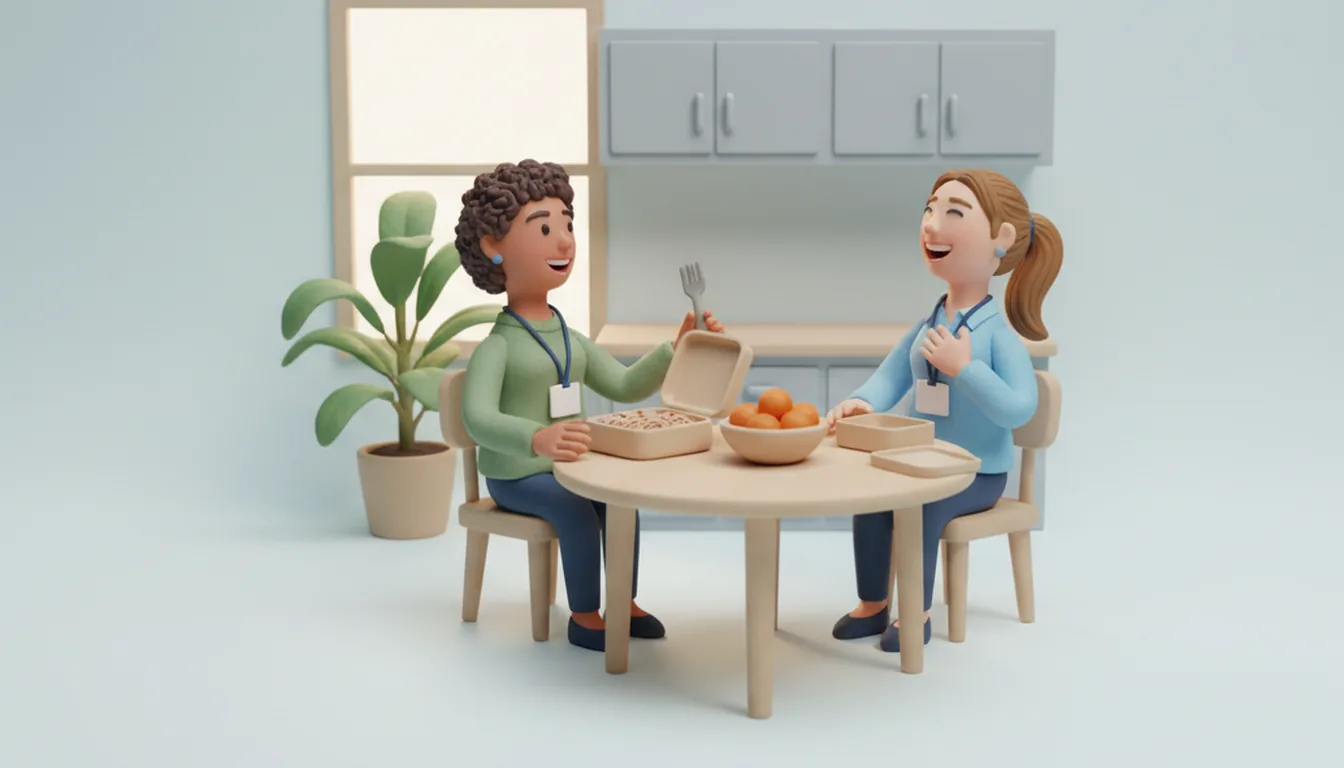
A colleague turns into a friend when the friendship starts to live outside the job. You meet on a day off for no work reason, you know each other's people, and you'd keep in touch if one of you left. Many work friendships start with one small shared moment and a habit that repeats. Some carry on into the rest of life, and others end at the door of the building, often because of how the two of you fit.
An example: Sunita and Leah work on the same floor, and for months they only talk about the jammed printer. Then Leah's lunch slides off the counter in the break room and lands upside down on the floor. Sunita is already at the round table by the window. She tips her open box of noodles toward the empty chair and holds up a spare fork. "Sit. I always make too much." Leah sits down with her empty box, puts a hand on her chest and laughs until her eyes water. After that they eat together most days, with a bowl of clementines between them, and soon Leah knows the names of Sunita's two brothers. When Sunita takes a job across town, they both expect the friendship to fade. It doesn't. Lunch becomes a Saturday breakfast once a month.
Work friend, work bestie or friendly colleague?
The words get mixed up, so here is how many people use them.
- A friendly colleague. You say hello, help each other out and chat by the lift. You wouldn't think of calling them on a Saturday.
- A work friend. You look for them at lunch and talk about your lives as well as the job. The friendship mostly lives at work, and that's fine.
- A work bestie. The one you message during a long meeting. They can tell what kind of morning you've had from the way you say hello. People also call this a workplace bestie.
- A friend you met at work. The job introduced you, and the friendship would carry on if it ended tomorrow.
Where you met is only one way to sort the people in your life. The guide to types of friends sorts them by what happens between two people instead.
How a colleague becomes a friend
Work makes the first steps easy, because you see each other every day without planning it. The rest of the way usually takes five small moves.
- A shared joke. The jammed printer or the lift that stops on every floor. It gives you something to talk about that isn't the task.
- A regular slot. The same lunch table, or the same walk to the train after work. Doing it again and again builds trust before anyone has to send an invitation.
- A little more each time. A brother's name, a weekend plan, a worry about a parent. Each of you tells a bit more, and each of you remembers it.
- The first plan with no work reason. A Saturday walk, a film, help carrying a sofa. This is the big step, and someone has to suggest it. A plain "Want to get breakfast on Saturday?" is enough.
- Meeting each other's people. A partner, a flatmate, a parent who is visiting. Once your work friend has seen your life away from your desk, the friendship has somewhere to live.
If your team has a morning meeting, a question of the day is an easy way to learn a little about each other before the work starts.
If your workplace is small or mostly online, making friends as an adult covers where else to look.
For that first shared joke, work jokes has clean ones about meetings, the coffee machine and Monday.
Are work friends real friends?
Some are friends for life, and some are friends of the place. To tell them apart, picture one of you leaving tomorrow. Then count how many of these are true.
- You've met on a day off, with no work reason at all.
- Less than half of what you talk about is work.
- You know their people by name, and they know yours.
- You'd tell them bad news that has nothing to do with the job.
- You'd both make the effort if the shared desk disappeared.
If four or five are true, the job only introduced you. If it's one or two, you have a good work friend, and that's worth a lot. Some of the nicest friendships at work are the ones that stay there.
When one of you leaves the job
Seeing each other every day did a lot of quiet work. Once that's gone, a work friendship needs a new place to meet, or it thins out. The first few months often decide which way it goes.
- Make a plan before the last day. Put a date in both calendars while you still sit near each other.
- Swap the place, keep the habit. The Tuesday lunch can become breakfast on the first Saturday of the month.
- Keep the old jokes. They're the history of the friendship. Add new ones from outside.
- Expect a quieter patch. Messages slow down for a while, and that's normal.
- Let some go. A few work friendships were about the place. You can be glad you had them and still wave warmly when you meet again.
If the one leaving is a close work friend, a small going away party makes a natural first plan outside the building. For the card on their last day, see farewell messages for a coworker.
Why some colleagues click and others never do
Two people can sit at neighboring desks for five years, work well together and never once meet on a weekend. Another pair is close by the end of the first month. Shyness and timing play a part, and so does fit. Typeza puts each pair of people in one of 16 relationship types, and a few of them turn up again and again at work.
- The colleague who becomes the easy friend. In Duality, each of you finds easy what the other struggles with. At first a dual can seem a bit odd in a meeting. Over lunch, time with them turns restful, and this relation can grow into a close friendship. For a shared project, the next relation often runs a job more smoothly.
- The colleague you'd pick for any project. In Business, you go about tasks the same way, so a handover needs few words and deadlines feel calm. Yet after years you may still know little about their weekends. This relation tends to stay around the shared task, which makes it great at work and slow to become friendship.
- The colleague who lifts the whole day. Activation feels like a jolt of energy. Ten minutes at their desk and you go back to yours in a better mood with two new ideas. Small doses suit it best, and a long week side by side can leave you both a little worn.
- The colleague you think out loud with. In Mirror, you care about the same things, each from a slightly different side. Lunch talk never gets dull, and one of you often spots what the other missed.
- The colleague who agrees with you and still does it their way. In Kindred, you want the same outcome, and then each of you wants a different route to it. Talking comes easily, and closeness often doesn't follow.
A relationship type never decides who can be your friend. It's often part of why one colleague seemed like an old friend within a month while another stayed a pleasant face at the next desk. A compatibility test with a colleague shows which of these you two have.
Who makes friends at work, by type
Some people have five work friends by the end of their first week. Others take a year. Typeza sees personality type as part of how people make friends at work. Eight of the 16 types:
- Ideator makes friends in the hallway, over an idea that has nothing to do with the task, and those talks can run long.
- Harmonizer remembers birthdays, brings soup when someone is ill and makes the break room feel like a kitchen at home.
- Mentor skips the small talk and asks how you really are, and the colleagues who answer honestly become friends.
- Inspector keeps a polite line between work and home for a long time. Once you've been let across it, you're in for good.
- Dreamer usually has one close work friend, often the quiet person at the next desk who notices the same small things.
- Entrepreneur bonds by getting things done, and the colleague who fixed a problem with them on a bad afternoon becomes a friend.
- Organizer builds friendship on routine: lunch at half past twelve, the same table and the same person every day.
- Encourager notices what each colleague is good at, says so, and keeps introducing people who ought to meet.
These are tendencies, and plenty of people make friends one way at one job and another way at the next.
See what kind of friends you and a colleague are
Typeza names the relationship type between two people and shows what comes easily to them and where they're likely to rub. The free friendship compatibility test is where you start, and you invite your work friend from your result.
Questions people ask
What is a work bestie?
Your closest friend at work, the one you eat lunch with, message during long meetings and tell first when something happens. Some work besties stay at work, and some become friends for life.
Can a coworker be your best friend?
Yes. Plenty of best friends met at work. It usually happens once the friendship has a life outside the job, with plans on days off and each other's people in it.
Written by Virko Kask, founder of Typeza
Written with the help of AI tools.
One question for two, every week
A question to ask your partner, friend or family, and how different types tend to answer it.
Free. Unsubscribe any time.