
How to deal with insecurities in a relationship, without blaming anyone
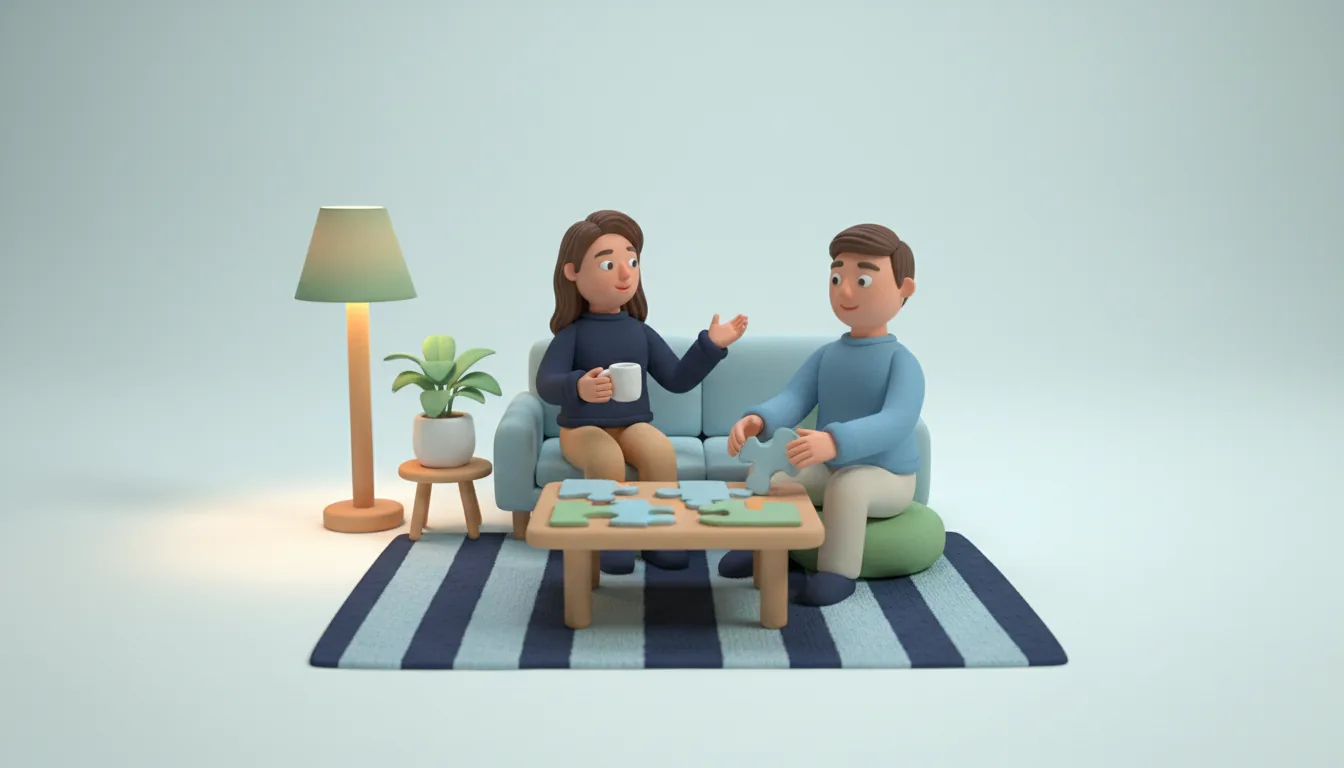
Insecurity in a relationship is the nagging doubt that you matter to your partner as much as you hope: that they still want you, that you are enough, that a quiet evening means nothing bad. It often grows out of small moments that you fill in with worry. To deal with it, notice what set the feeling off, check the story you told yourself against what you actually know, and tell your partner in plain words what you felt and what would help.
An example: Tessa had news one evening. Her sister was moving back to town, and she had been saving the story all day. Omar came home, said "fine" when she asked about his day, ate his pasta and sat down with the jigsaw puzzle on the coffee table. Tessa asked twice if everything was OK, and twice he said yes. By ten o'clock she had gone over the whole week in her head: the joke about his mother's cooking, the dinner she had canceled, the goodbye kiss he forgot. She went to bed sure that something was wrong between them.
At breakfast Omar mentioned that his knee had hurt all day and he had spent his lunch break on the phone with his brother about their dad's move. "I just needed quiet," he said. "I told you I was fine." Tessa laughed, a little embarrassed. She had spent a whole evening feeling insecure over a sore knee.
What feeling insecure in a relationship means
Feeling insecure means you are unsure of your place. You may feel it as a knot in the stomach when a reply takes longer than usual, or as an urge to ask "are we good?" more often than you would like. Some people go quiet and watch, and others ask questions or try extra hard to please.
A little of this is common, especially when a relationship is new or life around it is changing. It becomes a problem when the doubt is there most days and colors how you read everything your partner does. Then even a kind gesture looks suspicious, and an ordinary silence starts to feel like a verdict on you.
Where it starts on an ordinary day
Insecurity often starts in moments so small that you would feel silly mentioning them:
- A slow reply. You sent something warm at noon, and the answer came at five, with one word. The hours in between filled up with guesses.
- A quiet evening. Your partner is home but somewhere else in their head. Like Omar with his puzzle, they may simply be resting, and you read it as distance.
- Different needs for closeness. One of you wants every evening together, and the other needs a night alone each week. The guide to being clingy in a relationship looks at that gap from both sides.
- A new friend of theirs. Your partner keeps mentioning someone from their running group, and you notice the name a little too often. If the feeling turns into fear of losing them to someone, how to deal with jealousy is the closer fit.
- Plans that stay vague. You talk about next summer, and they say "we'll see." To one person that sounds relaxed. To another it sounds like doubt about the future.
None of these moments means something is wrong. Each one leaves a small gap, and a worried mind is very good at filling gaps.
Why am I so insecure in my relationship?
When you feel unsure even though things are going well, the cause is often a mix of these:
- You are tired or stretched. Doubts get louder when you've slept badly or had a rough week.
- You compare. Other couples seem to text all day and never argue. Your relationship looks quieter next to theirs, though it may be every bit as happy.
- Old experiences. Something from an earlier relationship or from your family can make a certain kind of silence feel familiar, even when this person is nothing like the last one.
- You and your partner work differently. This one is easy to overlook. Your partner may show love in ways you miss, and rest in ways you read as coldness.
That last one explains how two kind people can make each other feel unsure without meaning to.
How six types show it, and what calms each one
People feel insecure in different ways and need different things to feel steady again. Part of that follows type. Here are six of the 16 types:
- Ideator: may not notice the feeling until it leaks out as restlessness or a joke with a slight edge. Reading moods, their own included, is not their strong side. A plain sentence helps more than hints: "We're fine. I'm just tired tonight."
- Harmonizer: smooths things over, cooks the favorite dinner and avoids the hard question. What calms them is ease: sitting close on the sofa, a slow weekend morning, a thank-you for the small things they do unasked.
- Analyst: goes over what was said and looks for the logic in it. A specific explanation settles them faster than general reassurance: "I was on the phone with my brother until nine, that's all."
- Mentor: feels it strongly and usually shows it, and a confident face can hide real self-doubt. They may need to hear the kind words more than once, said with warmth.
- Organizer: does more. They fix the shelf and take over the chores, as if they had to earn their place. Calm comes from being noticed out loud ("I saw everything you did this week") and from being told to sit down and rest.
- Craftsman: goes quiet and keeps their hands busy. Time side by side, a shared task or a hand on the shoulder says more than a speech.
Omar's puzzle evening looks like the Craftsman way of resting. Tessa's need to hear the reason out loud looks more like the Mentor.
Talking about it without making it their fault
Insecurity is easier to carry once it is out in the open, as long as it doesn't come out as an accusation:
- Choose a relaxed moment. A walk or a slow breakfast works better than the minute your partner walks in.
- Describe the moment, then the feeling. "Last night you were really quiet, and I started to worry that I'd done something."
- Say what you made of it. "My head went straight to 'he's bored with me.' I know that's probably not true."
- Ask for one small thing. "When you need a quiet night, could you just say so? Then I can relax too."
- Listen to their side. Often the answer is something you never thought of, like a sore knee.
Leave out questions that work like tests ("Would you even notice if I left?"), which only make your partner defend themselves. If the two of you often talk past each other, communication styles in relationships walks through the common patterns.
If your partner is the one who feels unsure
Being on the other side has its own frustrations. You know you love them, and it can feel unfair to keep proving it.
- Take the feeling seriously, even when the reason seems small. "That's silly" only teaches them to hide it.
- Give specific comfort. "I loved Saturday with you" lands better than "Of course I love you."
- Say what your quiet means. A short "long day, I need an hour" saves them an evening of guessing.
How to stop feeling insecure, one habit at a time
The feeling may never vanish for good, but it can shrink and visit less often:
- Check the story against the facts. Write down what happened ("he replied at five") and what you added ("he doesn't care"). Often only the first part is true.
- Wait an hour before you react. Some worrying thoughts fade on their own.
- Keep your own life full. Friends and plans of your own mean your mood does not hang on one person's reply.
- Notice how your partner shows love. Maybe they rarely say it, but they always save you the last piece of cake. Count that too.
Find out what a quiet evening means to your partner
To one partner a quiet evening means rest, and to the other it can sound like an alarm, and personality type is part of that gap. Start with the free couples compatibility test. Then send your partner the result link. After that, the relationship type you share shows what tends to go smoothly for a couple like you and when you might read worry into a silence.
Questions people ask
Why do I feel insecure in my relationship when nothing is wrong?
Tiredness, comparing yourselves with other couples, old experiences and different ways of showing love can all make you doubt things that are fine.
Written by Virko Kask, founder of Typeza
Written with the help of AI tools.
One question for two, every week
A question to ask your partner, friend or family, and how different types tend to answer it.
Free. Unsubscribe any time.