
How to plan a small wedding, and what counts as a micro wedding
To plan a small wedding, agree on your number before anything else, then build the guest list from the inside out and stop at the circle where your number runs out. A micro wedding usually means 50 guests or fewer, and a small wedding often means under 100. Once the list is set, many other choices get easier, because you know exactly who you're planning for.
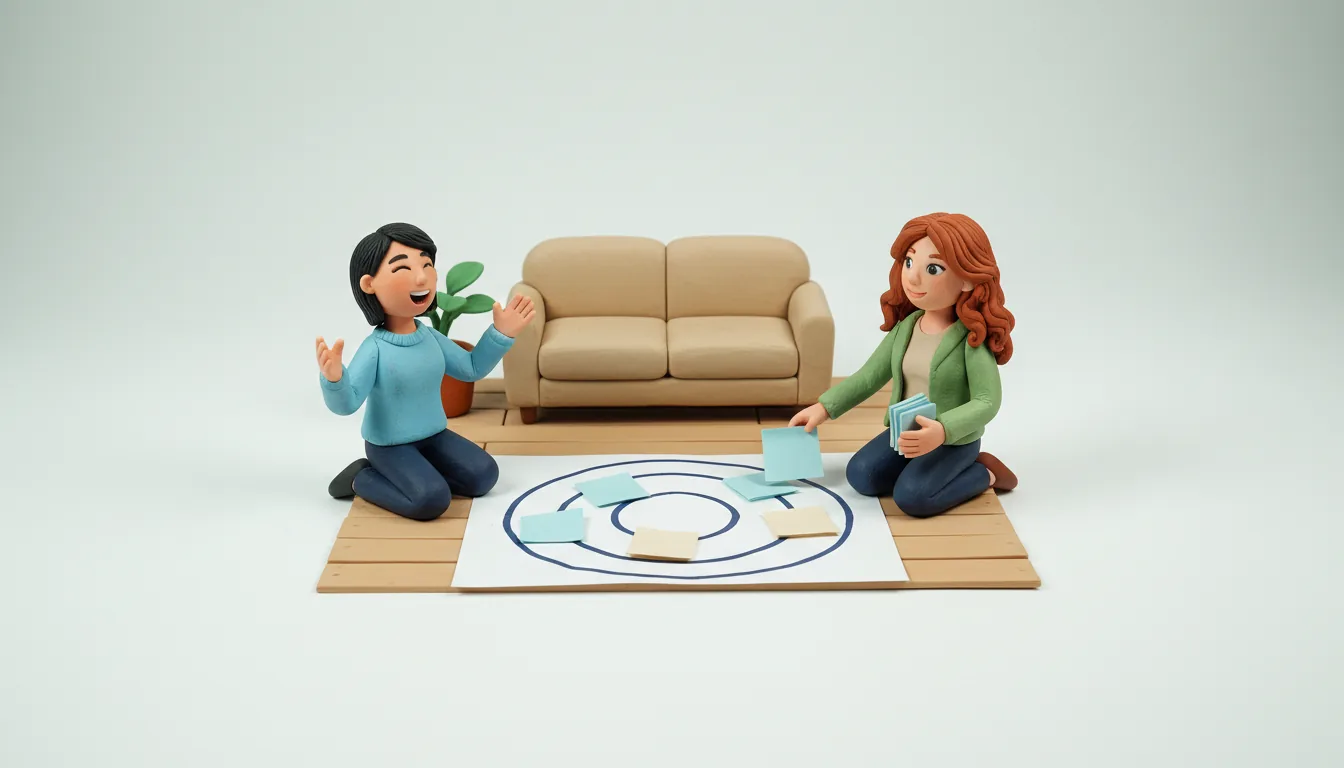
An example: Leila and Marta tape a big sheet of paper to their living room floor and draw three circles on it, one inside the other. The inner circle is for people whose absence would make the day feel wrong. The middle one is for people they've seen or called in the past year. The outer one is for everyone else. Each of them writes one name per sticky note. Leila fills her circles in ten minutes and laughs at how few notes she's used. Marta is still writing cousins. "Do I count the cousin I've met twice?" she asks. "Where would you put her?" Leila says. Marta looks at the paper for a long time and moves the note to the outer circle. By evening they have 32 notes in the two inner circles.
What counts as a micro wedding
There's no official cutoff, and wedding guides draw the lines a little differently. Roughly:
- An elopement. Just the two of you, or a handful of people at most, often with little notice. If that sounds closer to what you want, read what it means to elope.
- A micro wedding. Usually 50 guests or fewer. Some guides set the line lower, at 20 or 25. It still has a ceremony, a meal and guests.
- A small wedding. Up to about 100 guests in many guides, though plenty of couples would call 100 a medium wedding.
The Knot's survey of US weddings in 2023 put the average at about 115 guests, so anything well below that will feel small to many of the people you invite.
Why couples go small
Couples who choose a small wedding often say some version of the same thing: they want to talk to every guest. At a wedding of 150, the couple often spends the evening greeting people they barely know and gets five minutes with their closest friends. At 30, there's time for a real conversation at every table. A smaller list also costs less, which frees money for the things the two of you care about more. For others, one partner gets tired in big crowds, or the families live far apart and only a few can travel.
Build the guest list in three circles
A circle makes you decide where each person stands. Draw three circles and give each one a clear rule:
- The inner circle. People whose absence would make the day feel wrong. Parents, siblings and the friends you'd call first with big news. For many couples this is ten to twenty-five people.
- The middle circle. People you've seen or called in the past year and would miss on the day. Good friends, the aunt you actually talk to, a colleague who became a friend.
- The outer circle. Everyone else who might expect an invitation. Relatives you see every few years, old classmates, your parents' friends.
Fill the inner circle first, each partner on their own, then compare. Do the middle circle the same way. If your number runs out partway through the middle circle, that's your line, and the rest move to the outer one. Many people's friendships already fall into circles like these, and our look at how many friends adults have goes into that.
A few rules that keep the list short
Rules help because you decide once, instead of arguing over every name. Use the same ones for both families.
- The one-year rule. If you haven't seen or spoken to someone in a year, they go in the outer circle.
- Plus-ones for partners only. Guests in a couple come together. Single guests come alone, unless they'd know nobody else there.
- No duty invitations. Being invited to someone's wedding years ago doesn't mean you owe them a seat at yours.
- Coworkers only if they're friends. If you'd see them outside work, they can come. If you'd only see them at work, they can hear about it on Monday.
- Family goes by circle, too. A cousin goes where the relationship is, which may not be where the family tree puts them.
When one of you wants twelve guests and the other wants fifty
This is a common disagreement about a small wedding. Under each number there's usually a picture of the day. Marta wants fifty because she pictures her whole family at one long table. Leila wants twelve because she pictures being able to talk to everyone. Both pictures make sense.
Settle it by circle instead of by number. Agree that both inner circles come, whatever that adds up to. Then go through the middle circles together, one name at a time, and ask whether the day would feel different without that person. Another way is for each of you to name the six people you most want there besides family, and those twelve are fixed before anything else is discussed. If you still can't agree, some couples choose a middle path: a small ceremony with the inner circle, and a bigger, casual party for everyone else a few weeks later.
How to tell people they're not invited
People often take it better when they hear it from you, early and plainly. Tell the ones who might expect an invitation before the news spreads, by phone or in person for anyone close. Keep it about the size of the wedding:
- "We're keeping the wedding really small, just family and a few close friends. We'd love to take you out to dinner after and show you the photos."
- "We had to draw a hard line at 30 people, and it was harder than we thought. We didn't want you to hear it from someone else."
- "It's going to be a tiny ceremony. We're planning a party in the summer for everyone, and you're at the top of that list."
Then keep your word. If you promised a dinner or a party, put a date on it.
What a small wedding day can look like
A short guest list makes room for things that are hard to do with 150 people:
- One long table. Everyone sits together, and nobody ends up at the table by the door.
- A word for every guest. At 30 people, the two of you can stand up and say one sentence about each person.
- Guests in a half circle. For the ceremony, skip the rows of chairs and have everyone stand close around you.
- Games the whole room plays. A small group can play one game together, and our list of wedding reception games has some that work at any size.
- Everyone has a part. One friend leads the ceremony, one reads and one takes photos. Our guide to wedding party roles covers who does what.
For the planning steps every wedding shares, like the date and a timeline for the day, see how to plan a wedding.
How each type draws the circles
Typeza sees personality type as part of how people build a guest list. Eight of the 16 types:
- Harmonizer pictures a calm, cozy day and thinks about where each guest will sit and whether they'll be comfortable.
- Vitalizer pictures a full, lively room and finds a short list the hardest. Marta is a lot like a Vitalizer.
- Analyst wants a fair rule for who goes where and applies it to everyone.
- Inspector writes the rules down and checks that both families are treated the same way.
- Strategist thinks through where a big list would lead and is happy with a short one, since loud parties drain them.
- Guardian wants to know who'll be there, and cares most that the room is full of people they trust.
- Counselor wants every guest to be someone they can talk to properly, and often prefers the smallest list.
- Encourager wants guests who believe in the two of you, and may need help to finish the list.
Find out how you two weigh people
Two people can love the same friends and still draw the circles in different places, and type is often part of why. Typeza shows the relationship type you two form, what you find easy together and where your instincts differ. Take the free couples compatibility test, invite your partner from your result page and then sit down with the guest list.
Questions people ask
What is the difference between a micro wedding and an elopement?
An elopement is usually just the couple, sometimes with a witness or two, and often planned quietly. A micro wedding invites a small group of guests and usually has a ceremony and a meal.
Sources
- The Knot Worldwide, "Wedding Guests Take Center Stage". The 2023 Real Weddings Study of 9,318 US couples: an average of 115 guests.
Written by Virko Kask, founder of Typeza
Written with the help of AI tools.
One question for two, every week
A question to ask your partner, friend or family, and how different types tend to answer it.
Free. Unsubscribe any time.