
Wedding day timeline: an hour-by-hour plan for the day itself
A wedding day timeline is the written plan for the day itself, from the first hour of getting ready to the send-off. Build it backward from the ceremony time. The ceremony usually takes twenty to thirty minutes, guests mingle for about an hour afterward while the couple has photos taken, and the reception that follows runs four to five hours. Give the printed plan to one person who isn't getting married.
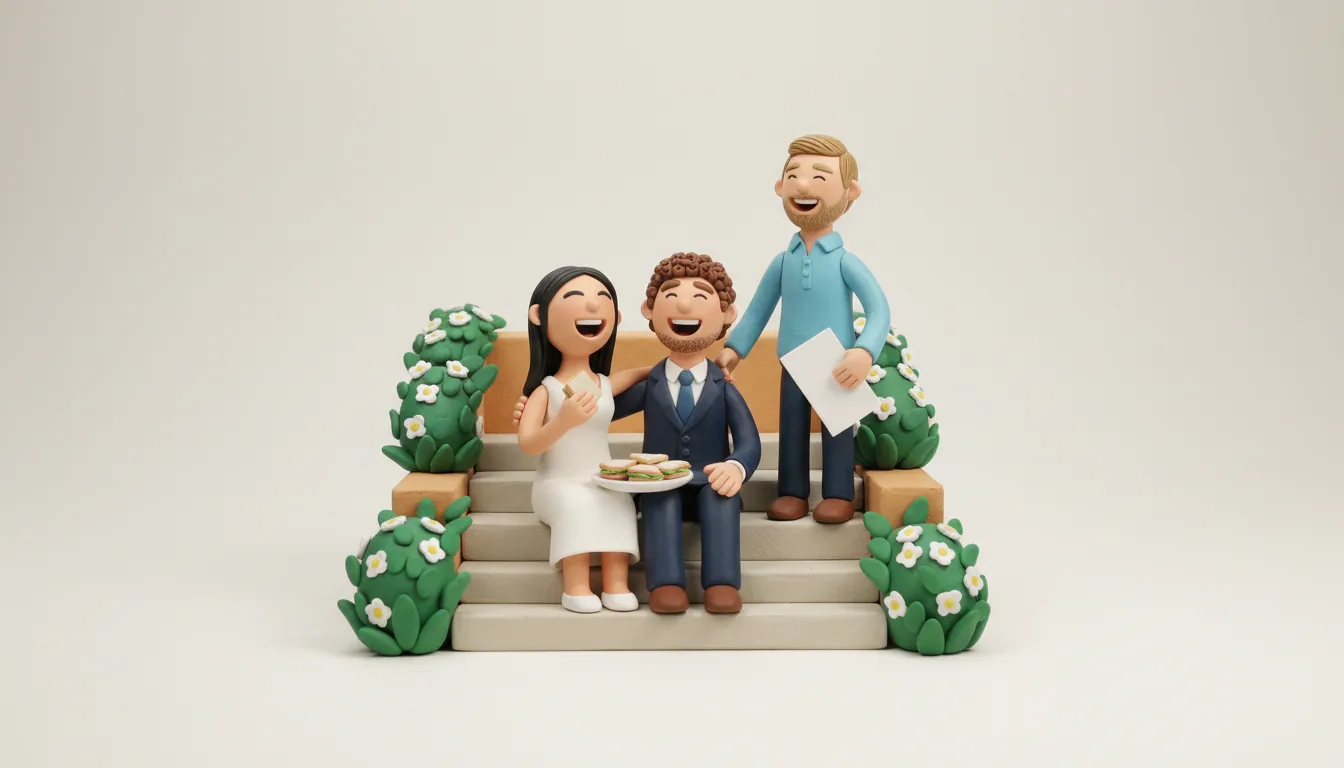
An example: Mei's first draft of the wedding day runs from 7 in the morning to 11:30 at night in fifteen-minute rows. Jonah reads all four pages, picks up her pen and draws a box around 12:30 to 1:30. Inside it he writes one word: nothing. Mei leaves the box in, mostly so she can win the next argument. On the day, the morning runs twenty minutes late, because Mei's sister can't find the car keys. The empty hour soaks up the delay, and the forty minutes left of it come right after they first see each other. They spend it on the stone steps behind the house with a plate of sandwiches, while their friend Cal stands on the top step with the timeline and sends everyone else around to the front.
The three parts of the day
Whatever time it starts, a wedding day falls into three parts.
- Before the ceremony. Getting ready, a real meal and, if you see each other first, the couple photos. Plan four to six hours.
- The ceremony and the hour after it. Guests arrive thirty minutes early, the ceremony takes twenty to thirty minutes, and then guests mingle for an hour while you have family photos taken.
- The reception. Four to five hours: your entrance, the meal, the speeches, the first dance, the cake, the dancing and the send-off.
Our wedding officiant script goes through the order inside the ceremony. The reception is looser. Many couples put the speeches between the main course and dessert, and the usual speaking order is in our wedding speeches guide. Games fit into a quiet stretch after dinner, and there are ideas in wedding reception games. The months of work before the wedding are in how to plan a wedding.
Build it backward from the ceremony
Start with the ceremony time, the one time that can't move, then count back and forward from it.
- Count back for the guests. They arrive about thirty minutes before. The two of you should be ready and out of sight fifteen minutes before that.
- Count back for photos and getting ready. A first look usually goes about two hours before the ceremony, and getting ready should end half an hour before it.
- Count forward for the hour after. Leave a full hour before the reception starts.
- Add slack. Fifteen extra minutes on every block before the ceremony, and one block with nothing in it at all.
Then read it out loud to someone who'll be there, and write a name next to every line that makes them ask "who's doing that?"
First look or no first look
A first look is a few private minutes before the ceremony when the two of you see each other for the first time that day. It changes the timeline more than any other choice.
- With a first look, the couple and wedding party photos happen before the ceremony. Afterward you need only fifteen or twenty minutes for family photos, and then you can join your guests.
- Without one, every photo happens in the hour after the ceremony, and many couples reach the reception having barely spoken to a guest.
Some couples want the first sight of each other to happen at the end of the aisle, and that's a good reason to skip it. Others are glad of ten quiet minutes together before a day of being looked at. Choose the one you'd regret less.
Three sample wedding timelines
Each one assumes a first look. Without one, move the photos to the hour after the ceremony.
A morning ceremony at 11 am
- 7:00 am. Breakfast, then getting ready.
- 9:00 am. First look and couple photos.
- 10:00 am. Wedding party and family photos.
- 10:30 am. Guests arrive and find their seats.
- 11:00 am. The ceremony.
- 11:30 am. Time to mingle and family photos.
- 12:30 pm. Your entrance and lunch.
- 1:15 pm. Speeches.
- 2:00 pm. First dance and cake.
- 2:15 pm. Dancing, lawn games and long talks.
- 4:30 pm. The send-off.
An afternoon ceremony at 4 pm
- 10:00 am. A late breakfast, then getting ready.
- 1:30 pm. First look.
- 2:00 pm. Couple and wedding party photos.
- 3:00 pm. Out of sight, feet up, something to eat.
- 3:30 pm. Guests arrive.
- 4:00 pm. The ceremony.
- 4:30 pm. Time to mingle and family photos.
- 5:30 pm. Your entrance and dinner.
- 6:30 pm. Speeches.
- 7:15 pm. First dance and cake.
- 7:30 pm. Dancing.
- 10:00 pm. The send-off.
An evening ceremony at 6 pm
- 12:00 pm. Lunch, then getting ready.
- 3:30 pm. First look and photos, while there's still good daylight.
- 5:00 pm. Out of sight and resting.
- 5:30 pm. Guests arrive.
- 6:00 pm. The ceremony.
- 6:30 pm. Time to mingle.
- 7:30 pm. Your entrance and dinner.
- 8:30 pm. Speeches.
- 9:00 pm. First dance and cake.
- 9:15 pm. Dancing.
- 11:30 pm. The send-off.
In autumn and winter the light goes early, so an evening wedding usually means taking your photos before the ceremony.
Who keeps the timeline on the day
It shouldn't be either of you. Hand the timeline to one person who'll be there all day and doesn't mind telling people where to go. That may be a coordinator, a calm friend or the MC who hosts the reception.
The keeper's job is simple:
- Carry the printed timeline and a list of phone numbers for everyone with a job.
- Gather people for each group photo, from a list you wrote in advance.
- Tell the kitchen and the speakers when the plan shifts.
- Make small changes on the spot, so nobody needs to ask the couple.
Send the final version to everyone with a job a week before, and print a few spare copies. Phones run out of battery by evening, and paper doesn't.
Where wedding days run late
Many days slip in the same few places.
- Getting ready. It often runs over, so start early.
- Family photos. Gathering twelve relatives takes longer than photographing them. Ask a cousin who knows everyone to call out the names from a list.
- Moving the guests. People walk slowly from the ceremony to the reception, especially with someone to hug on the way. Give it twenty minutes.
- The speeches. Five speakers at four minutes each comes to twenty minutes on paper and often forty in the room. Plan for the longer number.
When the day runs late, take the time back from the end of a block, and keep the ceremony and the meal whole.
Every minute planned, or see how it goes
Some people relax only once every minute is written down, and others feel boxed in by the same page. Typeza sees personality type as part of which of the two you are. Eight of the 16 types:
- Ideator would rather see how it goes. They lose interest by the third row and start adding surprises, so give them one block to fill.
- Harmonizer cares less about the times than about whether everyone has eaten. Jonah is a lot like one, which may explain the sandwiches.
- Analyst wants the whole day on paper, with the logic behind it. Explain once why the photos need a full hour, and they'll defend the timeline all day.
- Inspector checks every time twice and spots that the photos and the guest arrivals overlap by ten minutes.
- Diplomat trusts that they'll handle whatever comes up, and usually does.
- Entrepreneur treats the schedule as something to beat, and will bring the cake forward to win back fifteen minutes.
- Organizer writes the version with phone numbers on it. Mei is a lot like one.
- Encourager wants a calm, loose dinner with nobody rushing them along.
If you're one of each, split the day. The planner owns every block up to dinner. The other one gets the empty hour and the dance floor, where nothing has to happen on time.
See how you two work as a team
Writing a timeline together shows a lot about a couple: who wants it on paper, who wants room and who gives way first. Type is often part of why. Typeza names the relationship type you two form: the parts that come easy for you as a pair and the places where you each want something else. Take the free couples compatibility test first, and your result page has an invite to pass on to your partner.
Questions people ask
How long does a wedding day last?
For the couple, often ten to twelve hours from the start of getting ready to the send-off. Guests usually spend about six hours there.
Written by Virko Kask, founder of Typeza
Written with the help of AI tools.
One question for two, every week
A question to ask your partner, friend or family, and how different types tend to answer it.
Free. Unsubscribe any time.