
Wedding speeches: who speaks, in what order and for how long
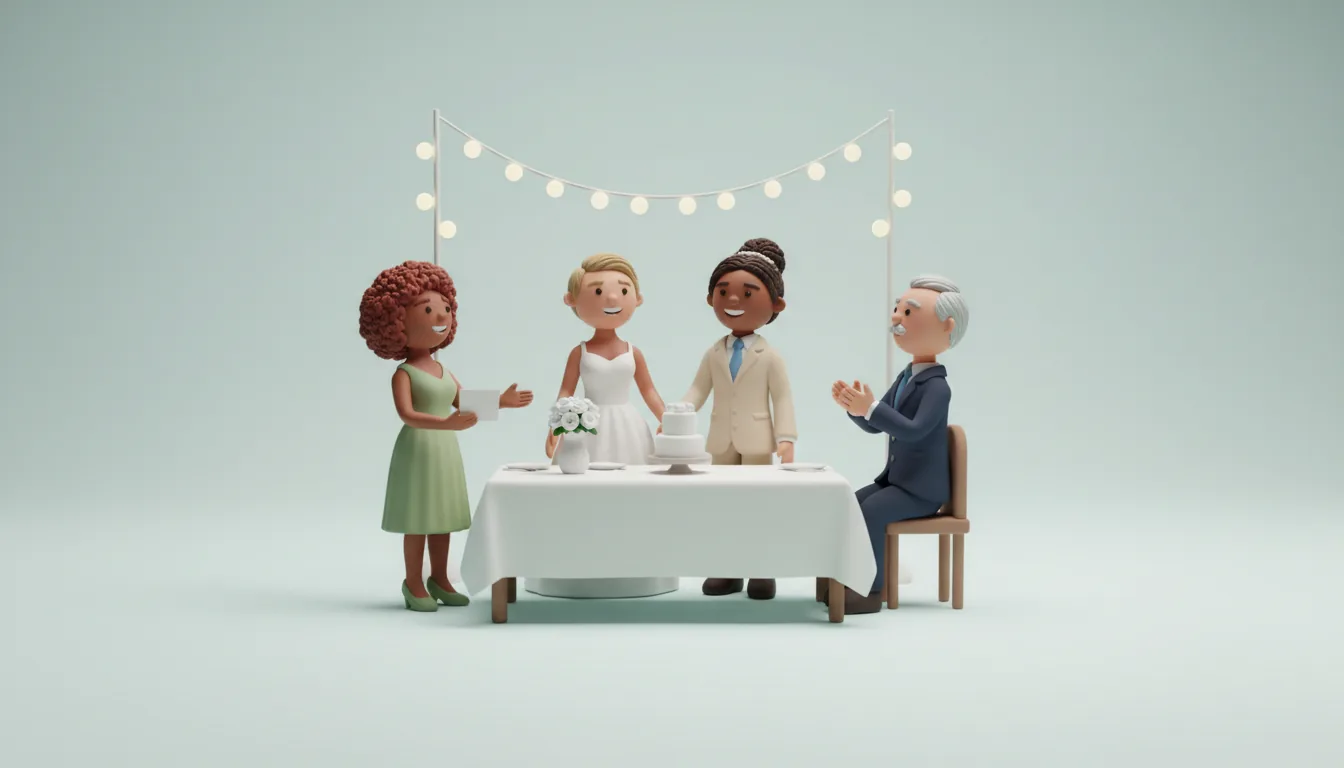
At many weddings, three to five people give speeches at the reception. The host speaks first, usually a parent of one of the couple, then the maid of honor and the best man, and the couple often closes with a short thank you. Each speech runs two to five minutes. The whole set is best kept to about twenty to thirty minutes, so guests are still listening when the last speaker sits down.
An example: Ama and Lucas had seven offers. Both fathers wanted to speak, and so did Lucas's mother, Ama's best friend Sade, Lucas's brother Theo, an uncle who "had a few words prepared" and a college roommate. So they kept four: Ama's father as host, then Sade, then Theo, and the two of them at the end. Everyone else got a page in the guest book to write down the speech they would have given. Their friend Rosa introduced each speaker, and the four speeches took nineteen minutes. The uncle filled two whole pages of the guest book. Ama reads them every anniversary.
The usual order of wedding speeches
There's no fixed rule, and the order changes from country to country. Guides often describe one of two lineups.
In the United States, the speeches usually go like this:
- The host. Traditionally the father of the bride. Today it's often both of her parents, both families or whoever is hosting.
- The groom's parents, if they'd like to say a few words. Many save theirs for the rehearsal dinner the night before.
- The maid of honor.
- The best man, who often goes last so the dancing can start right after.
- The couple, with a short thank you, if they want to speak.
In the United Kingdom, a common order is the father of the bride, then the groom, then the best man, usually after the meal. More couples there now add the bride or a maid of honor.
Some couples let the friends go first, so the parents close on a warm note. Any order works, as long as every speaker knows it a week before the day.
How many speeches, and how long each one runs
Three to five speeches is plenty for most receptions. Past six, the room starts to drift, however good each one is.
A single speech should run two to five minutes, which is about 250 to 650 words at a relaxed pace. A total of twenty to thirty minutes keeps the guests with you, and forty is about the limit. If more people want to speak than the evening can hold, give them another place to say it, like the rehearsal dinner or a page in the guest book.
When in the evening the speeches happen
There are three common slots.
- Before the meal. The speakers get it over with and can enjoy their food.
- Between the main course and dessert. A common choice. Everyone has eaten, and nobody is dancing yet.
- After the meal. A common British slot. It leads straight into the cake and the first dance.
Who introduces the speakers
Someone has to stand up and say who's next. That person is often called the MC, short for master of ceremonies. At a big reception it may be whoever runs the music, and at a smaller one a friend like Rosa does it well. The MC says each name with one line about who they are, and that line matters, because half the room may not know who Sade is. A good MC also has a quiet word with each speaker about time, so the couple never has to. The officiant, who leads the ceremony earlier in the day, has a different job, and you'll find their words in our wedding officiant script.
The bones of any wedding speech
Whoever gives it, a wedding speech hangs on the same simple frame.
- Who you are to them. One sentence for the guests who have never met you.
- One story or one picture. A single moment that shows something true about one of them, or both.
- The two of them together. What you notice when they're in the same room.
- The toast. A short spoken wish the room can share, such as "So here's to Ama and Lucas, and to every ordinary Tuesday they'll spend together."
A toast here means that last wish, said out loud. Nobody needs to hold anything. It just tells the guests the speech is over and gives them something to answer.
How to start and how to end
Getting through the first ten seconds does more for your nerves than anything else. Open with your name and your link to the couple, then pause and breathe.
- "Good evening. I'm Sade, and I've been Ama's friend since we shared a desk at our first job."
- "Hi everyone. I'm Theo, Lucas's brother, and the only person here who has beaten him at chess."
For the ending, look at the couple first, then at the room. Make the toast your last line, say it slowly and sit down. Don't add "one more thing."
- "To the two of you, and to the long table you'll always keep for us."
- "Lucas and Ama, we love you. Everyone, to the happy couple."
Speeches by role
The host or the father of the bride
The first speaker welcomes the guests, thanks those who traveled and greets the other family by name. Traditionally that's the bride's father, and today it may be both parents or her mother. The father of the bride speech covers the welcome and a story about a grown daughter.
The groom's parents
The groom's father, or both his parents, often speak at the rehearsal dinner, which the groom's family has traditionally hosted. The father of the groom speech is built around welcoming the newest member of the family.
The maid of honor
She's usually the bride's sister or closest friend. The maid of honor speech has samples for a sister and a best friend.
The best man
He often speaks last, so his toast can open the dancing. The best man speech helps him pick one story.
The couple themselves
More couples speak now, mostly to thank the guests, the families and everyone who helped. Keep it to two or three minutes and name the people who did the most. With two brides or two grooms, the lineup works the same way: each side picks its own best person, and the host still opens. For examples, including one for two people speaking together, see our bride speech guide.
A short toast when you have no role
Sometimes the MC opens the floor, or a table asks a guest to say something. A guest toast is one or two sentences, said standing, about the couple and not about you.
- "I've known Lucas for ten years and never seen him this calm. Here's to the person who did that."
- "To Ama and Lucas: may your arguments be short and your weekends long."
- "To the two of you, from all of us who drove a long way and would do it again."
If you'd like to say more, put it in the card. Our page on wedding card messages can help with the words.
Asking someone to speak: who'll love it and who'll dread it
Some people would be hurt not to be asked, and others would lose a month of sleep if they were. Personality type can help. Here's who to ask among seven of the 16 types, kept in types page order.
- Ideator says yes before you finish asking and may arrive with three versions. Ask for the shortest one.
- Vitalizer treats the speech as a present for the whole room. Give them a clear time limit.
- Analyst would rather write you a letter. If you still want them up there, ask early and say exactly how long.
- Mentor feels honored and may well cry halfway through. Seat them near the couple, where a pause looks natural.
- Strategist may agree out of loyalty and then dread it for weeks. Offer a smaller stage, like a reading at the ceremony.
- Encourager wants to thank everyone who helped, by name. That makes them a natural MC.
- Craftsman would rather do than talk. Ask them to set up the lights, and ask someone else to speak.
Rosa is an Encourager, which is why she knew something kind to say about every speaker.
Know the people you're asking to speak
Typeza puts a name to the relationship between two people, the parts that come naturally and the spots where you keep getting each other wrong. Find your own type first with the free personality test. Then send the link to your partner, or to the friend you're about to ask for a speech.
Questions people ask
Who gives speeches at a wedding?
Usually the host, often the bride's father or both her parents, then the maid of honor and the best man. The groom's parents and the couple may speak too. The couple decides who speaks.
What is the order of speeches at a wedding?
In the US it's often the host, the groom's parents if they speak, the maid of honor, the best man and then the couple. In the UK it's the father of the bride, the groom and the best man. Many couples change the order to fit their families.
How long should a wedding speech be?
Two to five minutes for each speaker, and about twenty to thirty minutes for all the speeches together.
Who gives the first toast at a wedding?
The host, who opens the speeches with a welcome. That's traditionally the bride's father, but it can be either parent, both families or a friend acting as MC.
What is the difference between a wedding speech and a toast?
A speech is the whole talk, with a story and a few words about the couple. The toast is the short wish at the end that the guests repeat together. A guest without a role can give a toast on its own.
Sources
- Wikipedia, "Wedding reception": toasts before or after the meal, often from the bride's father, the groom, the best man or the maid of honor.
- Wikipedia, "Rehearsal dinner": the dinner traditionally paid for by the groom's parents.
Written by Virko Kask, founder of Typeza
Written with the help of AI tools.
One question for two, every week
A question to ask your partner, friend or family, and how different types tend to answer it.
Free. Unsubscribe any time.