
Bride speech: what to say to your partner and your guests, with examples
A bride's speech is usually short, about two or three minutes. Thank the guests for coming, thank both families and the people who helped, then say a few warm, specific lines about your partner, and end by welcoming everyone to the rest of the evening. The same shape works when the two of you speak together. Keep it separate from your vows: the vows are promises you make to each other, and the speech is for the room.
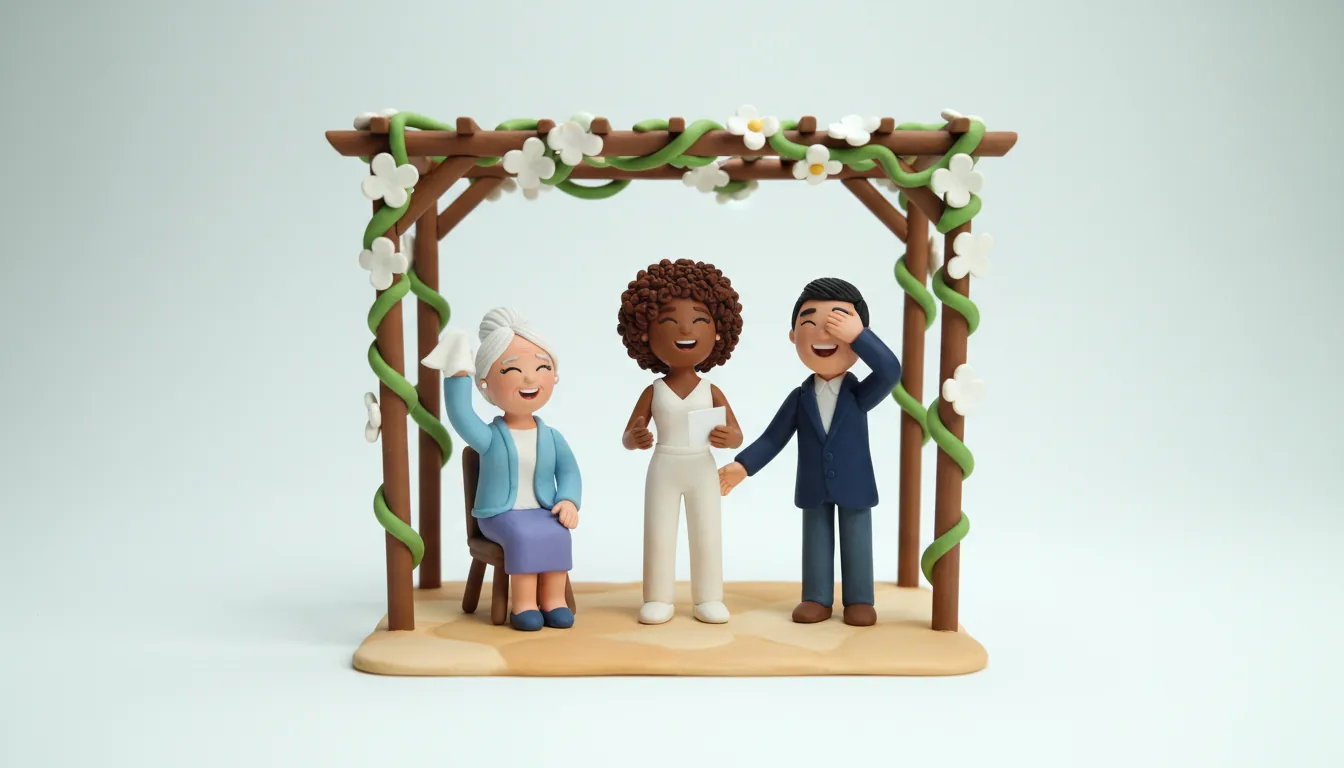
An example: Daniel had told everyone Hannah would do the talking. After the best man sat down, she stood under the pergola with one small card. She thanked the guests who'd come from Lagos and from Leeds, and she thanked both mothers by name. Then she turned to Daniel. "Every Sunday for three years, Daniel has phoned my grandmother to ask how her week went. Nobody asked him to. He just does." In the chair nearest them, Grandma Ivy lifted her white napkin and waved it over her head. Daniel put a hand over his eyes and laughed. The whole speech took just under three minutes.
Where the bride's speech fits in the evening
In the traditional British lineup, the father of the bride speaks first, then the groom, then the best man. The bride had no slot of her own. That has changed. Many brides now speak after the groom, some speak instead of him, and some couples give one speech together. Some couples speak at the start of the reception, right after the welcome, and others speak last, once the other speeches are done.
Pick the spot that's easiest on your nerves. Speaking early means you can enjoy the rest of the night. Speaking last lets you thank the earlier speakers by name. Our guide to wedding speech order shows the full lineup for every speaker. With two brides, decide together whether one of you speaks, both of you speak in turn, or you share one speech.
Who to thank, in a sensible order
A speech that thanks people in a clear order is easier to write and easier to listen to. This order works for many weddings.
- Everyone who came. A line for the guests who traveled far is always welcome.
- Both families. Name your parents, and your partner's parents, rather than saying "our families."
- The people who stood with you. Your maid of honor, best man and anyone else who stood up with you.
- The people who helped. The aunt who strung the lights, the friend who drove the grandparents, the cousin who ran the timeline.
- Your partner. Save them for last, so the speech ends on them.
Keep each thank-you to a sentence. You don't need to name every person who lifted a box, and the rest can get a note later. Our page on thank you card wording helps with those.
A few lines about your partner
This is the part people remember. Two or three sentences are enough, as long as they're specific.
- Choose one habit or one moment. A phone call every Sunday says more than "he's so kind."
- Say it to your partner, not about them. Turn and talk to them, and let the room overhear.
- Leave out the jokes only two of you get. If a line needs a backstory, it won't land.
- Skip the embarrassing stories. Those are the best man's job, if anyone's.
End with one simple sentence, like "I love you, and I'm so glad it's you." Then turn back to the guests.
How a speech differs from your vows
The two get mixed up, so it's worth keeping them apart. Vows are promises. You say them to each other during the ceremony, and the guests only witness them. The speech comes later, usually after the meal, and it's for the guests: you thank them, you share a little of your partner with them, and you invite them to celebrate.
So don't repeat your vows in the speech, and don't save your thank-yous for the vows. If you haven't written your vows yet, our guide on how to write wedding vows covers them.
A sample speech from the bride
Here's roughly what Hannah said. Swap in your own names and details.
> "Hi, everyone. For anyone who doesn't know me yet, I'm Hannah, and as of about four hours ago, I'm Daniel's wife. > > Thank you all for coming, from down the road and from much further away. Mum and Dad, thank you for everything, starting with the first thirty years. Grace and Peter, thank you for welcoming me like a daughter from the very first dinner. Uncle Bayo, thank you for the lights over the garden. Aisha and Kofi, thank you for keeping us calm this morning. > > Daniel, every Sunday for three years you've called Grandma Ivy to ask about her week. Nobody asked you to. That's how I knew. I love you, and I can't wait for all the ordinary days with you. > > Now please eat, dance and stay as late as you like."
If you speak together
A speech for two works best when you split it clearly. One of you can take the thank-yous and the other the warm words, or you can take turns line by line. Either way, write it together, mark who says what on two small cards and practice the handovers once or twice. Keep the total length about the same as a single speech. Two people talking for six minutes feels long, even at a wedding.
This is the speech Clara and June gave together, with the lines split between them.
> Clara: "Good evening! We're Clara and June, and before the dancing starts, we want to say thank you." > > June: "Thank you for coming, especially everyone who drove up the coast this morning. Mom and Dad, and Clara's mom, Ruth, thank you for saying yes to every plan we changed." > > Clara: "Maya and Sam, thank you for standing with us today and for keeping us on time." > > June: "Clara, you make every room warmer, and you're the only person who has ever made me like early mornings." > > Clara: "June, you notice when I've gone quiet before I do. Thank you for always asking." > > Both: "Enjoy tonight. We're so happy you're here."
How long to speak, and getting through it
Two or three minutes is plenty, which is about 300 to 400 words spoken at an easy pace. Write key words on a small card instead of the full text, so you look up more than you look down. Ask the host to introduce you, so you don't have to start cold. When the room laughs, wait for it to settle before your next line. If you cry, pause, breathe and carry on. Nobody minds.
What each type tends to praise in a partner
What a bride chooses to say about her partner can say something about her own personality. Here is what eight of the 16 types tend to single out in a speech.
- Ideator praises a partner's curiosity, and how they say yes to a wild idea before asking why.
- Vitalizer talks about the fun: the trips, the dancing, the way their partner lights up a room.
- Mentor speaks about growth, and how they've both become kinder and braver since they met.
- Commander keeps it short and strong, and praises the partner who stood firm when it counted.
- Diplomat praises how their partner jumps into every new plan and makes an ordinary day feel alive.
- Guardian praises loyalty and the small things done every week without being asked. Hannah is one.
- Organizer praises how their partner shows up, fixes things and follows through.
- Counselor tells a story about how their partner treats other people, often someone in the room.
See how you two show love
Some partners show love with words and others with the Sunday phone call. Typeza puts a name on the pair you form, including how each of you shows care and what the other notices. Start with the free couples compatibility test. Once you have a result, send your partner the invite.
Questions people ask
Does the bride give a speech at the wedding?
It's up to her. The traditional lineup left her out, but many brides speak now, either on their own or together with their partner.
When does the bride give her speech?
Usually during the speeches after the meal, often right after the groom. Some couples speak at the start of the reception instead, so they can relax for the rest of the night.
How long should a bride speech be?
About two or three minutes. That's long enough to thank everyone and say a few lines about your partner without losing the room.
Who does the bride thank in her speech?
The guests, both families, the wedding party and anyone who helped with the day. The partner usually comes last.
Can the bride and groom give a speech together?
Yes. Mark who says which line, and keep the total close to the length of one speech.
Sources
- Bridebook, "Wedding speech order": the traditional UK order of father of the bride, groom and best man, and bride speeches now common.
Written by Virko Kask, founder of Typeza
Written with the help of AI tools.
One question for two, every week
A question to ask your partner, friend or family, and how different types tend to answer it.
Free. Unsubscribe any time.