
How to write wedding vows that sound like you, by type
Wedding vows that sound like you have four simple parts: an opening that speaks to your partner by name, one short story that shows who they are to you, a few promises that fit your real life, and a closing line. About one minute is right, which is 120 to 180 words read at a calm pace. Write the way you'd talk to your partner at the kitchen table, and practice out loud until you can look up from the card.
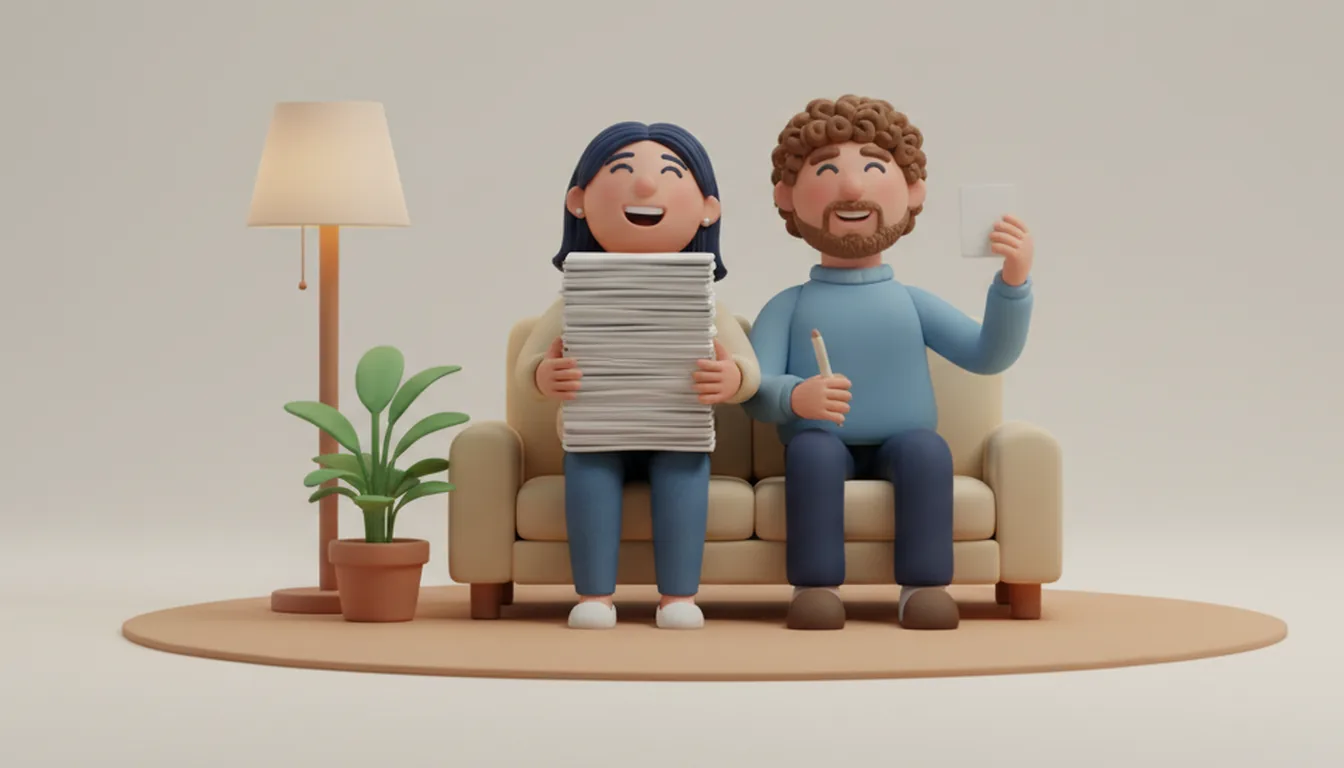
An example: three weeks before the wedding, Ada had four pages of vows and Sam had one sentence. They'd agreed not to read each other's words, so one evening they sat on the sofa and held them up. Ada lifted her stack with both hands. "I can't cut any of it," she said. Sam raised a small card and the pencil he'd been chewing for a week. "I've rewritten this line about forty times." They both laughed. Then they made a deal: one minute each, one story each, three promises each, and no peeking until the day. Ada got her four pages down to one. Sam's single sentence grew into six. At the ceremony Ada ended with a promise to always leave him the last bite of cake, and Sam looked up at her for his last line.
What goes into a vow
A vow is spoken to one person, in front of everyone else. That makes it different from a wedding speech, which is spoken to the room. If you're also giving one of those later, our best man speech guide covers it. Brides and couples who speak at the reception can use our bride speech guide. For the vow itself, you need four pieces.
- An opening. Say their name and where you are. "Sam, standing here with you feels like the easiest thing I've ever done."
- One story. A small moment that shows why it's them. The night they drove across town with soup, the way they laugh at their own jokes before the punchline. Keep it under thirty seconds.
- Promises. Three or four, some serious and some small. The small ones are the ones guests remember.
- A close. One line that sums it up and hands the moment back to the two of you.
Leave out anything only one or two guests would understand. A vow works best when your grandmother and your newest friend both get every word.
Traditional wedding vows
Plenty of couples skip writing and say the classic words, or say both. The best-known version grew out of the Church of England's Book of Common Prayer, and today it often goes like this:
> I, Ada, take you, Sam, to be my husband, to have and to hold from this day forward, for better, for worse, for richer, for poorer, in sickness and in health, to love and to cherish, till death do us part.
Each of you says it in turn, with your own names, and "husband," "wife" or "partner" as it fits. Most couples repeat it a few words at a time after the officiant, so nobody has to memorize it. The rules on wording differ from place to place. In England and Wales, for example, a civil ceremony must include set legal words, and you can add your own around them. Ask your registrar or officiant early.
Couples who like the shape but want it to sound more like them often change it a little:
- Say "I choose you" in place of "I take you."
- Keep the classic words, then add one line of your own, like a small promise or the name of the street where you met.
- Take turns line by line, so the vow sounds like a conversation.
- Write your own vows and close with "from this day forward."
Length, and who says them first
One minute each is a good target. Two minutes is long for a partner who is trying not to cry. Agree on a rough word count together, so one of you doesn't read a page while the other reads a line. You don't have to share the words, only the length.
In many ceremonies the groom goes first, though there's no fixed rule. Couples often decide together, toss a coin or let the officiant choose. Some like the more nervous partner to go first, so they can relax and listen.
How to start your vows
The first line is the hardest to write, so borrow a shape and fill it with your own details.
- "Ada, I've known for a long time that I wanted to say this in front of everyone."
- "The first time I saw you, you were arguing with a parking meter, and you won."
- "I've tried to write this a hundred times, and every version starts with your name."
- "Before I make any promises, I want to tell you what you've already given me."
If you're stuck, write down where you were when you knew. That sentence is often your opening.
Promises that sound like real life
Big promises carry weight, and small ones make people smile. A mix of both sounds like a real couple. A few to bend:
- "I promise to tell you the truth, even when it's awkward."
- "I promise to be on your side, especially in rooms where you're not."
- "I promise to keep learning how you like to be cared for, as you change."
- "I promise to always leave you the last bite of cake."
- "I promise to pretend I didn't hear you singing in the car."
- "I promise to make the coffee on mornings you'd rather not talk."
Choose promises you can keep on an ordinary Tuesday. A promise to "never argue" won't last a month, while "I promise to come back to the table after we argue" is one you can keep. If you'd like ideas about what a first year together asks of people, our advice for newlyweds gathers what other couples learned. Years from now, friends writing anniversary wishes for a couple may quote one of your small promises back at you.
How to end your vows
The last line should be short and easy to say with a shaky voice.
- "I choose you today, and every day after."
- "Whatever comes next, I want to meet it with you."
- "You're my favorite person, and now you're my family."
- "That's everything. Except the cake. You'll get the cake."
Pause after it. Let the moment sit for a breath before the officiant moves on.
Saying them out loud
Words that look fine on paper can trip you up when you say them. Read your vows aloud at least five times in the week before, standing up, at the speed you'd use for a nervous friend.
- Copy them onto a small card in large print. A card is easier to hold than a phone and won't light up with messages.
- Mark two or three places to breathe.
- Look up at your partner for the first line and the last one.
- If your voice shakes or you start to cry, stop, breathe and smile. Everyone will wait.
- Give the card to the officiant or a friend before the ceremony, so it isn't lost in a pocket.
The page writer, the one who freezes and the joker
Many people fall into one of three camps. The page writer has too much to say and has to cut, which hurts. The one who freezes stares at a blank card for weeks and needs a shape to fill. The joker turns every line into a laugh and needs one sentence that's plainly sincere. Personality shapes which camp you're in. Here are eight of the 16 types:
- Vitalizer writes warmly and fast, often pages of it. Keep the warmth and cut to the moments that sound most like the two of you.
- Analyst weighs every word and may freeze for weeks. Write one true story first, then add three precise promises.
- Mentor feels things deeply and finds words for them easily, so the first draft usually runs longest.
- Inspector finishes early and may sound a little formal. Add one small, funny promise to soften it.
- Dreamer writes in images and moods. Ground at least one line in something real that happened.
- Diplomat is the natural joker. Two laughs are plenty, and the last line should be plain and serious.
- Guardian speaks about loyalty, and their promises sound like they'll be kept. Let a little humor in.
- Craftsman prefers few words. Six honest lines about what you'll do for each other say plenty.
Ada is a Mentor, which explains the four pages.
Six lines on a small card
After the wedding, Sam kept his card in his wallet, and Ada kept her one page in a drawer. One rainy Sunday she read his six lines again and wondered how two people could go about the same task so differently.
See why your vows and your partner's look so different
Four pages from one partner and six lines from the other is a common pattern, and type explains a lot of it. Start with the free couples compatibility test. Afterward, slip your partner the link from your result. Once your partner has answered, you both see where you understand each other easily and where your words might get misread.
Questions people ask
What is a marriage vow?
A promise two people make to each other when they marry, spoken during the ceremony. It can be the officiant's standard words or words you write yourselves.
What are the traditional wedding vows?
The best-known version is "I take you to be my husband (or wife), to have and to hold from this day forward, for better, for worse, for richer, for poorer, in sickness and in health, to love and to cherish, till death do us part." Each partner says it in turn, usually after the officiant. Many couples keep these words and add one line of their own.
Do you have to write your own vows?
No. Many couples repeat words the officiant gives them, and some add a few lines of their own at the end. Couples who skip it the first time often write their own years later for a vow renewal.
Should you share your vows with your partner before the wedding?
Many couples keep the words a surprise but agree on the length and the tone, so the two vows sound like a pair.
Can you read your vows from your phone?
You can, though a card is safer. A phone can lock, run low or light up with a message at the worst moment.
How do you write vows if you're not a writer?
Talk instead. Record yourself telling a friend why you love your partner, then copy down the best sentences and trim them to a minute.
How do you make your vows romantic?
Be specific. A romantic vow names something only your partner does, like humming while they cook or saving you the window seat, and says what it means to you. Details like that make original marriage vows feel personal, and they make a more beautiful vow than any big word. Add one promise about the life you're building, and read it slowly.
Sources
- Wikipedia, "Marriage vows": the Book of Common Prayer wording, and the declaration and contracting words a civil wedding in England and Wales must include under the Marriage Act 1949.
Written by Virko Kask, founder of Typeza
Written with the help of AI tools.
One question for two, every week
A question to ask your partner, friend or family, and how different types tend to answer it.
Free. Unsubscribe any time.