
Wedding officiant script: what to say when you lead a friend's wedding
A wedding officiant script is everything the person leading the ceremony says, from the welcome to the moment they present the married couple. A civil ceremony usually takes twenty to thirty minutes and follows a simple order: a welcome, a few words about the couple, the question, the vows, the rings, the pronouncement, the kiss and the send-off. Write it with the couple, keep your own part short and build the middle around something true about these two people.
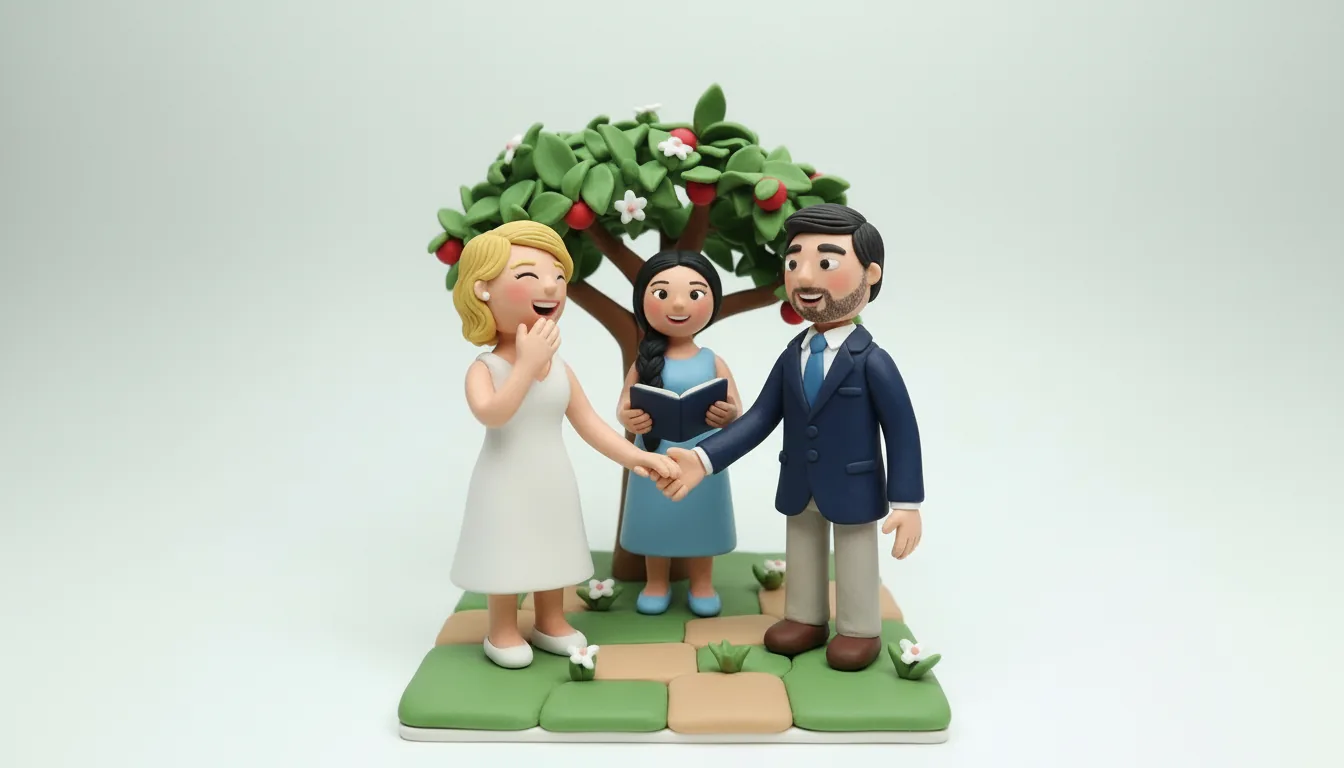
An example: Priya wrote her script at her friends' kitchen table. Before she wrote a word, she asked Nina and Tomas the same three questions, separately. What do you rely on the other one for? What still surprises you about them? What do you argue about that you secretly enjoy? Their answers didn't match at all. Nina said Tomas plans every trip down to the train times. Tomas said Nina is the reason the trips are any fun once they get there. Priya put the two answers side by side in the middle of the script and read them out in the garden, under the old apple tree. Her first line was: "Eleven years ago I dragged Nina to a pottery class where Tomas was the only person who could center the clay, and today they've asked me to marry them. I'm told that's the usual reward."
The order of a civil wedding ceremony
Many civil ceremonies run in this order, give or take a step.
- The entrance. Guests sit, music plays and the couple walk in. You're already at the front.
- The welcome. Two or three sentences to greet everyone.
- The couple's story. A short talk about the two of them, usually two to four minutes.
- A reading, if they want one. A friend or relative reads a poem or a short passage.
- The question. You ask each partner whether they come freely to marry the other, and each answers "I do."
- The vows. Their own words, or lines they repeat after you.
- The rings. One line from you and a short promise from each of them.
- The pronouncement. You declare them married.
- The kiss and the send-off. You present the couple to the guests and they walk out together.
Ask the couple to check what their local rules ask for, since some places need certain words or signatures for the marriage to be legal. Who may lead a legal wedding also differs from place to place, so check early whether a friend can do it. For couples who are already married, a vow renewal has a looser shape of its own.
The couple's story, built from how they differ
This is the heart of the ceremony, so spend most of your time here. Talk to each partner alone and ask both the same questions:
- What do you lean on the other one for?
- What did you notice about them early on that's still true?
- What do the two of you do differently, and how do you make it work?
Then lay the answers side by side. The places where they don't match are usually your best material, because they show what each partner brings that the other one lacks. One plans and one improvises. One talks a problem through out loud, and the other needs a long walk first. Pick one or two of those differences, tell each as a small scene with a time and a place, and close on what the two of them make together.
Two to four minutes is about 300 to 500 words. Leave out past partners, private jokes that need explaining and anything the couple would wince to hear in front of a grandparent. If you're also speaking at the reception, save your funniest story for later. Our guide to wedding speeches covers that part of the evening.
The question, the vows and the pronouncement
The question is short and a little formal, because it's where the ceremony turns from talk into promise. "Nina, do you come here freely to marry Tomas, and to share your life with him?"
If the couple wrote their own vows, you only introduce them and keep a spare copy in your folder. Couples still stuck on the first line can find help in how to write wedding vows. If they'd rather repeat after you, break the vow into short pieces they can say without running out of breath:
- "I choose you as my partner in life."
- "I promise to listen, to tell you the truth and to stay."
- "I'll laugh with you on the good days and hold your hand on the hard ones."
Say the pronouncement slowly, since everyone has been waiting for it: "By the promises you've just made, you are now married. You may kiss." Then step to the side, so the kiss belongs to the two of them in every photo. Ask beforehand how they'd like to be introduced afterward, by first names, a shared last name or two names.
A full sample script you can adapt
With vows and a reading, it runs about fifteen minutes.
Welcome. "Good afternoon, and welcome. I'm Priya, and I'm honored to stand here with Nina and Tomas today. Thank you for coming, some of you from next door and some from the other side of the world. For the next twenty minutes, please leave your phones in your pockets. Nina and Tomas would much rather see your faces."
The couple's story. "When I asked Tomas what he relies on Nina for, he said, 'She makes everything worth doing.' Nina said, 'He makes sure we actually do it.' Tomas books the train two months ahead. Nina gets off one stop early because the station looked pretty. Somehow they always arrive, and they always come home with a story. One of them watches the road and the other watches the view, and a good trip needs both."
The question. "Nina, do you come here freely to marry Tomas?" "I do." "Tomas, do you come here freely to marry Nina?" "I do."
The vows. "Nina and Tomas have written their own promises. Tomas, whenever you're ready."
The rings. "Please exchange your rings as a sign of the promises you've just made."
The pronouncement. "Nina and Tomas, you've made your promises in front of everyone who loves you. I'm delighted to declare you married. You may kiss."
The send-off. "Friends and family, for the first time as a married couple, Nina and Tomas!"
Short, funny or somewhere in between
For a ten-minute ceremony, keep the welcome, the question and the pronouncement, cut the story to one scene and skip the reading. A funny script still needs one plainly sincere moment, usually right before the vows. Two or three light lines in the story part are plenty, and they should poke fun at situations, never at a person:
- "Tomas proposed with a printed itinerary. Nina said yes and then changed the itinerary."
- "They agree on everything that matters, except where the thermostat belongs."
On the day: delivering it well
- Print the script in large type and keep it in a plain folder you can hold in one hand.
- Read it aloud at least three times, once with the couple at the rehearsal, which often comes the evening of the rehearsal dinner.
- Mark your cues on the page, such as when guests sit and when the reader comes up.
- Speak more slowly than feels natural, and look up at the guests at the end of each part.
Which friend should lead your ceremony
If you're the couple choosing an officiant, think about the job first: speaking calmly to a crowd, keeping time and writing about you with warmth. Here are eight of the 16 types:
- Ideator writes the most original script you'll hear. Ask to see a draft a month ahead.
- Vitalizer has the guests laughing in the first minute. Agree on a time limit.
- Mentor tells your story in a way that moves everyone, and may need a pause to steady their voice.
- Inspector knows every cue a month early. Ask for one warm scene in the first draft.
- Diplomat stays relaxed when a reader is late or the music starts at the wrong moment.
- Guardian speaks about loyalty and promises in a way people believe.
- Counselor is at their best at a small ceremony, where a quiet voice can fill the space.
- Craftsman keeps it short and steady and never wastes a word.
Priya is a Mentor. She made it to the vows before her voice wobbled, which Nina calls a personal record. For the other jobs friends take on at a wedding, see wedding party roles.
Give the couple's story something true to stand on
The best story part comes from knowing how two people fit together. Typeza names the relationship type two people form, what flows easily between the two of them and what they tend to see differently. If you're the couple, one of you can start the free couples compatibility test and later hand the other the invite from the result page. If you're officiating, pass the link to the couple and use what their result says when you write the middle of the script.
Questions people ask
What does an officiant say at a wedding?
The officiant welcomes the guests and says a few words about the couple. Then they ask each partner whether they come freely to marry, lead the vows, declare the couple married and present them to the guests.
How long should an officiant speech be?
The officiant's own talk about the couple usually runs two to four minutes. The whole ceremony, with vows and a reading, typically takes twenty to thirty minutes.
How do you start a wedding ceremony as an officiant?
Welcome the guests, introduce yourself with a line on how you met the couple, and thank everyone for coming. Then say in one sentence why you're all there.
What is an officiant?
The person who leads a wedding ceremony. It can be a close friend, a relative or a professional celebrant, where local law allows it.
Sources
- Wikipedia, "Marriage officiant": who may be an officiant, and what they must do, varies from one jurisdiction to another.
Written by Virko Kask, founder of Typeza
Written with the help of AI tools.
One question for two, every week
A question to ask your partner, friend or family, and how different types tend to answer it.
Free. Unsubscribe any time.