
Wedding MC: what the master of ceremonies does, says and when
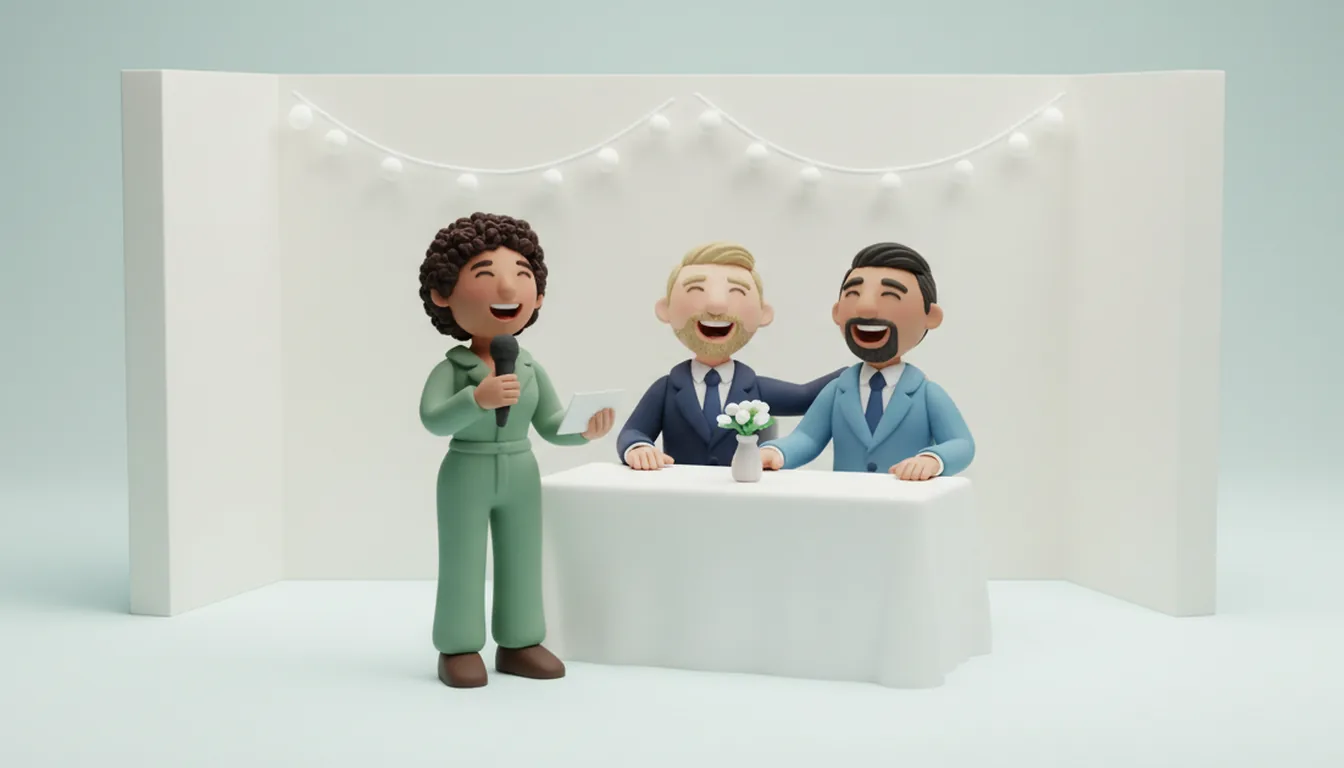
A wedding MC, short for master of ceremonies, is the host of the reception. The MC welcomes the guests, announces the couple, introduces each speaker in the order the couple chose, tells everyone what happens next and keeps the evening close to its timeline. It's usually a friend or relative who's at ease with a microphone. A good MC speaks often but briefly, and makes sure the couple never has to think about the schedule.
An example: forty minutes before the speeches, the kitchen told Bea that dinner would be half an hour late. Bea was the MC at Joel and Arjun's wedding, so the news came to her and not to them. She looked at her cards, one for each speaker, and moved the speech by Arjun's sister, Anjali, from after dinner to right now. She tapped Anjali on the shoulder, gave her ninety seconds' warning and picked up the microphone. "I have good news and better news," she said. "The good news is that dinner is worth the wait. The better news is that you get to hear from Anjali first."
Anjali's speech went well. Dinner came out as she sat down, and as far as the guests could tell, that had been the plan all along. Joel and Arjun laughed through it at the table behind Bea. They found out about the kitchen the next morning, when Bea told them over breakfast.
What a wedding MC does, from start to finish
The job starts a few weeks before the wedding and ends when the last guest leaves.
Before the day:
- Sit down with the couple and go through the order of the evening, the speakers and anything they'd rather skip.
- Get the timeline from whoever keeps it. Our wedding day timeline shows what a usual one looks like.
- Learn how to say every speaker's name, and ask the couple how they'd like to be announced.
- Ask each speaker how long they'll talk, and agree on a small signal for their last minute.
On the day:
- Test the microphone before the guests arrive.
- Welcome everyone and give the few notes they need.
- Announce the couple's entrance.
- Introduce each speaker, and thank each one afterward.
- Call the first dance, the cake and any games.
- Watch the time, and talk to the kitchen and whoever runs the music when the plan moves.
- Close the evening and gather the guests for the send-off.
The order of the speeches is the couple's choice, and our guide to wedding speeches covers the usual lineup. Games work the same way. The MC announces them, and wedding reception games has ideas to pick from.
MC, officiant or best man: three different jobs
People mix these up, because at a small wedding one friend may do two of them.
- The officiant leads the ceremony and marries the couple, from the welcome to the kiss. Our wedding officiant script covers what they say. The MC takes over when the ceremony ends.
- The best man and maid of honor each give one speech about a person they know well. The best man speech and maid of honor speech guides help them write it. The MC introduces them and leaves their stories to them.
- The MC speaks ten or fifteen times in an evening, half a minute at a time, and says very little about themselves.
If the best man is also the MC, ask someone else to introduce his speech. Announcing yourself is awkward for everyone.
What the MC says, moment by moment
Say the line, hand over the moment and step back. These work as written, or as a start for your own.
- The welcome. "Good evening, everyone, and welcome. I'm Bea, Joel's friend since our first week of college, and I'm your MC tonight. My job is to keep things moving so you can enjoy yourselves."
- Notes for the guests. "Dinner starts in about ten minutes. Your table is on the card with your name, and the photo corner is by the big window."
- The entrance. "Please stand and welcome the newly married Joel and Arjun!"
- Before the speeches. "We have three speeches tonight. All of them short, I've been promised."
- After a speech that moved the room. "Take a breath, everyone. I needed one too."
- The first dance. "Joel and Arjun would like the floor to themselves for one dance. After that, it's yours."
- The send-off. "It's nearly time to say goodbye to the couple. Please head outside and make two lines by the door."
A little humor helps, as long as it's about the evening and never at someone's expense. A line like "I've been asked to remind you that the dance floor isn't a spectator sport" works fine. A joke about the couple's past doesn't.
How to introduce a speaker
An introduction answers one question for the guests: who is this, and why are they speaking? Two or three sentences are enough.
- Say their name clearly.
- Say who they are to the couple.
- Add one small, kind detail, if you have one.
- Hand over with "Please welcome..."
A few that work:
- "Our first speaker has known Arjun longer than anyone in this room, because she's his big sister. Please welcome Anjali."
- "Next is Tom, who shared an apartment with Joel for three years and still has a spare key. Tom, over to you."
Don't tell the story the speaker is about to tell. Don't add a joke at their expense, either.
Keeping time without being the bad guy
Time is the MC's real job, and the trick is to sort it out before anyone runs over.
- Ask every speaker how long they'll talk a week before, and plan for a minute more.
- Sit where the speakers can see you. A small nod at the agreed time is usually enough.
- Keep the gaps short. Thirty seconds between speakers keeps the room with you, and two minutes of shuffling loses it.
- If a speech runs well over, stand up and move a few steps closer. Many speakers wrap up when they see you.
- If they don't, wait for a pause and say something warm, like "That's a lovely place to stop. Thank you, Tom."
When the evening starts late
Something runs late at many weddings. Guests only need to know two things: that something is happening, and roughly when.
- The couple is still out with photos. "Joel and Arjun are on their way, about ten minutes. Perfect time to find your seats."
- The kitchen is behind. Move something forward, as Bea did: a speech, a game or the photo corner. "We're switching things around a little, so you'll hear the first speech before dinner."
- A speaker can't be found. Call the next one and say nothing about the gap. The missing speaker can go later.
- The microphone stops working. Speak up without it, keep it short and wait for the room to go quiet before you start.
Never say on the microphone whose fault a delay is. Tell the couple about it later, or not at all.
Which friend makes a good MC
Look for someone who enjoys a room, thinks fast when the plan changes and is happy to make the evening about other people. Some couples choose two MCs, one from each side, so guests from both families feel looked after. Below are eight of the 16 types and how each one tends to handle the job, in types page order.
- Vitalizer warms up a room with the first sentence and notices the table that hasn't laughed yet. Give them the welcome.
- Mentor makes every speaker sound like the most important person in the room.
- Commander has no trouble getting a hundred guests back to their seats. Tell them which parts of the plan can bend and which can't, and they'll make the calls.
- Diplomat reads the room, charms the quiet tables and knows when to cut a game short or let the dancing run on.
- Strategist would rather not hold the microphone. Ask them to keep the timeline and stand near the MC instead.
- Entrepreneur keeps the evening on time and can rearrange the order in a minute when the kitchen falls behind. Bea is one.
- Organizer knows the running order by heart and starts each part when it should start. Their lines can sound formal, so pair them with a looser co-host.
- Encourager already knows half the guests and makes the other half feel like old friends. Agree on a time limit for the welcome.
Know the friend you hand the microphone to
An MC reads the room for you, so you need to trust how they'll do it. Typeza shows the relationship type between you and a friend, including the parts that feel easy when you're together and the places where you see things another way. Try the free friendship compatibility test, then send the link to the friend you're thinking of asking.
Questions people ask
What does an MC do at a wedding?
The MC hosts the reception. They welcome the guests, announce the couple, introduce the speakers, call the first dance and other moments, and keep the evening on time.
What is the difference between an MC and an officiant?
The officiant leads the ceremony and marries the couple. The MC hosts the reception afterward. One person can do both, but they're two separate jobs.
Who should be the MC at a wedding?
A friend or relative who's comfortable in front of a crowd, stays calm when plans change and knows people on both sides. Many couples pick someone who isn't already giving a speech.
Does the MC give a speech?
Usually not. The MC speaks many times but briefly, and leaves the speeches to the people the couple asked. A short welcome at the start and a thank you at the end are enough.
Is it MC or emcee?
Both are right. MC stands for master of ceremonies, and emcee is the same word spelled the way it sounds. The spelling emcee dates from the 1930s.
Sources
- Dictionary.com, "emcee": master of ceremonies, a spelling of the abbreviation MC first recorded in the 1930s.
Written by Virko Kask, founder of Typeza
Written with the help of AI tools.
One question for two, every week
A question to ask your partner, friend or family, and how different types tend to answer it.
Free. Unsubscribe any time.