
Wedding reception games and things to do for every guest
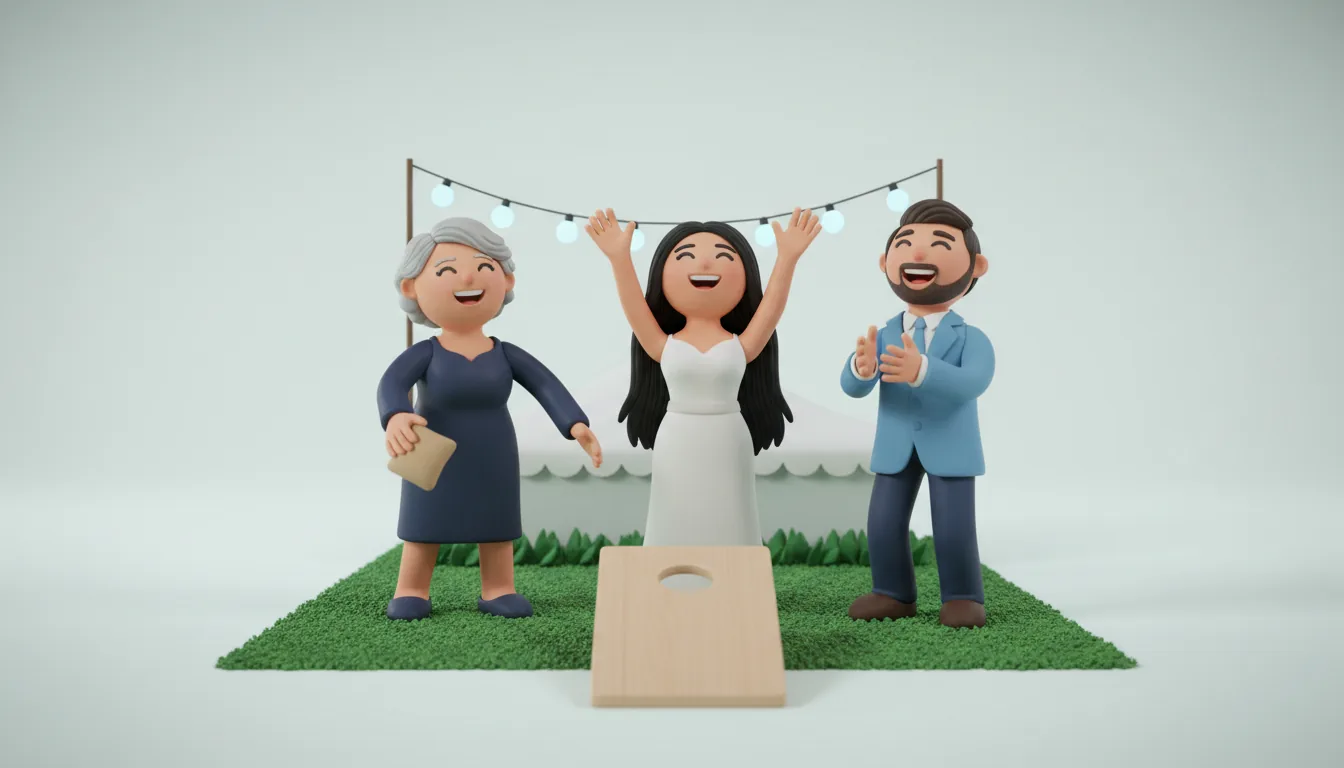
The best wedding reception games are short, easy to join and fit around the meal and the dancing. Guest bingo works while everyone waits for the couple, table quizzes work during dinner, an anniversary dance fills the floor, and lawn games like beanbag toss suit an outdoor reception. Two or three games are enough for many weddings. Choose ones a guest can join for five minutes and walk away from, and leave room for people who'd rather watch.
An example: at the start of Hana and Dev's lawn reception, Dev's aunt Pat told everyone she doesn't do games. She said it twice, once to Hana and once to the photographer. Then, while the dancing got going under the lights, she wandered over to the beanbag toss to keep Dev's college friends company. Somebody handed her a bag. She tossed it underhand, it dropped straight through the hole, and she looked as surprised as anyone. Forty minutes later Pat was still there with a beanbag in each hand, and she had beaten every one of Dev's friends at least once. At the end of the night Pat asked where they'd found the board, because she wanted one for her own backyard.
Where games fit in the evening
Many receptions follow roughly this order:
- Guests arrive and mingle while the couple has photos taken.
- The couple makes an entrance.
- The meal.
- Speeches, often between courses. Our guide to wedding speeches covers who speaks and for how long.
- The first dance, and sometimes a dance with each parent.
- Cutting the cake.
- Open dancing.
- The send-off.
Games work best in the gaps. That means the wait for the couple, the time between courses and the edge of the dance floor, where the guests who aren't dancing end up. Keep them away from the speeches and the first dance, when every eye should be on the two of you.
Games while guests wait for the couple
The hour after the ceremony is when guests know the fewest people. A light game gives them a reason to talk.
- Guest bingo. Each guest gets a card with squares like "traveled more than five hours," "met the couple before they met each other" and "shares a birthday month with one of them." They find someone who fits each square and get that person's initials.
- Guess the year. Hang a line of photos of the couple through the years. Guests stick a note with their guess under each one, and the answers go up later.
- Where in the world. Show photos of places the couple has been together, and let guests guess where each one was taken.
Table games during the meal
Table games keep people talking with whoever they're seated next to, which matters when the seating mixes two families.
- The table quiz. Put a card of ten questions about the couple on each table. The table with the most right answers goes first to the cake.
- A story, one line each. Each table writes the couple's love story, one sentence per person, without reading the lines before. The MC reads the best one out after dessert.
- Table charades. One person at each table acts out a moment from the couple's life, and the rest guess what it is.
- The couple's visit. When the couple stops at a table, that table has to tell them one thing they don't know about someone sitting there.
The shoe game and other games for the couple
The shoe game is the classic one. The two of you sit on chairs facing away from each other, each holding one of your own shoes and one of your partner's. The MC asks questions like "Who's the better driver?" and you each raise the shoe of the person you mean. Guests laugh hardest when you disagree. For more questions to ask, see our newlywed game questions.
Two more that put the couple in the middle:
- How well do you know your guests? The MC reads out a fact about a guest, and the couple has to guess who it is.
- Finish the sentence. One partner starts a sentence about the other, like "The first thing I noticed was," and the other has to finish it the way they think it ends.
Games between dances
A short game every hour or so pulls people back to the floor.
- The anniversary dance. Every married or long-term couple comes onto the floor. The MC calls out lengths of time, like "If you've been together less than five years, please sit down," until one couple is left. They often share one piece of advice with the newlyweds.
- Freeze dance. When the music stops, everyone freezes. Anyone who moves sits out, and the last dancer standing wins.
- Family against family. Each side picks three dancers for a short, friendly dance-off, and the guests cheer for a winner.
Lawn games for an outdoor reception
If you have grass, lawn games give guests something to do at their own pace. Set them at the edge of the space, away from the speeches.
- Beanbag toss. Two boards with a hole and some beanbags. Anyone can play, in any shoes.
- Giant stacking blocks. Players take turns pulling one block from the tower until it falls.
- Croquet. Slow and chatty, and good for older guests.
- Bocce or lawn bowls. Teams roll balls toward a small target ball.
- Badminton. Easy to start, even in the dark if you hang lights near the net.
Things to do that aren't games
Some guests would rather not play anything. They still like having something to do.
- A photo corner. A plain backdrop, good light and a box of hats and frames.
- A date-night jar. Guests write an idea for a date the couple can pull out during their first year. If guests get stuck, put a few ideas from fun things to do together next to the jar.
- A map of home towns. Guests put a pin where they live or grew up.
- A live painter. Someone paints the evening as it happens, and guests stop by to watch.
- Comfortable chairs near the dance floor. Plenty of guests enjoy the evening most by watching it.
Guests who join in and guests who watch
Some guests head for every game they see. Others would rather sit with a plate of cake and cheer. Both are having a good time. Here are seven of the 16 types:
- Vitalizer is first at the beanbag board and first on the floor for the dance-off. They pull the shy cousins in with them.
- Commander turns any game into a tournament with a score. Hand them the croquet set and let them run it.
- Dreamer likes to watch from a chair close by. The date-night jar or the photo corner suits them better than a contest.
- Diplomat goes where the energy is and gets a slow game moving. A dance-off with a crowd watching is just right.
- Entrepreneur tries every game once and moves on. Quick games with no setup keep them happy.
- Guardian makes sure the older relatives have seats near the games, and plays when someone asks them by name.
- Craftsman says little and turns out to be very good at lawn games. Let them build the block tower.
Pat, it turns out, is a Craftsman. That probably explains the beanbags.
Find out what kind of pair you are
Typeza shows how the two of you get along, from what feels easy together to where small mix-ups keep happening. Take the free couples compatibility test together, maybe on a quiet evening after the wedding.
Questions people ask
What do you do at a wedding reception?
Guests eat, listen to the speeches, watch the first dance and the cake cutting, and dance. Games and things to do fill the gaps between them.
Do you need games at a wedding reception?
No. Many receptions have none. Games help most when guests don't know each other or there's a long wait for the couple.
How do you keep wedding games from feeling awkward?
Keep them short and optional, explain each one in a sentence and never pull up anyone who doesn't want to play.
Written by Virko Kask, founder of Typeza
Written with the help of AI tools.
One question for two, every week
A question to ask your partner, friend or family, and how different types tend to answer it.
Free. Unsubscribe any time.