
How to read body language with friends and your partner
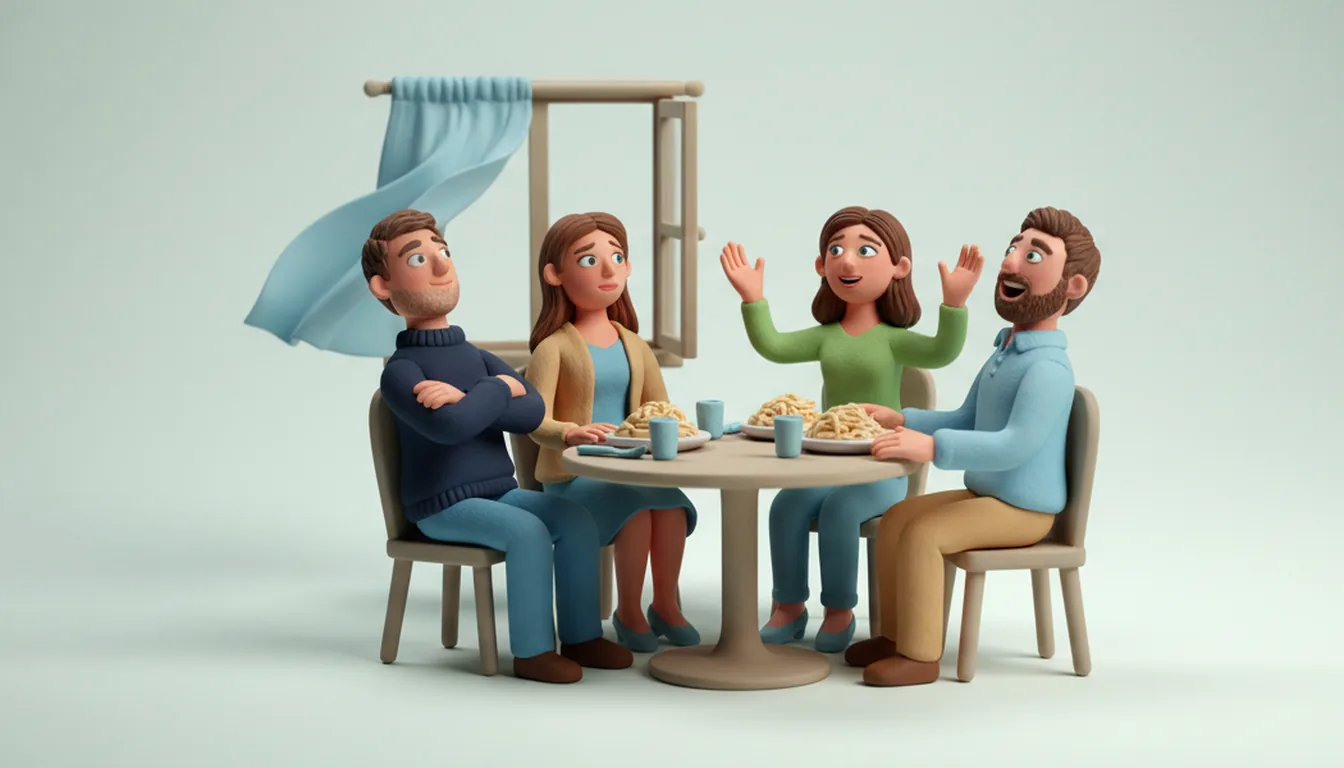
Reading body language means noticing what a person's face, posture, distance, touch and voice add to their words, and then checking your guess before you act on it. With friends and a partner you have one big advantage over strangers. You know how they usually look, so you can compare them with themselves.
An example: at Becca's dinner party, Lena kept glancing at her partner. Marco had been leaning back with his arms crossed for twenty minutes while Becca told the story of her disastrous kayak trip. Lena read it as boredom. Maybe annoyance, since he and Becca had argued about something silly the month before. On the walk home she asked, carefully, whether he'd had a bad time. Marco looked puzzled. "I was freezing. She had the window open all night."
Five things to watch
Much of what people show without words falls into five areas. Together they give you a decent picture.
Face
The face changes fastest. A real smile reaches the eyes and makes small creases at the corners. A polite smile stays on the mouth. Watch for a jaw that tightens, lips pressed together, or a look that slides away from yours at the moment a topic comes up.
Posture
Open body language means arms loose, shoulders relaxed and the body turned toward you. Closed body language is the opposite: arms folded, shoulders up, the body angled away. Leaning in usually shows interest. Leaning back can mean someone is relaxed, tired or, like Marco, cold.
Distance
People drift closer to those they feel at ease with. At a party, notice who stays near whom, and whose feet point toward the door. A friend who keeps an extra step of space tonight, when they usually stand close, may want some room.
Touch
Some people touch a lot, a hand on your arm, a hug hello and goodbye. Others barely touch at all. What matters is the change. A partner who usually reaches for your hand on the couch and stops doing it for a week is telling you something, even if it's only that their back hurts.
Voice
How something is said often tells you more than what's said. Listen for speed, pitch and volume. A friend who answers in short, flat sentences, or who goes much quieter than usual, is showing you more than the words "I'm fine."
Signs of ease and signs of strain
These are hints, never proof, but they're the ones worth noticing.
Signs someone is at ease:
- Their shoulders are low and their hands move freely.
- They lean in, laugh with their whole face and copy your posture without thinking.
- Their phone stays in a pocket or face down.
- They stay longer than they said they would.
Signs someone is uncomfortable:
- Short answers and a smile that stops at the mouth.
- Checking the time or the phone more than usual.
- Fidgeting, or going unusually still.
- The body turned away while the face stays polite.
Know their normal first
The most useful thing you can learn about a friend or partner is their baseline, the way they look on an ordinary good day. A friend who's always quiet isn't upset when she's quiet. A friend who never stops talking and suddenly goes silent is news.
With a partner, you've probably seen thousands of their faces already. You know the face they make when they're thinking and the one they make when they're hurt. Trust that history more than any general rule. A crossed arm on someone who always sits that way means nothing at all.
The same signal, different people
Part of why body language is so easy to misread is that people are built differently. A move that means "I'm upset" in one person means "I'm interested" in another. Personality type is part of it. Here are seven of the 16 types:
- Ideator: interrupts and jumps between topics when excited. It looks rude and usually means they love the conversation.
- Vitalizer: touches your arm, laughs out loud and shows every feeling on their face. If they suddenly go flat, something really is wrong.
- Analyst: folds their arms and looks into the distance while thinking hard about what you said. It can read as cold when they're paying close attention.
- Mentor: reacts with their whole face and both hands. Big gestures are normal for them and don't mean a crisis.
- Dreamer: may look away while listening and stay quiet even when moved. They usually feel a lot more than they show.
- Strategist: keeps a still face and few gestures, and can look stern while perfectly content.
- Craftsman: gets up mid-conversation to refill drinks or fix a wobbly chair. Busy hands are a sign they're comfortable.
These are tendencies, and every person is more than a type. Still, knowing that a quiet friend's crossed arms and a lively friend's interruptions can both be signs of interest saves a lot of worry.
Reading a friend in a group
Groups make reading harder, because everyone is reacting to everyone. A few things are worth a glance. Who hasn't said anything in a while? Who laughs a beat late, as if they missed the joke? Who keeps looking at the door, or at one person in particular?
When you spot someone on the edge, a small move helps. Turn toward them, ask them something easy, or make a little space in the circle. If you're the one who often feels stiff in a group and worries how you come across, socially awkward looks at that from the inside.
Don't over-read
It's easy to read too much into small things. Six common mistakes:
- Treating one signal as a message. Crossed arms alone mean almost nothing. Look for several changes at once.
- Forgetting the room. Cold, heat, noise, a bad chair and a long day all change how people sit and look.
- Reading your own mood into them. If you're worried, a neutral face looks angry. If you're happy, you miss the signs.
- Mixing up tired and bored. They look almost the same from across a table.
- Expecting everyone to show feelings the same way. Families, cultures and personalities differ in how much people touch, smile and look you in the eye.
- Arguing with a face. Telling your partner "your face says you're angry" when they say they're not rarely ends well.
Ask instead of guess
The simplest way to read someone you love is to ask. A light question, said kindly, works better than an hour of silent guessing.
- "You've gone quiet. Tired, or is something on your mind?"
- "I can't read you tonight. How are you doing?"
- "Was that joke okay? You looked a bit thrown."
- "Do you want to head home soon?"
- "You seem far away. Want to talk later?"
Then really listen to the answer, even if it surprises you. Being a better listener is a skill of its own, and that guide covers hearing what someone means and what to say while they talk.
Learn how you and your partner read each other
How much a person moves when relaxed, and what they read into someone else's stillness, both depend partly on type. The free couples compatibility test gives you your own type. Your result carries a link to send your partner, who takes the same test. With their answers in, your relationship type shows which signals you read without effort and which ones each of you tends to misread.
Questions people ask
What is open body language?
Arms loose, shoulders relaxed, the body turned toward the other person and a face that reacts to what's said. It usually signals that someone is comfortable and interested.
Can you learn to read body language?
Yes. Many people get better simply by paying attention to the people they see often and noticing when something changes. Asking a light question when you're unsure helps you learn faster.
Are crossed arms always a bad sign?
No. People cross their arms when they're cold, tired, thinking or just comfortable that way. Look for other changes before you decide what it means.
Sources
- Wikipedia, Smile: a felt (Duchenne) smile also raises the cheeks and creases the skin around the eyes, while a polite smile moves only the mouth.
Written by Virko Kask, founder of Typeza
Written with the help of AI tools.
One question for two, every week
A question to ask your partner, friend or family, and how different types tend to answer it.
Free. Unsubscribe any time.