
Keep your friends close and your enemies closer: what it really means
The saying tells you to stay near the people who might work against you, so that you know what they think and what they plan. You keep friends close because you trust them, and rivals even closer because you don't. In everyday life, a gentler version helps more. The closer you get to someone you clash with, the better you understand why you clash.
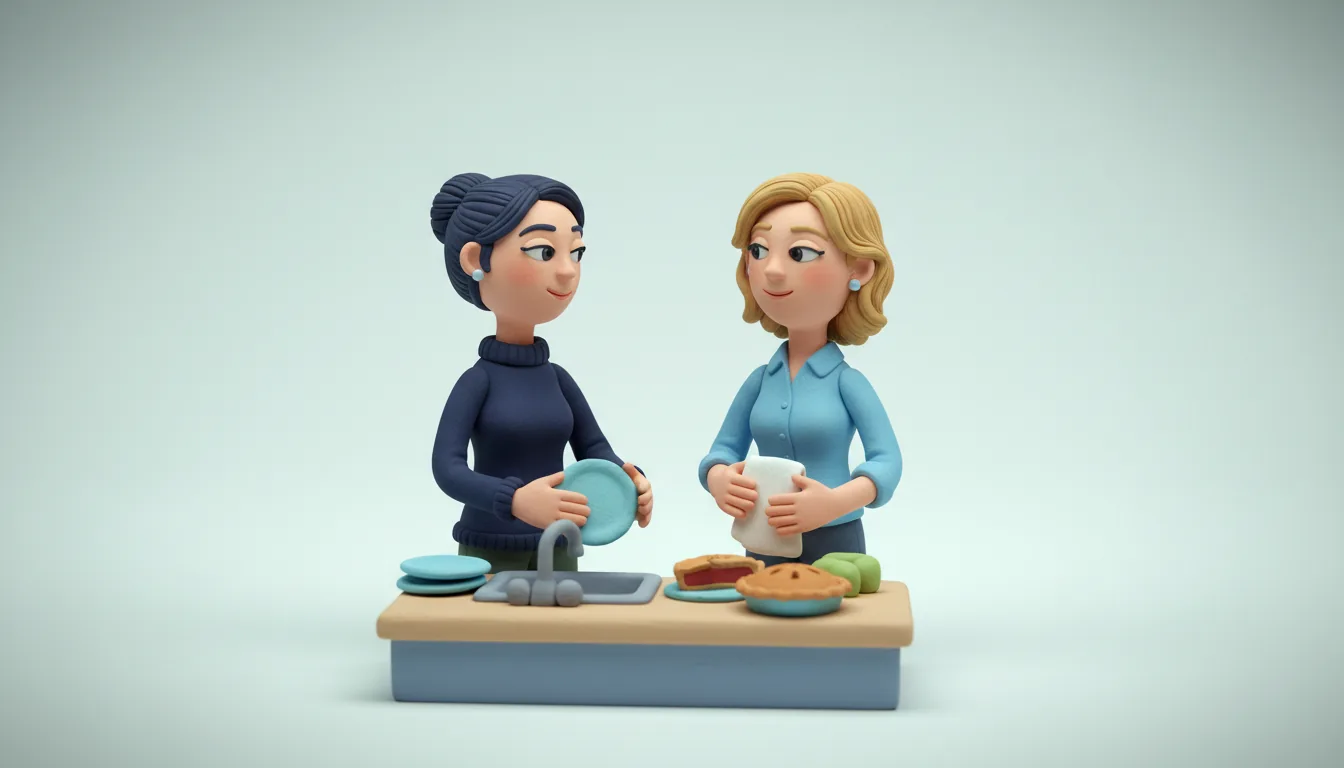
An example: Priya and her brother's wife, Celeste, have never liked each other. For years they have sat at opposite ends of every holiday table, polite in the way that makes everyone else nervous. At one Thanksgiving dinner, Priya's grandmother leans over and whispers, "Keep your friends close and your enemies closer." She means it as a joke. Priya takes her at her word and sits right next to Celeste, mostly to keep an eye on her. By the time the pie comes out, she has learned that Celeste grew up in a house where nobody spoke at dinner, that a table of fourteen loud relatives frightens her, and that the silences Priya read as coldness were mostly nerves. At the end of the night the two of them do the dishes together.
What does "keep your friends close and your enemies closer" mean?
At its plainest, the saying is advice about surprises. A rival you can see can't catch you off guard. If you know what someone wants and how they feel about you, nothing they do will come out of nowhere.
There's a second layer. A person who sits at your table, laughs at your jokes and feels included has fewer reasons to turn against you, so being close can take the edge off a feud before it grows.
People often say the phrase with a smile, more than as a real plan. You'll hear a few versions, such as "keep your friends close but your enemies closer" and "keep your friends close but your enemies even closer," and they all mean the same thing. In a sentence:
- "She invited her ex to the barbecue? Keep your friends close and your enemies closer, I suppose."
- "My aunt always asks her sister-in-law to help in the kitchen. She calls it keeping her enemies closer."
Who said "keep your friends close" first?
Two famous names usually get the credit: Sun Tzu, the ancient Chinese general who wrote The Art of War, and Machiavelli, the Italian writer from the 1500s. No source from before 1974 has been found for either. The exact line people quote today became famous through The Godfather Part II in 1974, where a mafia boss says his father taught him to keep his friends close and his enemies closer. From the film it moved into everyday speech.
Is it good advice?
It depends on what "closer" means to you.
It helps when you can't avoid the person anyway. Your brother married her, or he has been in your friend group since college. Staying near them means fewer surprises, and time spent side by side often softens a feud that distance would keep sharp.
It goes wrong when closer turns into watching. If you sit next to someone only to catch them out, you'll spend every holiday reading each sentence for an insult, and you will find a few, because anyone looks worse under a microscope.
If someone keeps hurting you on purpose, the saying stops being useful. Distance is the wiser choice with a person like that.
Get closer to understand them
Watching a person means collecting evidence. Understanding them means asking why they act the way they do. The first keeps you on guard, while the second can slowly change how the two of you feel about each other.
Priya had a list of things Celeste did wrong: she left early, she barely spoke, she never asked about anyone's kids. Three hours side by side turned that list into a picture of a shy person in a loud family, trying hard not to say the wrong thing. Celeste hadn't changed at all that evening, but the way Priya saw her had.
A few habits help "closer" mean understanding:
- Ask one real question about their life, and listen to the whole answer.
- Watch how they act with the people they're comfortable with, since that is usually closer to who they are.
- Find one thing they care about, even if it bores you.
- Give them the benefit of the doubt once, and see what happens.
You don't have to end up liking them. Knowing why someone acts the way they do often takes the sting out of what they do.
When the rival sits in your own friend group
Friend groups have their own quiet feuds. There's your best friend's new partner who seems to dislike you on sight, and the old friend who turns every story into a contest about whose holiday was better. There's the ex who stayed in the group after the breakup, so now you both come to every birthday.
Leaving the group over one person is rarely worth it. Being close here can mean sitting at the same end of the table and asking about their weekend. Some friend-group rivals are really competing for the same thing, often the attention of one person they both love. And some people are lovely one moment and sharp-elbowed the next, which is the frenemy, a kind of friend all of its own.
When the person you clash with is family
You can step back from a friend group. Family keeps coming back every holiday, wedding and birthday. The sister-in-law, the cousin who always has to win, the stepdad who comments on everything will be at the table again next year, and so will you.
Family gatherings also come with an audience, and two people who clash will often act it out for the room. Getting closer works best away from the crowd. A drive to pick up the food, a shared job in the kitchen or a short walk after lunch gives two people a chance to talk without anyone watching.
Why some people get under your skin
Some "enemies" are simply people who work differently from you. Typeza sees personality type as part of this. Six of the 16 types often get misread like this:
- Analyst: points out the flaw in your argument because it's there. It can sound cold or superior, though they are only trying to be accurate.
- Inspector: notices what wasn't done properly and says so. A relaxed relative hears criticism, while the Inspector simply cares about doing things right.
- Commander: blunt, fast and used to taking charge. People feel run over, even when the Commander only wanted the problem solved.
- Strategist: asks the skeptical question nobody else wanted to ask. It sounds dismissive, but they are testing the idea for holes.
- Entrepreneur: treats long talks about feelings as a delay. Others take it as not caring about them.
- Guardian: holds firm views about right and wrong and takes time to trust. A new in-law can feel judged and shut out for years.
Some pairs of people also rub each other the wrong way by design. In Typeza, any two types form one of 16 relationship types, and in a Conflict relationship the two people differ on every base trait. Each tends to press on the other's softest spot. Pairs like that often get on better with a little distance, which turns the old saying on its head.
How to keep the peace with someone you can't avoid
- Share a task. Doing the dishes, running the grill or picking up a grandparent gives you something to do besides judge each other.
- Ask about what they love. Many people soften when they get to talk about their garden, their team or their dog.
- Keep hard talks one-on-one. An audience makes everyone defend their position.
- Agree on the topics you'll skip. You don't need to settle every old argument.
- Plan a way out. A short visit that ends well beats a long one that ends badly.
- Give it time. Feuds built over years rarely melt in one evening.
See where the friction comes from
The person you clash with may just be a different type, and knowing both types can take some of the sting out of it. The friendship compatibility test is free and shows your own strengths and weak spots. If you feel brave, send your result's link to the rival at your table. Once the rival finishes, a relationship type page opens for the two of you, with notes on where you fit and where a clash is likely.
Questions people ask
Is "keep your friends close" from The Art of War?
No source shows it there. People often credit Sun Tzu's book, and also Machiavelli, but the line became famous through The Godfather Part II.
What does "keep your friends close" mean on its own?
It means looking after the people you trust. Stay in touch, show up for them and don't let good friendships drift.
Sources
- Wikiquote, "The Godfather Part II". The line spoken by Michael Corleone in the 1974 film, and the note that no published source from before the film has been found for the Sun Tzu or Machiavelli credit.
Written by Virko Kask, founder of Typeza
Written with the help of AI tools.
One question for two, every week
A question to ask your partner, friend or family, and how different types tend to answer it.
Free. Unsubscribe any time.