
One hand washes the other: give and take between friends
"One hand washes the other" means that people do better when they help each other: you help me, I help you, and we both come out ahead. Try washing one hand on its own. It never gets properly clean until the other hand joins in.
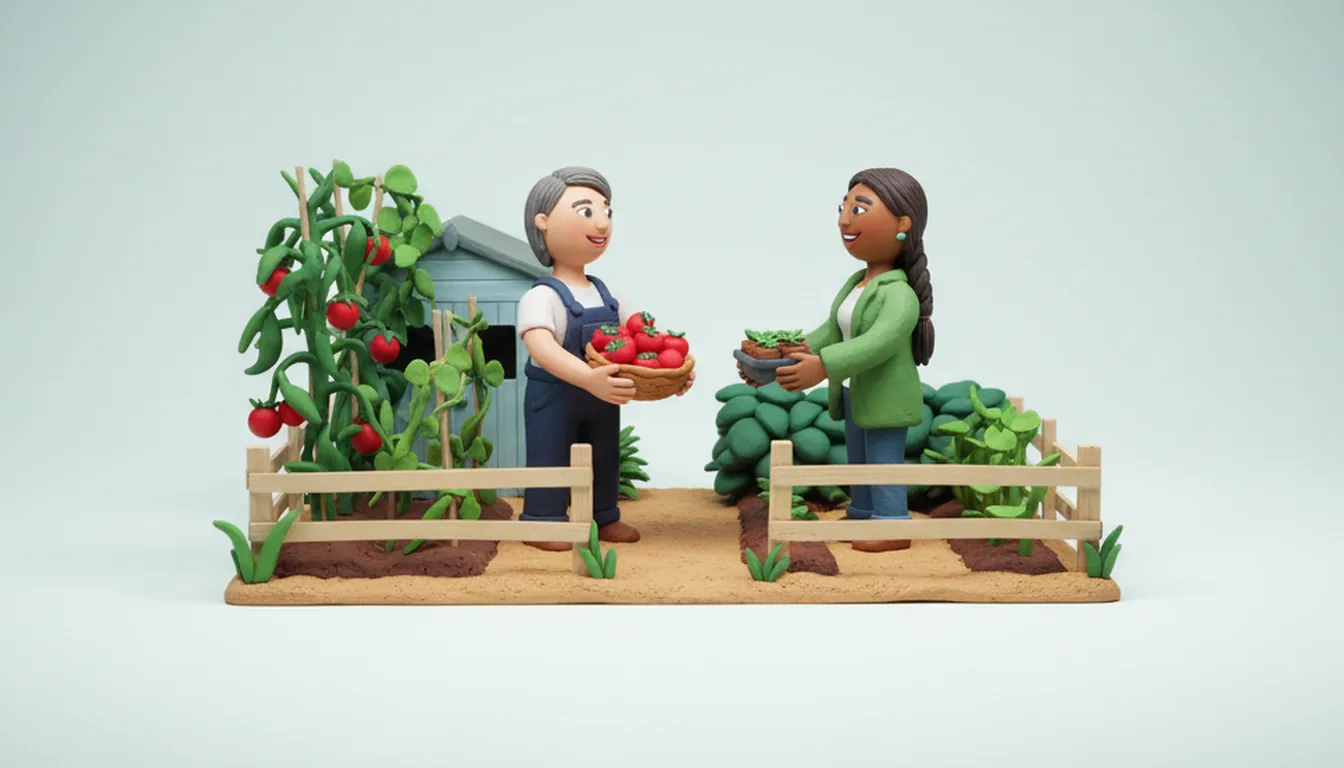
An example: Nadia and Bea have had neighboring plots at the community garden for six years. Nobody remembers who started it. Nadia waters Bea's beans when Bea is away. Bea grows too many seedlings every spring and passes the extras over the fence. In August, when Nadia's tomatoes all ripen in the same week, a basket goes the other way. They've never kept a list, and neither could tell you who's ahead. Last Saturday they met at the fence at the same moment, Nadia holding out tomatoes and Bea holding out a tray of young lettuce, and both of them laughed.
What "one hand washes the other" means
The saying is often used for friends, neighbors, siblings and couples who carry each other's load without making a fuss about it.
It has a second, cooler meaning too. Some people say it with a raised eyebrow, about favors swapped quietly for gain. The words are the same in both cases, so the tone tells you which one someone means. This article is about the warm one, and about the point where the warm one starts to slide toward the cool one.
From a Greek poet to Latin
The idea is very old. The Greek comic poet Epicharmus, who lived in Sicily about 2,500 years ago, had a line that paired a hand with a hand and added "give something and take something." A dialogue once credited to Plato, the Axiochus, has Socrates quoting it. Later Greek collections give the plain form, "a hand washes a hand." In Latin it became "manus manum lavat." It turns up in a satire on the death of the emperor Claudius, usually credited to Seneca, and in the Satyricon of Petronius. In the 1500s the scholar Erasmus gathered it into his big book of old sayings.
Some give the Greek verb as "washes" and others as "rubs" or "scratches." The meaning has stayed the same for over two thousand years.
And both wash the face
In some languages the saying has a second half: "one hand washes the other, and both wash the face." Catalan is one of them. Where the longer form started is not clear.
The ending adds something nice. When two hands help each other, they can also do a job neither could do alone. Nadia and Bea's swaps keep both plots going. Together they also built the low fence between them and a shared compost bin that neither would have bothered with on her own.
Give and take without a ledger
The best version of this saying has no list. Friends who help each other well don't count. One of you drives the other to the airport. A month later the other one brings soup over on a bad evening. It evens out over years, not weeks, and some years it doesn't even out at all.
A lot of it is small. Sending the photo you took of them, holding a place in the queue, remembering how they take their coffee. Our piece on small gestures in friendship has more of these, and they often matter more than the big favors.
How it works in a family
Families run on give and take, often across long stretches of time. An adult daughter helps her father set up his new phone, and he spends a Saturday fixing her fence. Two sisters take turns hosting the summer lunch. A brother who's good with forms fills them in for both of them, and his sister cooks for his birthday every year.
Over a lifetime the direction often flips. A mother who drove her son to his early shifts when he was twenty may have him driving her to the station when she's seventy. Nobody keeps that ledger either.
Couples have their own version, and it doesn't always mean an exact split. One partner cooks, the other handles the car and the bills, and both feel the load is fair. If it stops feeling fair, our article on the 50/50 relationship looks at how to share chores and effort so both of you are comfortable.
When help turns into a trade
Give and take can slowly turn into a trade, and it usually happens without anyone saying so. Watch for these signs:
- Someone starts keeping score. "I drove you twice last month" is said out loud, or thought often.
- Help comes with strings. A favor is done mainly so it can be called in later.
- The return has to be quick. If the soup isn't followed by a favor within the week, there's tension.
- One side only gives. One friend always helps and the other is always busy.
If you keep washing a hand that never washes yours, it's worth reading about the one-sided friendship. And if you're the one who never asks, asking for help explains why letting a friend help you is part of the deal too.
If you catch yourself keeping score, ask what's behind it. Often the list is a sign you feel taken for granted. Saying that to your friend is easier than adding it up in your head, and many friends would rather hear it.
Keeping it a give and take
A few habits keep the warm meaning alive:
- Give without a receipt. Help because you want to, and let it go.
- Let people help you back. Refusing every return favor can make the other person feel like a guest in the friendship.
- Say thank you in plain words. A short "that really helped" goes further than you'd think. Our tips on how to show appreciation go into the ways different people like to hear it.
- Talk about it if it feels off. "I've been feeling like the driver lately" is easier to hear early than after a year.
Who keeps count, and who gives and forgets
Some people quietly keep track of who did what. Others give and forget the same day. Type has a say in which one you are. Six of the 16 types:
- Vitalizer jumps in to help on the spot and rarely thinks about what comes back.
- Inspector notices who pulls their weight and remembers it, even if they never say so.
- Diplomat helps fast, often by knowing the right person to call, and is already on to the next thing.
- Guardian gives steadily for years, like the neighbor who waters your plants without being asked.
- Organizer likes things fair and clear, and may want a turn-taking plan for the driving.
- Encourager gives freely and generously, and forgets most of it by the next day.
Why some friends swap so easily
Some friendships settle into an easy give and take from the start, and others take work to balance. Typeza tells you the relationship type you and a friend share, including who tends to help whom. Take the free friendship compatibility test, then pass the link on so your friend can take it too.
Questions people ask
What does "one hand washes the other" mean?
It means helping each other works better than going it alone. Among friends, it's a warm way to say "we look out for each other."
Is "one hand washes the other" positive or negative?
It can be both. Among friends and family it's warm, about helping each other. Said with a raised eyebrow, it can hint at favors swapped quietly for gain.
What is the longer version of the saying?
A longer version is "one hand washes the other, and both wash the face." The second half says that two people helping each other can do what neither could do alone.
Who first said "one hand washes the other"?
No one person. The oldest known version is a line by the Greek comic poet Epicharmus, about 2,500 years ago.
What does "manus manum lavat" mean?
It's Latin for "a hand washes a hand." The meaning is the same as in English: people who help each other both come out ahead.
Sources
- Sententiae Antiquae, "One Hand Washes the Other". Erasmus, Adages 1.1.33: the Epicharmus line quoted by Socrates in the Axiochus, the Greek "a hand washes a hand," and Seneca's use of it.
- The Latin Library, Petronius, Satyricon (end of section 45) and Seneca, Apocolocyntosis (section 9). Both have "manus manum lavat."
Written by Virko Kask, founder of Typeza
Written with the help of AI tools.
One question for two, every week
A question to ask your partner, friend or family, and how different types tend to answer it.
Free. Unsubscribe any time.