
What does patronizing mean? Signs someone talks down to you
A patronizing remark sounds kind on the surface and still leaves you feeling small, because it treats you as less capable than you really are. The friendliness is often real, but under it sits the idea that things have to be made simple for you.
The verb is patronize, so a person who patronizes you talks down to you in a soft, falsely kind way. British English spells it patronising and means the same thing. There's also an older, neutral sense, where to patronize a bakery or a garage just means you're a regular customer there. Close words are condescending, belittling and talking down. The opposite is treating someone as an equal, or plain respect.
How patronizing shows up in everyday talk
Most patronizing comes in small doses, so it's easy to miss at first. You notice it later, when you're still a little annoyed and can't quite say why.
- They explain something you clearly know already, slowly and from the very start.
- They call you "sweetheart", "dear" or "buddy" in a tone that puts them a step above you.
- They praise you for something ordinary, like parking the car or cooking rice, as if it were a surprise.
- They hand you tips you never asked for and finish with "trust me".
- They say "you wouldn't understand" or "don't worry about the details".
- They tell you about your own job, hobby or home as if you'd never thought about it.
One of these on a busy day means little. The word fits when the same tone keeps coming back, and you start to brace yourself before you talk to that person.
The phone lesson in Aram's kitchen
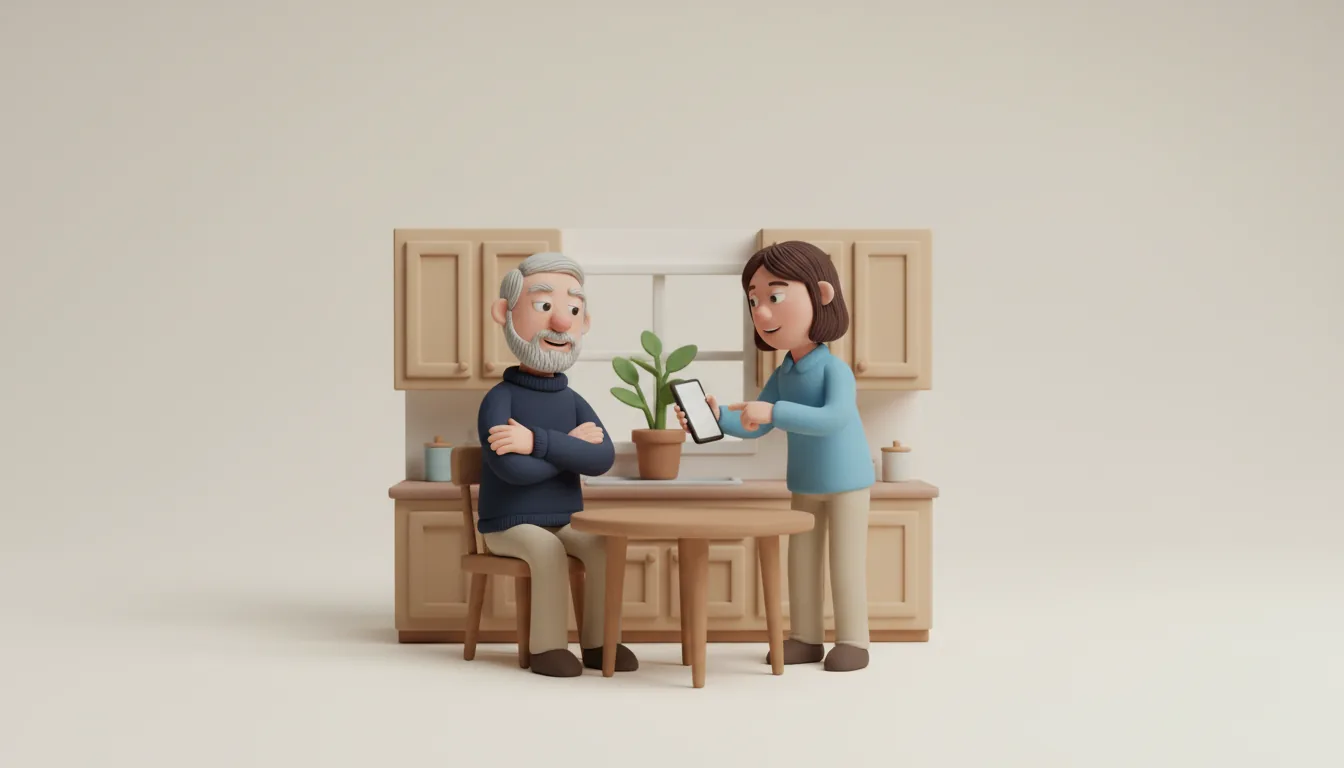
An example: Lina, 34, came home one Saturday to set up her father's new phone. Aram, 63, sat at the small round table in the kitchen with his arms folded. Lina stood next to him, held the phone where he could see it and pointed at the blank screen. "Okay, Dad. This little picture is the camera. You press it once. Just once."
Aram raised one eyebrow and smiled. "Lina, I put in every wire in this kitchen. I think I can find the camera."
She laughed, and then she heard herself. She had been using the slow, bright voice people use for someone who is lost. She hadn't meant anything by it. She only wanted it to go well.
An hour later her car's tire light came on, and Aram walked her out to the street to explain air pressure. "Now, sweetheart, the air goes in here." Lina looked at him, and he looked back, and they both started laughing. They made a deal on the spot. When either one of them starts the slow voice, the other just says, "I'm not twelve." It has come up four times since, twice for each of them.
Patronizing vs condescending
Both words mean talking down to someone, and people often swap one for the other. The difference is in the wrapping. Condescending is the wider word. It covers any way of acting above someone, even a cold one, like a loud sigh before answering your question. Patronizing is the kind version, where the low opinion arrives inside help, praise or a gentle voice. "I wouldn't expect you to follow this" is condescending. "Oh, look at you, you did it all by yourself!" to a grown adult is patronizing. So most patronizing remarks are also condescending, while a lot of condescension has no sweetness on top at all.
A few other words sit close by. Looking down on people because you rank yourself higher is one of the warning signs in confidence vs arrogance. Cool distance with no friendliness at all reads more as stuck up. When someone needs to be the most important person in the room, that's a big ego. Being visibly pleased with yourself is smug, which can happen with no one being talked down to. And patronizing is a good case of nice without kind, a gap that kind vs nice explains well.
A patronizing partner, parent or relative
With a partner it often starts in one area where they know more. A partner who handles the money might explain every bill to you in a slow voice, or a partner who cooks might watch you chop an onion and say "good try". Each time on its own is small. Over a year it can teach you to stop offering ideas in that area at all.
Parents of grown sons and daughters have an old habit to fight. For two decades they really did know more about most things, and the voice they used back then can come back at thirty or forty. A father might still ask if you've remembered your keys. A mother might praise your new flat as if she were surprised you managed it. When a parent goes past the tone and takes the task out of your hands, that's closer to overbearing. As the story above shows, it can run the other way too, from a grown son or daughter to a parent.
Relatives usually do it at family meals. An aunt explains your own field to you in front of everyone, or an uncle calls your career choice "a nice little hobby". Judging the choice itself is judgmental. Patronizing is the gentle smile that comes with it.
Patronizing without meaning to be
Plenty of people who come across as patronizing think well of you. Some are just careful explainers. Others feel nervous and over-prepare, or grew up in a family where everyone talked that way. A few simply care about getting things right and don't notice that you already have the basics.
Personality type explains part of it. The Analyst likes to lay out a subject step by step so nothing is left out, and to them a full explanation is a form of respect. The Commander tends to hear a slow, careful explanation as doubt about what they can do. The Diplomat reads the tone more than the words and can feel talked down to by a voice that was only trying to be clear. The Organizer wants things to work in practice and shows you how, out of care.
So an Analyst parent and a Commander son can both mean well and still leave the kitchen annoyed with each other. This comes from type theory, which describes how people tend to react, not how your relative will. Treat it as a way to see the other side, not as advice for any one family.
What to say when someone patronizes you
"Don't patronize me" means "stop talking down to me, I understand this as well as you do". It's fair to say, but said sharply it usually starts an argument about tone. Softer lines often work better.
- Say what you already know. "I've done this a few times, so you can skip the first part."
- Name the tone lightly. "You're doing the slow voice again." A smile helps.
- Ask a real question. "Do you think I can't do it?" Most people say no, and then they listen to themselves.
- Use a shared signal. Like Lina and Aram's "I'm not twelve", one agreed word saves a lot of explaining.
- Keep it short. Long objections give the other person more to explain.
If someone keeps it up after you've said something, say it once more, calmly and plainly: "I'd like you to talk to me as an equal." That's the whole meaning of "don't patronize me", without the bite.
Am I being patronizing?
You see it in others long before you see it in yourself. When you're the one doing it, it just feels like helping. A few questions can show you.
- Do you start explaining before you've asked how much the other person already knows?
- Do you praise adults for things any adult does?
- Do people say "I know" to you more than they used to?
- Do you use pet names with people you'd never call that in a calm moment?
None of this makes you a bad person. It usually comes from wanting things to go well. The fix is easy to describe and takes practice. Ask first ("Have you used one of these before?"), then pitch your help at the level they tell you.
Learn why one person hears help and another hears a put-down
Typeza lays out how two people's types meet, including how each of you likes to be helped and explained to. It starts with the free personality test. After that, invite the person whose kind words keep landing wrong, and compare.
Questions people ask
When is "as we discussed" helpful, and when is it patronizing?
It helps when it points to a real earlier talk and saves time. It turns patronizing when it means "I already told you this" and is said to make the other person look slow.
How do you use patronizing in a sentence?
"She gave me a patronizing pat on the arm and said I'd understand when I was older." You can also say someone spoke patronizingly, or that a comment had a patronizing tone.
What is an example of patronizing behavior?
Explaining how to use an oven to an adult who has cooked for years, or saying "good job" in a high voice when someone does an ordinary task. Calling someone "sweetie" during a disagreement is another common one.
Is it rude to say "don't patronize me"?
It's direct more than rude, but it can sound sharp. "I've got this, thanks" or "You don't need to explain that part" makes the same point with less heat.
Sources
- Dictionary.com, "patronize". Treating someone as inferior while seeming kind, the customer sense and the British spelling patronise.
Written by Virko Kask, founder of Typeza
Written with the help of AI tools.
One question for two, every week
A question to ask your partner, friend or family, and how different types tend to answer it.
Free. Unsubscribe any time.