
The squeaky wheel gets the grease: meaning, and who gets heard at home
"The squeaky wheel gets the grease" means that the person who complains or asks the loudest is the one who gets attention and help. The oldest known printing is a short American verse from 1903: the wheel that squeaks the loudest is the one that gets the grease.
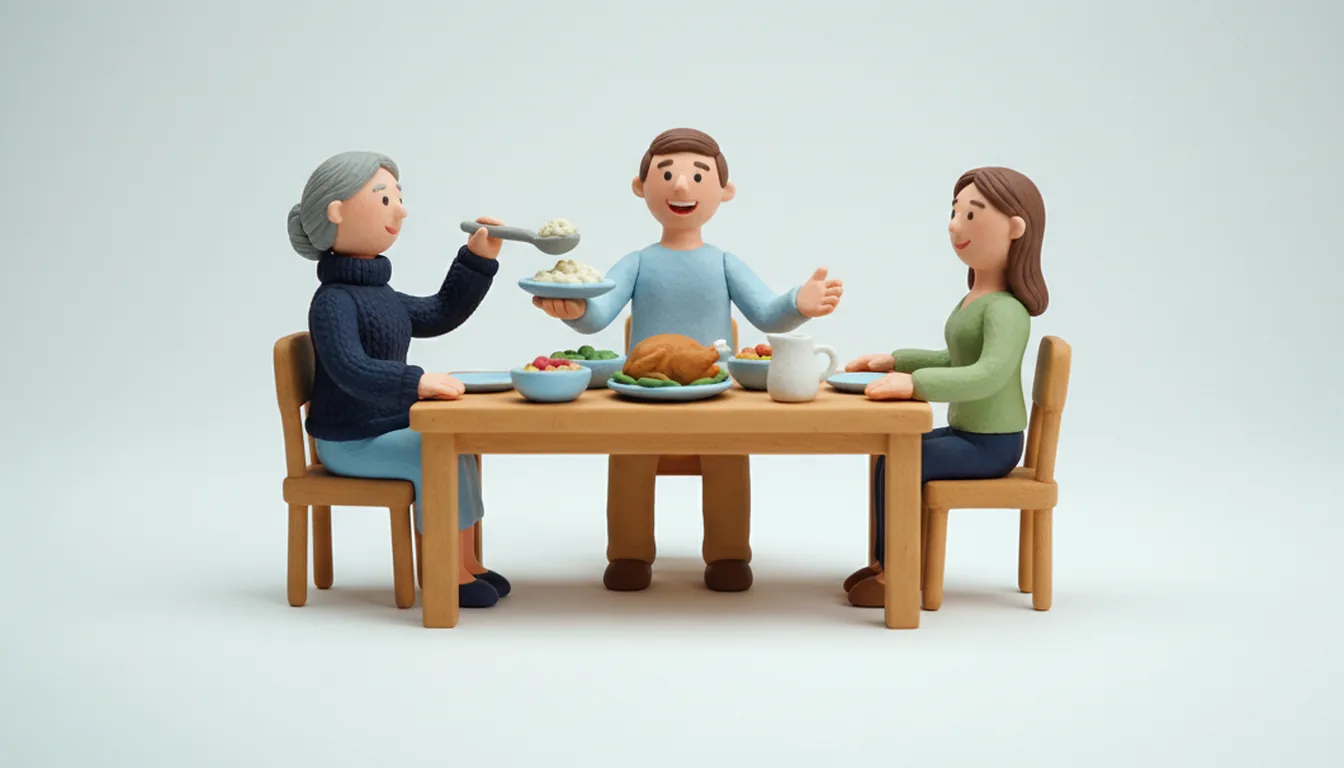
An example: at the Novak house it plays out every Thanksgiving. Daniel holds out his plate and talks about the long drive he has ahead of him, so Mom fills his plate first. Dinner is at four, because Daniel asked for four. The game goes on the TV, because Daniel asked for that too. His sister Mira has wanted dinner at two for six years, so she can drive home before dark. She mentioned it once, four years ago, and then let it go.
Their mom loves them both the same. She simply answers the request in front of her, and Mira's wish never made it to the table.
Grease or oil, and the saying that answers back
You'll hear a few versions. "The squeaky wheel gets the oil" means exactly the same thing. People also say "squeaky wheel" on its own for someone who complains a lot, as in "he's the squeaky wheel of the family."
There's a well known saying from Japan that points the other way: "The nail that sticks out gets hammered down." Speak up too much, it warns, and you'll pay for it. Both sayings are true some of the time, which is why people still argue about them.
In everyday talk the saying shows up in three ways:
- As advice to a quiet person. "Call them again. The squeaky wheel gets the grease."
- As an excuse. "I know I keep asking, but hey, squeaky wheel."
- As a sigh about something unfair. "Of course he got the big bedroom. Squeaky wheel."
Who squeaks in a family
Families settle into roles over the years, and one of the clearest is who asks and who waits. One grown child calls Mom with every problem and gets the most calls back. One sibling asks for help with the move and gets three cousins and a truck. Another never asks and is assumed to be fine. When the family plans a holiday, the loud voices decide the dates, and the quiet ones fit around them.
Nobody plans it that way. Parents and siblings answer what they hear, and the person who never brings anything up slowly drops off the list of people whose wishes count. From the outside it looks like one rule for the loud sibling and another for the quiet one. Family dynamics are full of small patterns like this one that nobody chose and everybody keeps.
The quiet one who gets missed
In many groups there's a Mira. They aren't unhappy every day, and they rarely make a fuss. Watch for these signs that someone close to you is being missed:
- They say "I don't mind" or "whatever works" almost every time.
- Their plans are the first to move when something else comes up.
- They stopped suggesting things a while ago.
- They leave early, or quietly skip the next get together.
- One day they snap over something small, and everyone is surprised.
That last one matters. Quiet people often keep a long list in their head, and when it spills over it looks out of nowhere to everyone else. Being a quiet person is fine. Being the one whose wishes never count wears anyone down.
Squeaky wheels among friends and in a couple
In the group chat
Five friends plan a weekend away. Two of them reply within a minute with strong opinions about the place, the date and the budget. Two send a thumbs up. One doesn't answer at all, because by the time she reads it, it's settled. The weekend ends up shaped by the two fast typers, and the fifth friend finds a reason not to come.
At home with a partner
In a couple, the pattern grows slowly. One partner says what they want each time: this restaurant, that couch, Christmas with my parents again. The other goes along to keep the peace. Ten years in, the quieter one realizes they can't remember the last holiday they chose, and the louder one has no idea anything is wrong.
Loud and quiet wheels, type by type
Some people say what they want the moment they know it. Others wait to be asked, or decide it isn't worth the fuss. Being a Daniel or a Mira is partly personality type. Eight types, in types page order:
- Harmonizer: cares most about a calm, pleasant room and will often swallow a wish to keep it that way.
- Vitalizer: says what they want with feeling, and the whole room tends to respond.
- Commander: asks directly and expects a yes, so their wishes get handled first.
- Diplomat: speaks up, pushes, and usually gets the plan moving their way.
- Entrepreneur: asks quickly for the practical thing, like the earlier train or the cheaper hotel.
- Guardian: stays quiet until a line is crossed, then says so very clearly.
- Counselor: puts other people's comfort first and hopes someone will think to ask.
- Craftsman: asks only when it really matters, and then expects it to be heard the first time.
Daniel sounds like a Diplomat. Mira, who has kept the peace at every family dinner since she was twelve, sounds a lot like a Harmonizer. Neither of them is doing anything wrong. The loud ones usually have no idea the quiet ones wanted something, and the quiet ones assume everyone already knows. If you're the quiet one, how to be more assertive has words for speaking up with the people you love.
How a fair family or couple notices the quiet one
- Ask by name. "Mira, what time works for you?" gets an answer that "Does four work for everyone?" never will.
- Take turns. Alternate who picks the restaurant, the movie or the holiday, and keep track, the way some couples split chores in a 50/50 relationship.
- Ask in private or by text. Quiet people often find it easier to say what they want when the whole table isn't watching.
- Hear "I don't mind" as a starting point. Follow up with "If you had to choose, which one?"
- Look over a whole year. One evening doesn't tell you much. Twelve months of the same person choosing tells you a lot.
- Make it easy the first time. When a quiet person finally asks for something, say yes if you possibly can.
How to ask for what you need without complaining
Speaking up doesn't have to mean squeaking. A request is short and points forward. A complaint looks back at what went wrong, and it often repeats. A few things keep you on the right side:
- Ask early. Before the plan is set is far easier than after.
- Say what you want. "Could we eat at two this year?" works better than "Dinner is always so late."
- Give one reason. "I'd like to drive home before dark." Then stop.
- Ask once, clearly. Hints don't count as asking, however clear they seem to you.
- Don't save it up. A small wish said today beats ten small wishes said at once next year.
If you're the one who squeaks about everything and wants to squeak less, how to stop complaining looks at it from the other side.
Find out if you are the loud wheel or the quiet one
Whether you ask out loud or wait to be noticed depends a lot on type, which is why two siblings can grow up at the same table and ask for things so differently. The free personality test puts a name on your type, with what you're good at and what you struggle with. From your result, send a brother, sister or parent the link to the same test. When they are done, your relationship type explains where your family pairing runs smoothly and where it squeaks.
Questions people ask
Is it "squeaky wheel gets the grease" or "gets the oil"?
Both are used and mean the same thing.
Where does the squeaky wheel saying come from?
The oldest printing found so far is the 1903 verse, in a book of comic country stories. A poem often dated to about 1870 has never been found.
What is the opposite of the squeaky wheel gets the grease?
The Japanese saying "the nail that sticks out gets hammered down" is the best known opposite. It warns that speaking up can get you into trouble. In English, you catch more flies with honey says a warm ask works better than a loud one.
Is being the squeaky wheel a bad thing?
It depends on how often and how. Asking clearly for what you need is healthy. Complaining about everything wears people out, and it can push quieter people's needs out of sight.
Sources
- Quote Investigator, "The Squeaky Wheel Gets the Grease". The 1903 verse in Cal Stewart's Uncle Josh Weathersby stories, and why the Josh Billings poem "The Kicker" is unproven.
- Wikipedia, "The squeaky wheel gets the grease". Meaning, the unknown origin and the Japanese saying about the nail that sticks out.
Written by Virko Kask, founder of Typeza
Written with the help of AI tools.
One question for two, every week
A question to ask your partner, friend or family, and how different types tend to answer it.
Free. Unsubscribe any time.