
Green with envy: meaning, and envy between friends and siblings
Green with envy means very envious: you want what someone else has so much that you can feel it, a little sick and a little sour. It often turns up between close friends and between brothers and sisters, and it usually says more about something you want for yourself than about the other person. Handled with a little care, it can turn into an honest talk or a goal of your own.
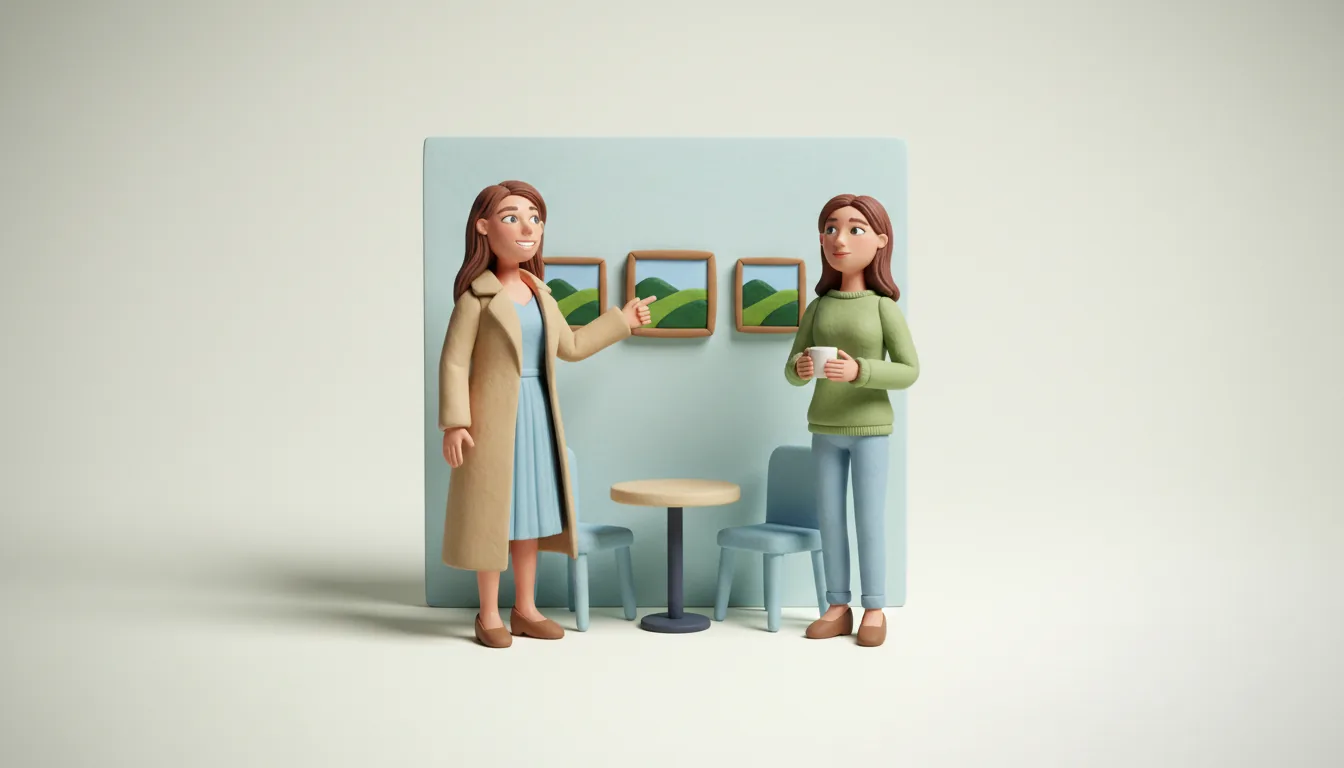
An example: Maya, 34, walked into the corner café on a Saturday morning and stopped at the back wall. Three small paintings of green hills hung there in wooden frames, and the card under them said Jules Moreau. Jules, her best friend since college, stood next to them in her camel coat, grinning. "My first show," she said. "It's only a café, but still." Maya hugged her and told her they were beautiful, and she meant it. She also felt a small, sour pinch she didn't like at all. In college they had both painted. Jules kept going. Maya's brushes had been in a shoebox under her bed for ten years.
That pinch is what people mean by green with envy.
Where the green in green with envy comes from
The wording "green with envy" dates from the mid-1800s. The link between green and envy is older. Shakespeare wrote of "the green sickness" in Antony and Cleopatra, and in Othello he called jealousy "the green-eyed monster."
Envy is wanting something another person has, while jealousy is the worry that a rival will take someone you already have, the feeling how to deal with jealousy is about.
In everyday talk the phrase is often light, almost a compliment:
- "Your garden looks amazing. I'm green with envy."
- "Two weeks in Portugal? I'm so green with envy."
- "She sings like that without a single lesson, and I'm a little green with envy."
Said out loud like that, it means "I'd love that too," and nobody minds. The heavier kind is the one you keep to yourself, the way Maya did in the café.
Why it stings most with the people closest to you
Few people envy a famous painter they have never met. Maya envied Jules, who started in the same art class with the same cheap brushes. When someone's life looks a lot like yours, their good news shows you exactly where you stopped, and the comparison is hard to avoid.
The feeling can sit right next to real love. You can be proud of a friend and sour about her success in the same minute. It doesn't make anyone a bad friend. What matters is what you do with it next.
Envy between adult friends
Grown friends rarely envy each other's things for long. The sting tends to come from something closer to the heart:
- a talent the friend kept up while you let yours go
- a relationship that seems easy
- a calm, confident way with new people
- the energy to run, travel or start something new
- a bigger, busier circle of friends
You can spot it in yourself by small habits. You go quiet when she shares her news, you notice a flaw in her success before anything else, or you find a reason to skip the evening that celebrates it. None of that has to become a problem, as long as you catch it early.
Sometimes it runs the other way, and a friend goes cool whenever something good happens to you. The jealous friend guide covers how to tell and what to say.
Envy between grown brothers and sisters
Siblings carry the longest comparison of all, since many grew up hearing whose grades were better or who helped more at home. As adults the topics change. An example: Dana, 45, envies how easily her younger brother Luis chats with their dad for an hour on the phone, while her own calls with Dad last four minutes. Luis envies Dana's Sunday dinners with a table full of friends, because he has two close friends and a quiet apartment. Neither said a word about it until a long drive to their aunt's 80th birthday.
It happens between siblings more than they admit. Each one envies the other, each thinks the other has it easier, and both are a little surprised to hear it. One honest sentence on a car ride can clear up something that has been sitting there for decades.
Who compares and who shrugs, by type
Some people notice every way a friend is ahead of them. Others hardly notice, and a few turn envy into fuel on the spot. How the feeling shows up often follows personality type. Eight examples, following the types page order:
- Ideator: shrugs quickly, because a friend's success gives them three new ideas of their own. The risk is starting all three and finishing none.
- Harmonizer: rarely compares results. If they envy anything, it is a friend's ease and comfort, and a cozy evening together usually settles it.
- Analyst: compares quietly and in detail, then says nothing. Asking the friend how she did it turns the feeling into something useful.
- Diplomat: feels it fast and turns it into a friendly challenge. "Fine, I'm signing up for that race too."
- Strategist: looks at what it would actually take to get there. Either makes a plan or decides it isn't worth it, and moves on.
- Entrepreneur: notices who is ahead and goes after it right away. Needs to watch that a friendship doesn't become a race.
- Organizer: compares in private and can feel behind for weeks. Saying it out loud to a trusted friend helps more than working harder.
- Craftsman: mostly shrugs and does their own thing. When envy does come, it is for a skill, and they go learn it with their hands.
Saying it out loud, kindly
A plain talk can take the sting out of envy, if you keep it short and keep it yours. Say it lightly and own it: "I'll be honest, I'm a bit envious of your show. That's mine to sort out, and I'm really proud of you." Leave it there. Don't ask your friend to play her news down or to feel bad about it.
Then ask a real question, such as "How did you keep painting all these years?" Curiosity moves you from the outside of her success to the inside of her story, and the envy often fades while she tells it. With a sibling it can sound like this: "I've always envied how easy it is for you with Dad. Is it actually easy?"
When envy points at a goal
Envy is a rough but honest pointer at what you want. Ask yourself one question: do I want the thing itself, or do I just want to stop feeling behind? Maya didn't want a café show. She wanted to paint again.
If it is the thing, pick one small step for this week. Buy one tube of paint, book one class, call one person. Sometimes the answer is the other one, and the envy is a case of the grass looking greener on the other side: the other life looks better from a distance, and up close you wouldn't trade. Once you see that, the pinch usually loosens.
Maya's Sunday mornings
Over a second coffee, Maya said it. "I'm a bit envious, and I think it's because I miss painting." Jules laughed with relief. She had been afraid Maya found the paintings silly. "Then come paint with me," she said. "Sundays, my kitchen table." That night Maya dug out the shoebox. Two tubes had dried up, and the rest were fine. Three Sundays later she finished a small, slightly crooked picture of the café window.
See why one friend shares her work and another keeps it hidden
Envy between close friends often comes from two different ways of chasing the same wish, and your type says a lot about your way. The free friendship compatibility test shows it. Send the friend you tend to compare yourself with the link from your result. After she answers, the two of you learn your relationship type, with what is easy in your friendship and what can get tricky.
Questions people ask
What does green with envy mean?
It means full of desire for what someone else has, or simply very envious. People often use it lightly, as a compliment: "Your garden is lovely, I'm green with envy."
Why is envy linked to the color green?
Nobody knows for sure. A popular story points to ancient Greece and a sickly, pale face, but it rests on retellings. What is clear is that Shakespeare tied green to envy and jealousy in more than one play, and the color stuck in English.
Is it normal to envy your best friend?
Yes. Envy shows up most with people whose lives look like yours, and a best friend is often the closest match. It sits alongside real love and fades faster once you name it.
Sources
- Dictionary.com, "green with envy". The meaning, the mid-1800s date of the wording and Shakespeare's "green sickness" in Antony and Cleopatra.
- William Shakespeare, Othello, Act 3, Scene 3. Jealousy as "the green-eyed monster."
Written by Virko Kask, founder of Typeza
Written with the help of AI tools.
One question for two, every week
A question to ask your partner, friend or family, and how different types tend to answer it.
Free. Unsubscribe any time.