
Passive aggressive: what it means, everyday examples, and what to say
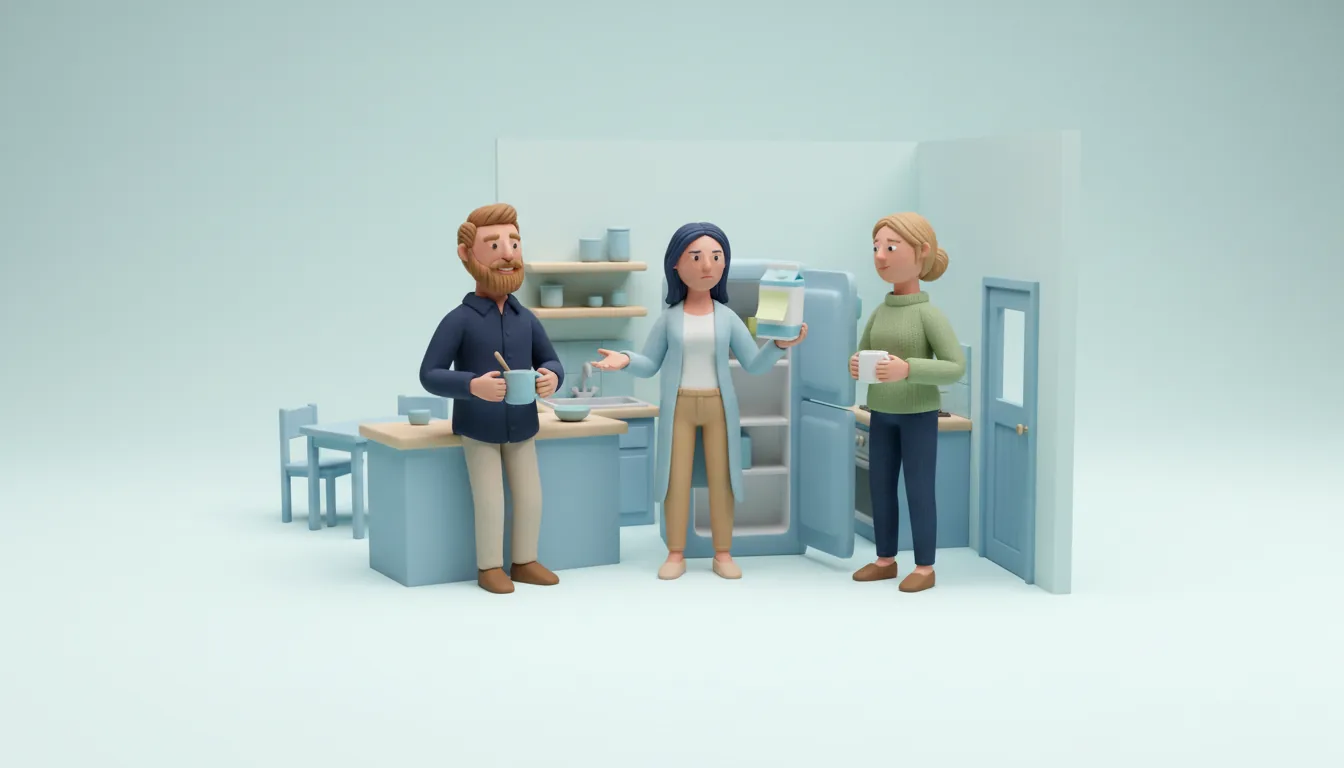
Passive aggressive means showing anger or annoyance in a roundabout way instead of saying it out loud. The words sound polite or even friendly, while the message underneath is "I'm upset with you."
An example: Ellie opened the fridge on Sunday morning and found the oat milk carton empty, with a yellow sticky note on it: "Hope it was delicious!!" Her housemate Dev stood at the counter, stirring his coffee and humming a little too brightly. Sofia, the third person in the flat, picked up her mug and slipped out of the kitchen. Ellie had finished the milk on Friday night. Nobody mentioned it again, and the kitchen stayed chilly for a week.
What does passive aggressive mean?
It can be a note, a tone of voice, a joke, a favor done slowly on purpose, or a text with one word too many. The real complaint stays unsaid, so the other person has to guess, and if they ask what's wrong, the answer is usually "Nothing, why?" Dev's note was about the milk. It was also about the fact that he didn't feel able to say "Could you buy more when you finish it?"
Passive aggressive examples between friends
Friendships run on goodwill, so small resentments tend to come out sideways instead of in a talk.
- Answering a second cancellation with "No worries, I know you're SO busy!!" and then leaving that friend off the next plan.
- "Forgetting" to save a seat for one person at a group dinner.
- Saying "Must be nice" when a friend mentions a weekend away.
- A teasing line in front of everyone, like "Mia's here on time? Someone call the news."
- Bringing up an old favor at just the right moment: "Sure, it's fine. Remember who got up at dawn for your airport run."
Passive aggressive examples in a couple
Couples share a home and a calendar, which gives annoyance plenty of places to hide.
- "Do whatever you want," said in a voice that means "please don't."
- Thanking the dog, loudly, for listening while your partner scrolls on the phone.
- Turning the thermostat back every time your partner changes it, without a word.
- "Have fun with your friends. I'll be here." Then a long list of what got done while they were out.
- Agreeing to a visit to their parents with "Sure, it's been a whole three weeks."
Passive aggressive examples in the family
Grown children and their parents have decades of history, and everyone knows exactly which comment will land.
- A mother who says "Don't worry about calling, I know you have your own life now."
- "Your brother calls every Sunday, but I'm sure you're busy."
- A sibling who replies to everyone's news in the family group chat except yours.
- Bringing your own dish to your sister-in-law's dinner "just in case."
If one relative makes every family lunch tense, dealing with difficult people has ideas for the table and for trips.
Passive aggressive examples between housemates
Shared homes are full of small rules nobody agreed on out loud, which makes them a classic setting.
- Notes on the fridge, the bathroom mirror or the washing machine. "Some of us get up at six!" Nobody is named, and it's left to whoever the shoe fits.
- Moving a housemate's wet laundry out of the machine and leaving it in a heap on top.
- Writing names on every carton and jar after one yogurt goes missing.
- A message in the house chat that starts "Just a reminder for EVERYONE" when it's plainly about one person.
- Taking out the trash and posting a photo of the empty bin to the chat.
Passive aggressive texts and messages
Texting is where this habit thrives, because tone gets lost and every period seems to mean something. Messages people often read as passive aggressive:
- "K."
- "Noted."
- "Per my last message..."
- "Wow. Okay then."
- "Just checking you saw my text from Tuesday."
- "No rush!" sent for the third time in a day.
- A reply two days late that just says "haha."
Plenty of people just write short messages, and dry texting is often a habit with no hidden meaning. Judge a text by what came before it.
Why people go the passive aggressive route
Often the reason is a wish to avoid an open fight. Saying "I'm angry with you" feels risky. A cheerful note feels safe, because if the other person reacts, the writer can say it was only a joke. Other reasons often sit underneath:
- The issue feels too small to raise. Complaining about milk seems petty, so the annoyance finds another way out.
- They grew up with quiet anger. In some families nobody raised a voice, and adults from those homes often keep the habit.
- Saying it directly once went badly. If the last honest talk ended in a fight, the next complaint goes underground.
- They want you to guess. If you notice without being told, it feels like proof that you care.
- They're tired. A sticky note takes ten seconds. A real conversation takes energy they don't have that day.
Many people who do this are simply stuck between being annoyed and being afraid of the fight. If you recognize yourself here, learning to be more assertive gives you the plain sentence to use instead.
Passive aggressive, or just a bad day?
One sharp reply after a long day isn't a pattern, and a few questions help you tell the difference. Did something happen that they might be upset about? Do their words and their tone point in different directions? Does the same kind of remark keep coming back around one topic? If most of the answers are no, the person may simply be distracted, blunt or having a rough week.
What to say back to a passive aggressive comment
The aim is to bring the hidden message into the open, kindly, so you can deal with the real thing.
- Take it at face value, warmly. "Thanks for the reminder, I'll get milk today." Often this ends it, and nobody loses face.
- Ask about the real issue. "Was that note for me? I'd honestly rather you just tell me."
- Say what you notice, without blame. "You seemed off after I mentioned the trip. Did it bother you?"
- Make it easy to answer. "If I did something that annoyed you, I want to know. I won't be upset."
- Skip the counterattack. A note in reply to a note starts a war of sticky notes.
- Say how the pattern feels. If it keeps happening: "When I get notes instead of a conversation, I feel watched in my own kitchen."
Ellie knocked on Dev's door that evening with a new carton and said, "I think the note was for me. Sorry about the milk. Next time just text me." Dev laughed and admitted he'd written three versions of the note before picking the nicest one.
Who drops hints and who says it straight
How people show annoyance partly follows their personality type. Some say it the moment they feel it, while others would rather leave a hint and hope it lands. Here are six of the 16, taken in types page order:
- Harmonizer: wants home to feel peaceful, so they swallow small irritations. When one finally escapes, it often comes out as a light joke with an edge.
- Analyst: names the problem in plain words, sometimes too plainly, and may miss a hint entirely. To them, a note about milk is a note about milk.
- Mentor: feels things intensely and shows it. You rarely have to guess they're upset, though the reaction may be bigger than the milk deserves.
- Inspector: cares about clear rules and fair shares. If a house rule keeps getting broken, they may write it down and pin it up, which others can read as a pointed note.
- Entrepreneur: has little patience for hints. They would rather say "this isn't working, let's fix it" and move on.
- Organizer: shows care by doing things. When annoyed, they may quietly take over the chore and keep count.
A type doesn't make anyone passive aggressive. It only shapes which way the annoyance tends to travel when someone doesn't feel free to speak.
Find out why you hint or speak up
Whether you leave a sticky note or say it straight comes partly from type, and so does how guilty you feel before anyone has said a word. The free personality test shows what your type handles well and where it tends to get stuck. Send a housemate, partner or friend the link from your result so they can take the same test. After they answer, the relationship type between you spells out what tends to go smoothly and where friction usually starts.
Questions people ask
What is an example of passive aggressive behavior?
Leaving a pointed note instead of talking, "forgetting" to invite someone, or sending a cheerful text with a sting in it. The annoyance is real, and it's never said directly.
Is it passive aggressive or passive-aggressive?
Both mean the same thing. Dictionaries spell it with a hyphen, as in "a passive-aggressive text," and everyday writing often drops it. The word was first recorded in the late 1940s.
What makes a person passive aggressive?
Usually a wish to avoid open conflict. People act this way when saying "I'm upset" feels risky or petty, when honesty went badly before, or when they grew up in a home where anger stayed quiet.
How do you respond to a passive aggressive text?
Reply to the words at face value, or ask kindly whether something is bothering them. If it keeps happening, suggest talking in person. A pointed text in return usually makes it worse.
Sources
- Dictionary.com, "passive-aggressive": the hyphenated spelling, the sense of showing negative feelings in indirect ways, and first use in 1945-50.
Written by Virko Kask, founder of Typeza
Written with the help of AI tools.
One question for two, every week
A question to ask your partner, friend or family, and how different types tend to answer it.
Free. Unsubscribe any time.