
Paternal vs maternal grandparents, and why one bond can feel closer
Your paternal grandparents are your father's parents. Your maternal grandparents are your mother's parents. So your mom's mother is your maternal grandmother, and your dad's father is your paternal grandfather.
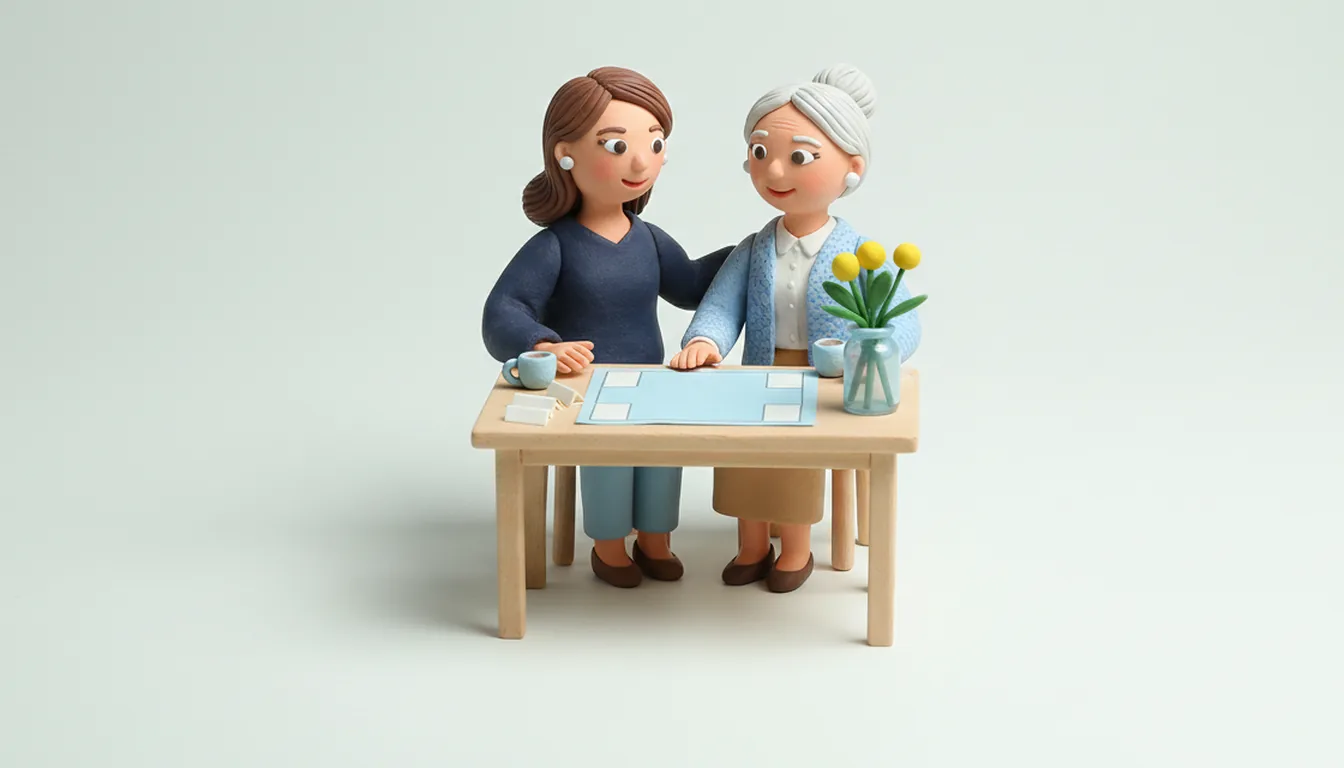
An example: Lena, 29, spends her Sunday afternoons at her Nana's kitchen table, planning her wedding. On the third Sunday, with paper name cards spread between the teacups, Nana picked one up and asked, "And where are you putting your father's mother?" Lena laughed. She had never once thought of Grandma June as her "father's mother." Then she looked at the plan and went quiet. She had put Nana, her maternal grandmother, at the head table without thinking about it. Grandma June, her paternal grandmother, was at table four. Lena loves them both. She just feels closer to one, and that's common.
Paternal and maternal: what the words mean
Both words come from Latin. "Paternal" comes from pater, father, and "maternal" from mater, mother. In family words they tell you which parent's side a relative is on.
The same words work for other relatives too. A paternal aunt is your father's sister, and a maternal uncle is your mother's brother. In everyday talk most people say "my grandma on my dad's side" or "my mom's parents." Forms, family trees and doctors' questionnaires tend to use the formal words.
Your four grandparents at a glance
Most people have four biological grandparents, two on each side.
- Your father's mother is your paternal grandmother.
- Your father's father is your paternal grandfather.
- Your mother's mother is your maternal grandmother.
- Your mother's father is your maternal grandfather.
Read the other way around, you are a grandchild to all four of them. To your mother's parents you are their daughter's child, so you are their maternal grandson or granddaughter. To your father's parents you are their son's child, their paternal grandchild.
Great-grandparents and the generations above
The same rule carries up the family tree. Your father's grandparents are your paternal great-grandparents, and your mother's grandparents are your maternal great-grandparents. You have up to eight great-grandparents, four on each side, and up to sixteen great-great-grandparents.
Your second cousins share a set of great-grandparents with you, and what is a second cousin shows how to count your way to them. Your grandparents' sisters belong up here too, and what is a great aunt sorts out what to call them.
Step-grandparents, adoptive grandparents and grandparents by marriage
- Adoptive grandparents are the parents of your adoptive mother or father. They are your maternal or paternal grandparents, and the words work the same.
- Step-grandparents are a parent's stepparent, or a grandparent's new husband or wife. If your grandmother remarried, her husband is your step-grandfather, on the same side as she is.
- Your spouse's grandparents are your grandparents-in-law. You won't find that phrase on many forms, but people understand it.
- Bonus grandparents is a warm name some families use for step-grandparents or for an older friend of the family who fills the role.
How families tell the two sides apart
With four grandparents, most families need a way to say which one they mean. A few habits are common:
- Different names for each side. Nana and Papa on one side, Grandma and Grandpa on the other.
- The town they live in. "Grandma Boston" and "Grandma Florida."
- Their first names. Grandma June, Grandpa Lou.
- Their language. Families with roots in two countries often use Oma, Abuela or Nonna for one side and English names for the other.
Many grown grandchildren also notice that each side has its own style. One side may be loud, with big holiday dinners and everyone talking at once, while the other is quieter, with small visits and long walks after lunch.
Grandparents often pick their own name when the first grandchild arrives. If yours did, grandma and grandpa names lists many of the options, sorted by the kind of grandparent who tends to choose them.
Does it matter which side a grandparent is on?
For the relationship itself, no. On average you inherit about a quarter of your DNA from each of your four biological grandparents, though the exact share varies by chance. The side can still matter in a few practical ways:
- Family names. In many countries a child takes the father's surname, so the paternal side often shares your last name and the maternal side doesn't.
- Health history. Doctors sometimes ask whether a condition ran on your mother's side or your father's, so it's useful to know which relative belongs where.
- Family trees and records. Old records, citizenship papers and family tree sites all sort relatives by side.
- Traditions. Many families split holidays by side, with one Christmas at the maternal grandparents' house and the next at the paternal ones'.
Why an adult grandchild can feel closer to one grandparent
Lena felt guilty about table four. Feeling closer to one grandparent is common, and it rarely means anything is wrong.
The usual reasons are practical. One set lived nearby and the other lived a plane ride away. In many families one parent keeps up the family calendar and the phone calls, so that parent's side gets more visits. Age and health play a part, and so do divorces, moves and old family quarrels that had nothing to do with you. Research shows a pattern as well. Studies in many societies find that the mother's mother tends to give grandchildren the most time and care, and the father's father the least.
Then there is plain fit. Some grandparents and grandchildren get each other. They laugh at the same things and can talk for hours, while with another grandparent the conversation stays at the weather. Personality type explains a lot of that. Here is how six of Typeza's 16 types tend to show up as grandparents, in types page order:
- Harmonizer: the grandparent whose kitchen always smells of something baking. Visits feel like rest.
- Vitalizer: throws the big family dinners and phones on every birthday, often first.
- Analyst: would rather talk about a book, a news story or how something works than make small talk.
- Inspector: keeps the photo albums labeled by year and knows exactly who married whom.
- Guardian: fiercely loyal to the family, full of old stories and firm about what's right.
- Organizer: shows love by fixing your car, driving you to the airport and sending you home with a full bag of food.
A grown grandchild tends to feel closest to the grandparent whose way of loving matches what they need. Someone who craves deep talks may click with the Analyst grandfather and feel a bit lost with the Vitalizer grandmother, even though she loves them just as much. It shows in a grandma's birthday card too, and in the card a grandparent writes to a grown grandson.
If you want to see what's behind your own closest and hardest bonds, Typeza's family compatibility test is free. You read 41 pairs of statements and pick the one in each pair that sounds more like you. Your type is ready right away. It comes with a bar for each base trait, showing where you lean, and a short free profile of what you do well and where you tend to trip up. No account is required to read it. Typeza is for anyone 16 or older, so a grandparent can take it too, maybe with you sitting beside them. To link the two of you, make a free account and invite them from your result page. Once they've answered, each of you can open the relationship type that links you, one of 16, with what feels natural between you and what takes more patience.
Lena moved Grandma June to the head table. June told her later it was the best seat she'd had at any wedding.
Questions people ask
What is the difference between paternal and maternal grandparents?
Paternal grandparents are your father's parents. Maternal grandparents are your mother's parents. Together they make up your four grandparents.
Is my mom's mom my maternal grandmother?
Yes. Your mother's mother is your maternal grandmother, and your mother's father is your maternal grandfather.
What is a paternal great-grandmother?
She is one of your father's grandmothers. You have two paternal great-grandmothers, one from each of your father's parents.
Are you more related to one set of grandparents?
No. On average you get about 25% of your DNA from each grandparent, and the exact share varies by chance, not by side. Feeling closer to one side comes from time, distance and how well you get along.
Sources
- Wiktionary, "paternal" and "maternal". The Latin roots pater and mater, and the sense "related through the father" or "through the mother."
- The Tech Interactive, "How much DNA do you inherit from each grandparent?" (2020). About 25% from each grandparent on average, varying by chance.
- Helle, Tanskanen, Coall and Danielsbacka, "Matrilateral bias of grandparental investment in grandchildren persists despite the grandchildren's adverse early life experiences", Proceedings of the Royal Society B (2022). The common finding that maternal grandmothers invest the most in grandchildren and paternal grandfathers the least.
Written by Virko Kask, founder of Typeza
Written with the help of AI tools.
One question for two, every week
A question to ask your partner, friend or family, and how different types tend to answer it.
Free. Unsubscribe any time.