
Pet peeves in relationships: examples, and why only one of you minds
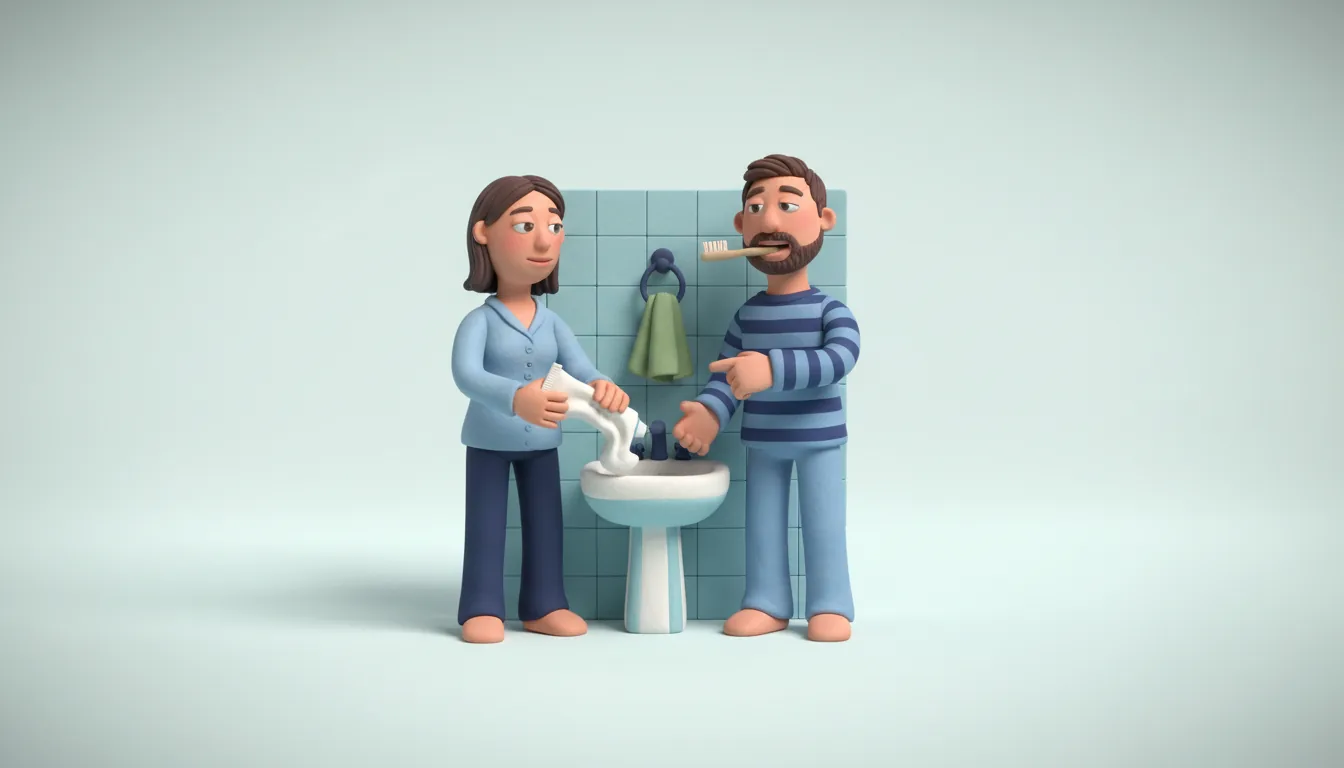
A pet peeve in a relationship is a small habit of your partner's that does no harm on its own and still bothers you a lot.
An example: he leaves the kitchen cupboard doors open, every single one. She closes them behind him and says nothing for three years. Then one evening she watches a video in bed with the sound on, he sighs, and she learns that this has bothered him since their first month together.
What is a pet peeve in a relationship?
A pet peeve is a small habit or behavior that annoys you far more than it should. In a relationship, it is usually something your partner does often and without thinking, like leaving wet towels on the bed or answering a long message with "k".
On its own, a pet peeve is minor. Nobody leaves a partner over a cupboard door. What makes it hard is the repetition, because the tenth time feels different from the first.
The word peeve comes from peevish, an old word for easily annoyed. Pet means your own favorite, as in a pet project. The phrase became common in American English in the early twentieth century.
Common pet peeves in relationships
The same habits come up in many homes. These are some of the biggest pet peeves in a relationship.
At home
- Wet towels on the bed or on the floor
- Dishes left "to soak" for two days
- Cupboard doors and drawers left open
- The toothpaste tube squeezed in the middle, or the cap left off
- An empty toilet paper roll that nobody replaces
Talking and texting
- Interrupting, or finishing your sentences for you
- Saying "fine" when it is clearly not fine
- One word replies to a long message
- Correcting small details while you tell a story
Phones and screens
- Scrolling during dinner or in the middle of a talk
- Videos with the sound on in bed
Time and plans
- Being late, always by "only ten minutes"
- Saying "I don't mind" about dinner, and then minding
Sounds
- Loud chewing or slurping
- Cracking knuckles
Many lists also include bigger things, like lying or never saying sorry. Those are about trust and respect, and they belong on a different list.
Do men and women have different pet peeves?
Online lists often split pet peeves into ones for guys and ones for girls. A list of pet peeves about men might include the toilet seat left up and socks on the floor. A list for women might include long bathroom routines and too many pillows on the bed.
These lists are fun. Still, the habit that bothers someone depends much more on the person than on their gender. Plenty of men can't stand a messy kitchen, and plenty of women leave every cupboard open. If you want to know what bothers your partner, ask them instead of a list.
Why pet peeves feel bigger than they are
A pet peeve rarely hurts because of the habit itself. It hurts because of what it seems to say.
- It feels like a message. Wet towels on the bed can start to sound like "I don't care about your comfort", even when your partner never gave it a thought.
- It repeats. One open drawer is nothing, but five hundred open drawers feel like a pattern.
- It lands when you are tired. After a long day, a sound you would not notice on a Sunday becomes too much.
- It touches something you care about. If order matters to you, you see mess everywhere.
The last point explains why your partner can live with the same habit and feel nothing. They notice other things first, so the open drawer simply never reaches them.
How to deal with pet peeves in a relationship
Many pet peeves never go away completely. The aim is to make them smaller and to keep them from turning into a fight.
- Pick the ones that matter. If you raise every small thing, your partner stops hearing any of them.
- Say it once, at a calm time. In the moment, with the wet towel in your hand, it sounds like an attack. Over coffee on a good day, it sounds like a request.
- Talk about the habit, not the person. "Could you hang the towel up?" lands better than "You never think about anyone else."
- Make it a trade. Each of you names one habit you would like the other to change, and each of you gives one up.
- Look for an easy fix. A hook by the bed or a second tube of toothpaste can solve what a hundred talks did not.
- Let some go, and check your own list. A few quirks are part of the person you chose, and you likely have a habit that bothers your partner just as much.
If you have just moved in together, expect a new list in the first months. Moving in together covers what usually changes when you share a home. When small things keep turning into the same big fight, what couples argue about looks at what sits under it.
Why the same habit is funny in one couple and a fight in another
Your personality type shapes what you notice first. The relationship type between you and your partner, one of 16 in socionics, the theory behind Typeza, shapes how your habits land on each other. A compatibility test names that type once both partners have answered. Three couples show the difference.
The couple who share every pet peeve
Two Inspectors have been married for fifteen years. Both like order and both are always on time. Their kitchen is spotless, and neither of them has ever left a towel on the bed. They share their pet peeves too: loud people on the train, friends who are late, plans that change at the last minute. Complaining about them together is one of their favorite hobbies. Their relationship type, Identity, doubles their strengths and their weak spot. Theirs is surprises. When a holiday flight is delayed, both get tense at once, and nobody is there to make a joke. It helps when one of them learns to ask, "Okay, what is the fun version of this?"
The partner who fixes your habits for you
A Diplomat lives in the moment. He drops his keys wherever he stands and leaves his jacket on the nearest chair. His wife, an Organizer, loves to take care of him in practical ways. She puts the keys in the bowl, hangs up the jacket and books his dentist, and she does it gladly. The Organizer gives and the Diplomat receives, which makes her the Supplier and him the Orderer. His pet peeve is being managed. "I can find my own keys," he says, and she feels pushed away. It goes best when he thanks her for the help he likes and names one or two things that are his to handle, and when she sees that his need for room is not about her.
The partner who corrects every story
An Analyst and an Encourager love dinner parties. She tells the stories, with a little color added. Halfway through, he corrects her: "It was Tuesday, not Friday, and we waited forty minutes, not three hours." To him, getting the facts right matters. To her, being corrected in front of friends is the worst pet peeve of all. In this Supervision pair the Analyst is the Supervisor, and his natural way lands right on the weakest spot of the Encourager, the Supervisee. He means no harm and is usually right, which makes it worse. It helps when he lets small facts go at the table, and when she tells him which details matter to her and which ones are just part of the fun.
Some pet peeves have little to do with type. A habit from the family you grew up in, like wearing shoes in the house, can bother a partner from a family where nobody ever did that.
In Duality, a habit that would annoy someone else often comes with a strength that makes up for it, because each person does with ease what the other finds hardest. Dual couples have pet peeves too. They just turn into jokes more often than into fights.
Whether a habit is fair to ask about is up to the two of you. The patterns only explain why the same small thing is a joke in one home and a sore spot in another.
How to see which habits will bother you two
Three years of closing cupboard doors in silence is a long time. Your relationship type is a good guide to which habits will get under each other's skin, and only the test reveals it. Do the free couples compatibility test first and invite your partner through your result. Afterward, the result tells you which relationship type you are in and which small habits are most likely to grate.
Questions people ask
What are pet peeves in a relationship?
Small habits of a partner that annoy you more than they should, like loud chewing, wet towels on the bed or being late. They are minor on their own and feel bigger because they repeat.
What are the most common pet peeves in a relationship?
Mess at home, phones at the table, lateness, interrupting and loud eating are common ones.
Is it normal to be annoyed by your partner?
Yes. Living close to someone means you see all their habits, and some of them will bother you. It becomes a problem when small annoyances turn into contempt, or when nothing is ever talked about. That slow slide is what the saying familiarity breeds contempt is about.
What is the difference between a pet peeve and a deal breaker?
A pet peeve is a habit you can live with, even if it bothers you. A deal breaker is something you cannot accept in a relationship at all, like lying, cheating or wanting a different future.
What are common pet peeves on a first date?
Checking a phone mid-conversation, arriving late without a message, talking only about yourself and being rude to the server are common ones. They weigh more on a first date because there is nothing else yet to set against them.
Sources
- Wikipedia, "Pet peeve". Peeve as a back-formation from peevish, and the phrase's start in the United States early in the twentieth century.
- Wiktionary, "peevish". Quick to become cross over small things.
Written by Virko Kask, founder of Typeza
Written with the help of AI tools.
One question for two, every week
A question to ask your partner, friend or family, and how different types tend to answer it.
Free. Unsubscribe any time.