
When one door closes, another opens: who said it and what it means
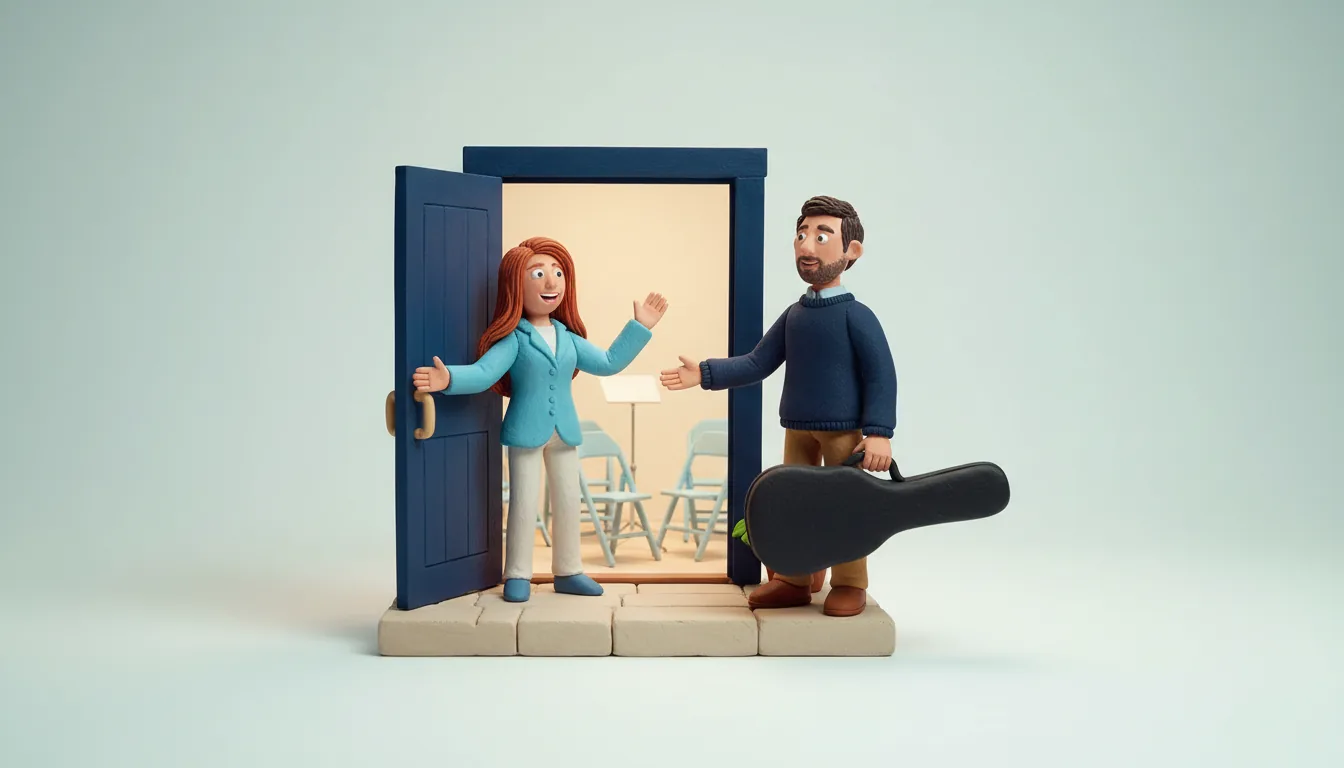
Many quote sites will tell you that Alexander Graham Bell said "when one door closes, another opens." There's no good evidence that he did. The saying is hundreds of years older than the telephone, and the longer version usually pinned on him first appeared in print in 1909 under another name. Its meaning is simpler than its history. When something in your life ends, like a friendship, a home or a plan, something new often turns up, though it's easy to miss while you're still looking back.
An example: the band Jonas played bass in for nine years ended on a Tuesday in March, when their drummer moved to Canada. For weeks the bass case stood by his front door, and he told everyone he'd find another band "when things settled down." In May his friend Mira told him that the Thursday music night at the community hall needed a bass player. On the first Thursday she held the hall's blue door open with one hand and waved him in with the other, while he stood on the step with the case and thought about going home. "When one door closes, another opens," she said. "You just have to walk through it." He did. He now plays there every week, and one of the new friends he made is a drummer.
Did Alexander Graham Bell say it?
Probably not. Quote Investigator, a site that traces famous lines back to their first printing, found that Bell's name was first attached to the saying in a small newspaper in January 1935. Bell had died in 1922. The same passage joined the saying to a line an American speaker used in 1859, when Bell was twelve, so it was a patchwork from the start.
Sources still differ. Many quote collections still give Bell the credit. Quote Investigator treats it as a later guess. If you want to put a name under the quote in a card, "unknown" or "old proverb" is the honest choice.
A door that's older than the telephone
The short saying was a proverb long before anyone printed it under a famous name. The earliest English example Quote Investigator found is in a 1586 translation of Lazarillo de Tormes, a Spanish novel first published by 1554:
"When one doore is shut the other openeth."
A 1620 English translation of Don Quixote has nearly the same line, and some sources call Cervantes the earliest. Quote Investigator puts the Lazarillo translation first.
The longer version took shape much later. A Vermont farm newspaper printed it in 1909 and credited the German writer Jean Paul, who had died in 1825, but Quote Investigator found no support for that either. Helen Keller used a version in a 1929 book and again in 1957, which is why her name turns up beside it too. So depending on where you look, the author is Bell, Keller, Jean Paul, Cervantes or nobody at all, and nobody at all is the closest to the truth.
The half many people leave off
The long version adds a warning to the promise. It says, roughly, that we look so long and so sadly at the door that closed that we don't see the one that opened for us.
That second half is the useful part. The short saying sounds like a guarantee that something better is on its way. The long one says the new door is often already there, and the trouble is where we're looking. What Jonas needed was a friend to point at the open door and hold it for him.
Doors that close between people
Many of the doors in everyday life are about people and places. A few common ones:
- A friendship that fades. Not every friendship lasts, and some end with no fight at all. Some friends are right for one season of life, and letting that end frees time for the people you see now.
- A move. Leaving a city means leaving the café, the neighbors and the friend who lived five minutes away. The new place has its own versions of all three, once you start looking.
- A group that ends. A band, a book club, a running group or a weekly game night. When the group goes, the habit of meeting people often goes with it, unless you replace it on purpose.
- A plan that falls through. The flat you didn't get, the trip that was cancelled, the class that filled up first.
Some doors you close yourself, on purpose and for good, and burning bridges is about those. When the thing ending was simply a good time, like a holiday or a last night together, the saying that all good things come to an end fits better.
Who stands at the closed door longest, by type
How long someone looks back at a closed door depends partly on personality type. Here are eight of the 16 types:
- Ideator is often through the next door before the old one has finished closing, sometimes through three at once.
- Harmonizer misses the comfort of the old room and settles into a new one once it starts to feel cozy.
- Vitalizer feels the loss out loud, talks it through with friends and bounces back fast.
- Analyst wants to understand why the door closed before walking anywhere else.
- Inspector looks for a clear plan B and steps through once it seems solid.
- Dreamer can stand at the closed door for a long time, lost in their own thoughts, and often needs a friend to point out the open one.
- Entrepreneur treats a closed door as useful information and starts trying other doors the same week.
- Craftsman says little, keeps their hands busy and finds the next thing by doing.
If Jonas had to guess, he'd call himself a Dreamer. Mira is the friend who holds the door.
When to say it, and when to wait
The saying works best once someone has started to look forward. Said on the day a door slams, it can sound like you're skipping past their sadness, the same trouble everything happens for a reason runs into. If the ending is a death, leave this saying out entirely.
In the first days, plain words do more:
- "That's a real loss. I'm sorry it ended."
- "Want to get out of the house on Saturday?"
- "You don't have to know what's next yet."
A few weeks later, when they start talking about what might come next, the saying can land as encouragement. It helps most when it comes with something concrete, like Mira's invitation to Thursday night.
How to spot the door that's open
New doors rarely look like the old ones, which is part of why people miss them. A few habits help:
- Say goodbye to the old door properly. A last dinner, a thank-you message or one honest conversation makes it easier to stop looking back.
- Tell people what you're looking for. Jonas told nobody he wanted to play again. The moment Mira knew, she had an answer.
- Say yes to one small invitation. One Thursday is enough to find out whether it fits.
- Look sideways as well as ahead. The new thing may be a different shape, like a folk night instead of a band or a walking group instead of a gym friend.
- Give it a few tries. The first visit to anything new feels awkward. By the third you'll know.
See what you do when a door shuts
Some people mourn a closed door for months, and others are through the next one by Friday. Your type explains part of that. Typeza shows your personality type and, when you invite someone, the relationship type you two make. Begin with the free personality test, then send it to the friend who once held a door open for you.
Questions people ask
Who said "when one door closes, another opens"?
No one person. The short form is an old proverb that appears in English translations of Spanish novels from 1586 and 1620. The longer version is often credited to Alexander Graham Bell or Helen Keller, but Bell's name was added years after his death, and the long form was in print before Keller used it.
What does "when one door closes, another opens" mean?
It means that when one thing in your life ends, a new chance often appears. The longer version adds that we often miss the new chance because we keep looking at what ended.
What is the full door quote?
The long form says, roughly, that when one door of happiness closes another opens, but we often look so long at the closed door that we don't see the one that opened for us. The wording changes from source to source.
Is it "another door opens" or "a window opens"?
Both forms are around. The window version is best known from the 1965 film The Sound of Music, where it's said about God, and people often mix the two into "when one door closes, a window opens."
What's another way to say it?
"One chapter ends and another begins," "Every ending makes room for something new" or simply "Something else will come along."
Sources
- Quote Investigator, "When One Door Closes, Another Opens". The 1586 and 1620 translations, the 1909 Vermont paper, Helen Keller in 1929 and 1957, and Bell's name from January 1935.
- Wikipedia, "Lazarillo de Tormes". The oldest editions date from 1554.
- Wikiquote, "The Sound of Music (film)". The 1965 film's line about the Lord opening a window.
Written by Virko Kask, founder of Typeza
Written with the help of AI tools.
One question for two, every week
A question to ask your partner, friend or family, and how different types tend to answer it.
Free. Unsubscribe any time.