
When in Rome, do as the Romans do: meaning at your partner's family table
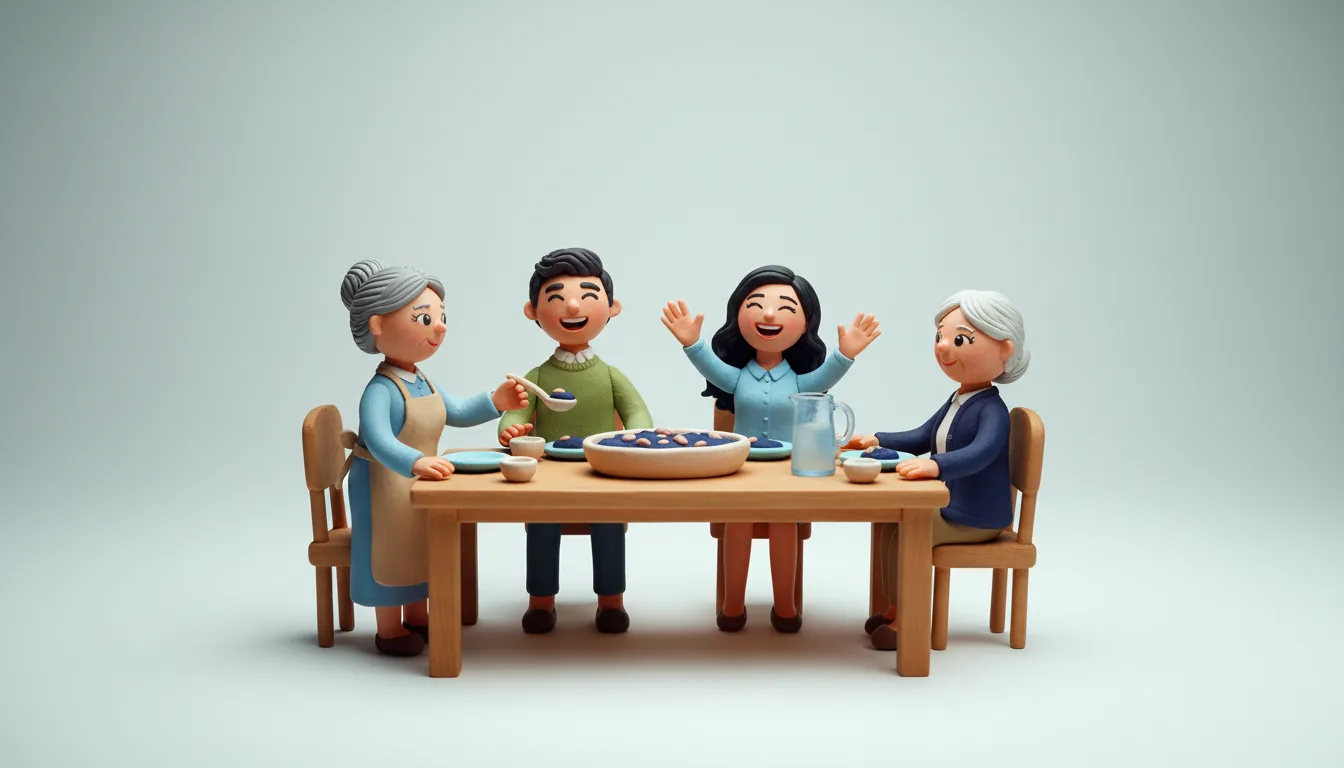
"When in Rome, do as the Romans do" means that when you're a guest somewhere, you follow the way things are done there, even if you'd do them differently at home. People say it before a first visit to a partner's family, on a weekend at a friend's house or in the first weeks at a new job. The short form, "when in Rome," is often a cheerful excuse to join in.
An example: Priya has her first Sunday lunch with Tomás's family and gets one thing wrong in the first ten minutes. She clears her plate and says she's full. Tomás's mother, Rosa, looks worried, as if the stew has failed. In Priya's family you finish what's on your plate to say thank you. In Tomás's family an empty plate means you're still hungry, and saying no to seconds means you didn't like the food. Tomás leans over and whispers, "When in Rome." So when Rosa comes round with the big spoon, Priya holds out her plate, takes a small second helping and praises the stew. Then she lifts both hands and laughs as Rosa turns straight to Tomás's plate. At the end of the table his grandmother, Lucía, smiles.
A fast day, a bishop and a question from Milan
The story behind the saying is about 1,600 years old. In the 380s the young Augustine was living in Milan, and his mother, Monica, had followed him there. She found that the church in Milan didn't fast on Saturdays, the way Christians did in Rome, and she didn't know which custom to keep. Augustine took the question to Ambrose, the bishop of Milan. In the year 400 he wrote the answer down in a letter to a man named Januarius:
> "When I visit Rome, I fast on Saturday; when I am here, I do not fast."
Ambrose's advice was to follow the custom of whatever place you're in. Over the centuries his answer became a short Latin proverb, and much later the English line we use now. Translations word Ambrose's answer a little differently, but the idea stays the same: in someone else's place, keep their custom on small things.
At your partner's family table
Every family has rules nobody writes down. Some wait for the oldest person to start eating. Some take their shoes off at the door, hug hello and argue loudly and happily about everything. Others shake hands, keep their voices low and would be shocked by a raised one. Guests clear the table in one house and are told firmly to sit down in the next.
For a first visit, a few habits help:
- Ask your partner beforehand what's normal, from the shoes to the seconds.
- Watch the first ten minutes before you do much of anything.
- Follow on the small things, like when to start eating and whether to help clear.
- When you can't tell, quietly ask your partner whether to help with the dishes or stay put. Nobody minds being asked.
Small customs cost you very little, and following them tells the family you respect their home. If something matters more than that, the piece on boundaries with in-laws covers how to say so kindly.
A weekend at a friend's place
A friend's home runs on its own clock. They eat at six and you usually eat at nine. They're up at seven with the radio on. Their dog sleeps on the sofa, and that's simply where the dog sleeps.
A good guest fits into that rhythm for a couple of days. Eat when they eat, ask when the bathroom is free in the morning, and offer to cook one meal your way. Many friends love a guest who joins in and leaves the place as they found it. If something really doesn't work for you, like a late night before your early train, say it once and plainly.
Your first weeks at a new job
A new workplace has customs too, and many of them are about people. Maybe the team eats lunch together at noon, or everyone eats at their desk. Maybe there's cake in the kitchen for every birthday, or nobody mentions birthdays at all. Some teams say everything straight out, and others wrap it gently.
Give it two weeks before you change anything. Join the lunch, sign the card and learn names. Once people know you, it's easier to bring in a habit of your own, like the Friday walk you liked at your last place.
When you're the one hosting
The saying puts all the work on the guest, but the hosts can help a lot. Tomás could have told Priya about the seconds on the drive over. A short "My mom will feed you until you beg, so leave some on your plate" would have saved her the worried look.
If you're bringing a partner or a friend home, tell them the two or three things that matter most to your family. Then let the rest go. A guest who keeps their shoes on by mistake has done nothing wrong, and a family that laughs it off makes everyone relax.
Where fitting in should stop
Following a custom is kind. Changing who you are is a different thing. You can take seconds of the stew without laughing at a joke you find cruel, and you can join a family's holiday without giving up every one of your own. Couples who mix two families often keep some of each, and the article on holiday traditions has ideas for blending them.
A useful test is to ask whether the custom is about the place or about you. Shoes, mealtimes and who sits where are about the place. Your values, your voice and how you treat people are about you, and those travel with you. If being a good guest starts to feel like playing a part, being yourself around new people is worth a read.
Quick adapters and habit keepers, by type
Some people fit into a new home in an afternoon. Others need several visits and still miss their own way of doing things. Typeza sees personality type as part of it. Eight of the 16 types:
- Ideator finds new customs interesting and will try anything once, then ask where the habit came from.
- Harmonizer notices who needs a top-up or a cushion and quietly helps. They'll go along with a lot to keep the table calm.
- Inspector is happy to follow the rules once someone explains them. Unspoken rules are what trip them up.
- Commander tends to keep their own pace and may end up running the kitchen by the second visit.
- Dreamer watches quietly and adapts slowly. A calm corner and a little time help a lot.
- Diplomat reads a room faster than anyone and matches it within minutes.
- Guardian wants to know who will be at the table before the first visit, and stays a little formal until they know whom to trust.
- Organizer asks how things are done here and starts helping, often before anyone else stands up.
Priya, who reads the table in ten minutes, is a lot like the Diplomat.
See how you fit with your partner's family
A partner's family is a whole new set of people, and you'll get along with each of them in a different way. With Typeza, you and a relative find out which relationship type you form, what comes easy with each other and where mix-ups tend to start. Take the free family compatibility test, then pass the invite on your result to your partner's mom, dad or sister.
Questions people ask
Who said "when in Rome, do as the Romans do"?
The idea goes back to Ambrose, a bishop of Milan in the 300s, as Augustine reported it in a letter in the year 400. The English wording came much later.
Is "when in Rome" an excuse to do anything?
People sometimes use it that way as a joke, for a second dessert or a late night out. It fits small customs. It doesn't cover anything you'd regret back home.
Sources
- New Advent, Augustine, Letter 54, to Januarius. Monica in Milan, the Saturday fast and Ambrose's answer, dated 400.
- Wiktionary, "when in Rome, do as the Romans do". The Medieval Latin proverb attributed to Ambrose and the meaning.
Written by Virko Kask, founder of Typeza
Written with the help of AI tools.
One question for two, every week
A question to ask your partner, friend or family, and how different types tend to answer it.
Free. Unsubscribe any time.