
The apple doesn't fall far from the tree: meaning, and when it isn't true
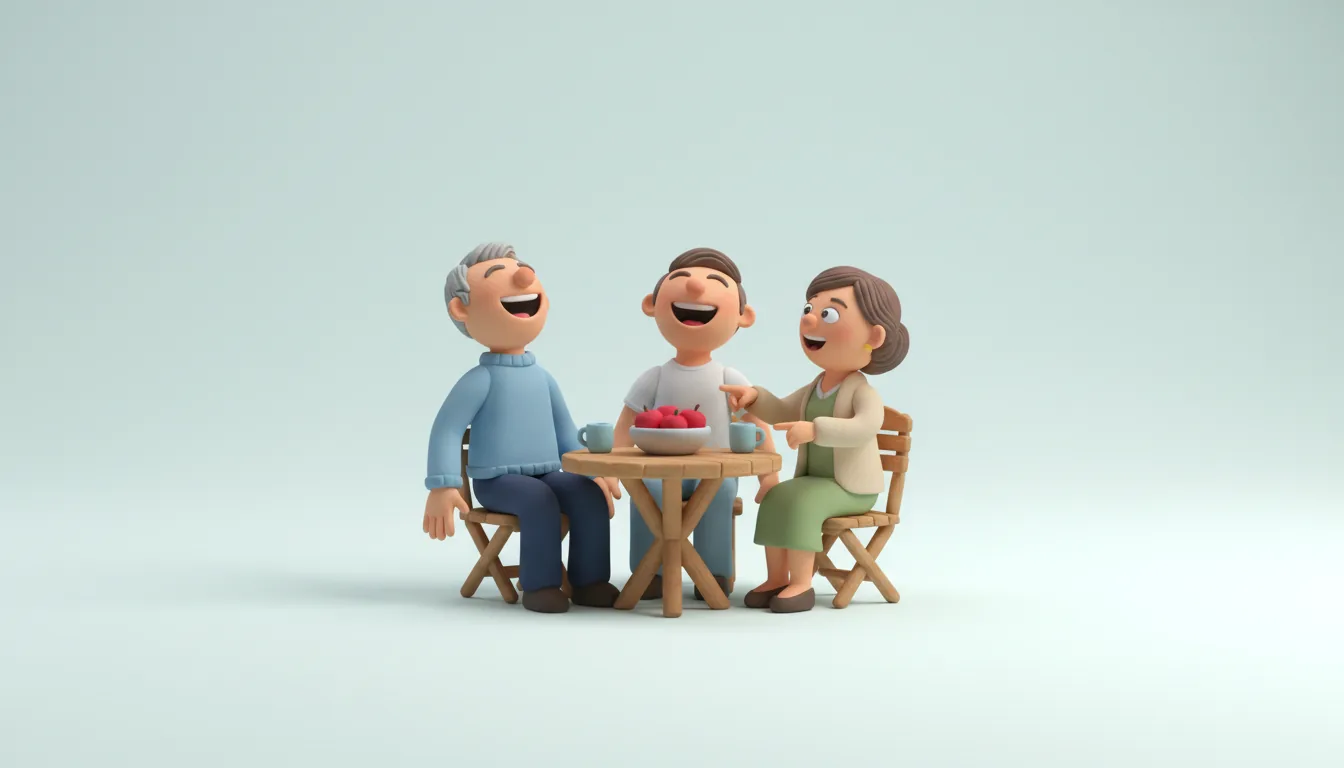
The apple doesn't fall far from the tree means that children are often like their parents. People say it when a son or daughter shows a parent's habit, talent or fault.
An example: at a family lunch, a man tells a story and laughs at his own joke before the end. His grown son does the same thing five minutes later. An aunt shakes her head and says, "Well, the apple doesn't fall far from the tree." Everyone laughs. His sister, who is nothing like their mother, does not.
What does "the apple doesn't fall far from the tree" mean?
An apple drops from the tree and lands close to it, and in the same way a child tends to end up close to where they came from.
People use it in two ways:
- As praise. A daughter becomes a fine cook like her mother. "The apple doesn't fall far from the tree."
- As a light dig. A son is late to everything, just like his father. Same words, a different tone.
You can also hear it as "the fruit doesn't fall far from the tree" or "the acorn doesn't fall far from the oak". They all mean the same.
Where does the saying come from?
It is an old proverb found in many languages, including German and Russian. In English it appears in print by 1842. The picture is simple and needs no explaining: fruit falls straight down and lands near the trunk. That may be why the saying has lasted so long in so many places.
Similar sayings in English are "like father, like son", "like mother, like daughter" and "a chip off the old block". All of them point to the same idea: children often turn out a lot like their parents.
Examples of the saying in a sentence
- "Her dad was a teacher for forty years, and now she runs a school. The apple doesn't fall far from the tree."
- "He argues with every referee, just like his mother did. The apple doesn't fall far from the tree."
- "Both of them fix old cars on weekends. I guess the apple doesn't fall far from the tree."
What does it mean when the apple falls far from the tree?
The opposite saying, "the apple fell far from the tree", means a child turned out very different from their parents. A quiet bookworm in a loud sporty family, a musician born to two accountants, or a daughter who moved across the world from parents who never left their town.
People say it with surprise or with a smile. It does not mean the child is worse or better, only different.
Is the saying true?
Partly. Children pick up a great deal from the family they grow up in: phrases, jokes, how to argue at the dinner table, what counts as a good life. Much of this looks like personality from the outside, and it is why a son can laugh exactly like his father.
The saying misses a lot, though. Two children from the same parents can be very different people. A parent and an adult child can share every habit and still see the world in different ways. In socionics, the theory Typeza is built on, a personality type is not handed down. Any parent and any child can be any two of the 16 types.
When the saying stings
Some people hear it as an insult. An adult who has worked hard not to repeat a parent's temper, money habits or coldness can feel slapped by "you're just like your father". Others feel the comparison wipes out everything they built on their own.
Before you say it, think about the tone and the person. "You have your mom's eye for color" is kind. "Typical, just like your dad" rarely is. If someone says it to you and it hurts, you can say so calmly: "We're alike in some ways. I'm my own person too."
Why some adult children are so like a parent and others are not
In Typeza, any two people form one of 16 relationship types. The type says a lot about whether a parent and an adult child feel alike, and what they find easy or hard together. Four parent and child pairs show the range.
The son who is his father all over again
A father and his grown son are both Craftsmen. Both are calm, good with their hands and happiest fixing something in the garage. They need few words to work together, and relatives joke that they are the same man thirty years apart. In Typeza terms they are an Identity pair. They understand each other at once, and they share a blind spot. When they both put off a hard talk, nobody in the pair starts it, so it helps when one of them makes the first move on purpose.
The daughter who looks like a copy and argues like a rival
An Analyst mother and her daughter, an Entrepreneur, love the same topics and talk about money, work and the news for hours. Everyone says the daughter is her mother all over again. Yet they rarely agree. The mother wants a plan that holds together before anything starts. The daughter wants to start now and fix it on the way. Their relationship type, Extinguishment, gives them shared ground and two different readings of it. Their talks are some of the best either of them has. Doing a project together is where it goes wrong.
The daughter who looks up to her mother
A Harmonizer mother runs a calm, cozy home. Her daughter, an Inspector, has always admired it and finds herself copying it in her own flat. She calls often and offers help before she is asked. The mother loves her and still needs more room than her daughter wants to give. The help runs from the daughter, the Supplier, to the mother, the Orderer. The daughter feels like a copy, but the pull goes one way. Both do better when the mother says thank you out loud and the daughter does not read the mother's need for space as a no.
The son who is nothing like his father
A Commander father is direct, quick and always doing something. His grown son, a Strategist, is quiet, thinks far ahead and would rather plan than rush. People say the apple fell far from the tree. Yet they get on well. The father gets things moving, and the son sees where they will lead. This is Semi-duality, close to the fit of Duality with one gap the two of them leave open. Being nothing alike can still mean a good match.
Many other families have a parent and an adult child in Duality. They are nothing alike, and each one covers what the other is missing. Between a parent and an adult child it can feel like the easiest bond in the family.
No family is better for having one pattern or another. The patterns only explain why "just like your mother" can be true of one child and make no sense for another.
How to see what you share with your parent
The son who laughs at his own jokes like his father may or may not share his type. A habit says little about it, and so does a shared job. Take the free family compatibility test, and your result will let you invite a parent, a grown child or a sibling. Typeza is for people 16 and older, so a younger brother or sister will have to wait. As each of them finishes, you both see the relationship type between you. Our articles on the father and son relationship, mother and daughter relationship and family dynamics go deeper.
Questions people ask
What does "the apple doesn't fall far from the tree" mean?
It means children are often like their parents in habits, talents, interests or faults. It can be praise or a light dig, depending on the tone.
Is "the apple doesn't fall far from the tree" an idiom?
Yes. It is a proverb, a short saying with a meaning beyond the words. Nobody is talking about real apples.
What is the opposite of "the apple doesn't fall far from the tree"?
"The apple fell far from the tree." It means a child turned out very different from their parents.
What is another way to say "the apple doesn't fall far from the tree"?
Like father, like son. Like mother, like daughter. A chip off the old block. The fruit doesn't fall far from the tree.
What are some other idioms about apples?
The apple of my eye is someone you love dearly. One bad apple spoils the bunch says one person can drag down a whole group. How about them apples is a playful "What do you think of that?" after you prove a point.
Sources
- Wiktionary, "the apple does not fall far from the tree". The meaning, the 1842 English quotation and the German and Russian forms.
Written by Virko Kask, founder of Typeza
Written with the help of AI tools.
One question for two, every week
A question to ask your partner, friend or family, and how different types tend to answer it.
Free. Unsubscribe any time.