
What is self-awareness? Examples, exercises, and how to build it
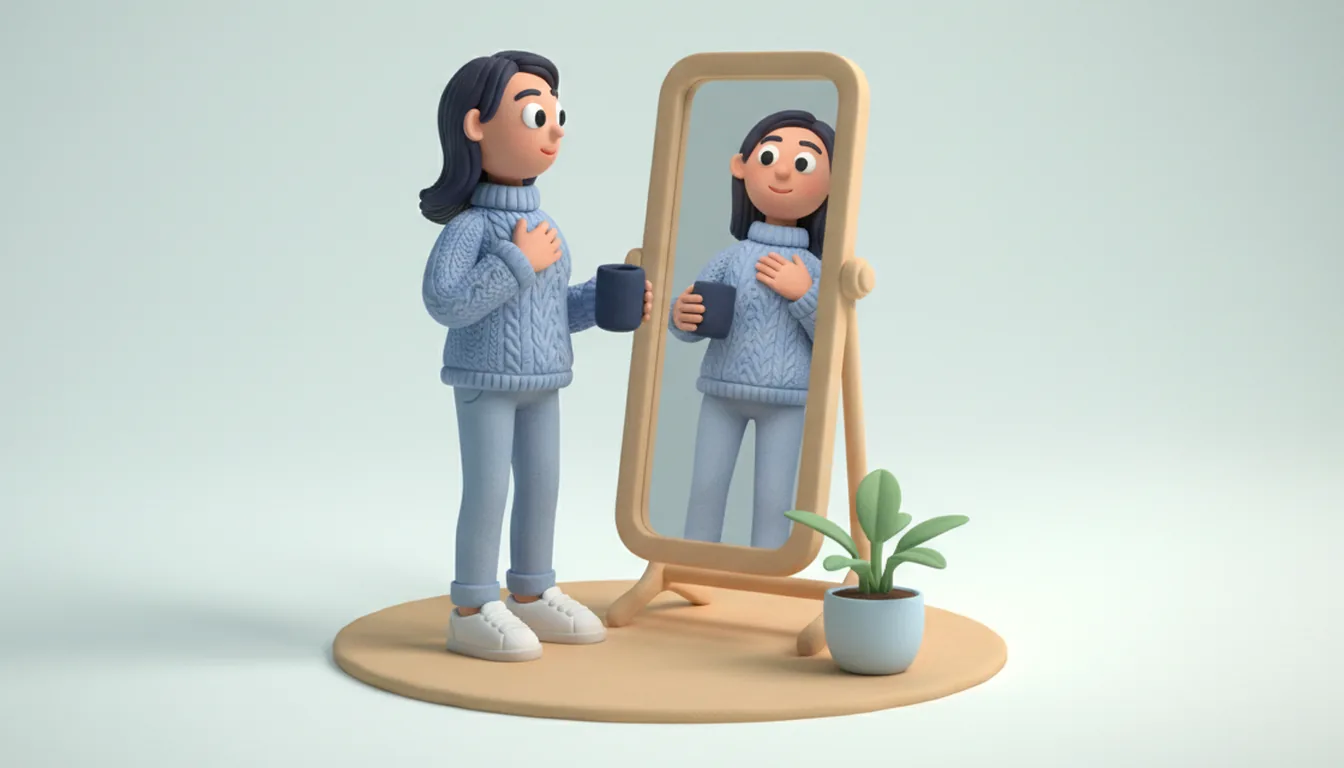
Self-awareness is the ability to see yourself clearly. You notice what you feel, think and do while it happens, you understand why, and you know how it comes across to other people. It has two sides. Internal self-awareness is how well you know your own feelings, values and habits. External self-awareness is how well you know the way others see you. Both grow with practice.
An example: Nina is in the middle of a story at a friend's barbecue when she notices she has cut off the same person three times. She stops, laughs and says, "Sorry, go on. I do that when I get excited." Her friend looks surprised, and a little pleased. Nobody had pointed it out to Nina.
What is self-awareness?
Self-awareness means you can watch yourself while you live your life. You feel angry, and you also notice, "I'm angry because I feel ignored." You say something sharp, and a second later you know it landed badly.
It is different from thinking about yourself a lot. Some people spend hours on their own thoughts and still miss what everyone around them sees. What counts is whether your picture of yourself matches how you really act.
Internal and external self-awareness
Internal self-awareness is the view from the inside. You know what you value, what drains you and how you tend to react. People who are strong here make choices that fit them and can say what they need. When that inside view is blurry, even small choices drag on, which is part of why some people are indecisive.
External self-awareness is the view from the outside. You know how your words, your face and your habits land with other people. Do you come across as calm or cold? Warm or pushy? People who are strong here are easier to sort things out with, because they can guess how they affect a room.
The two do not always come together. You can know your feelings in detail and have no idea that you look bored when you listen. Or you can read every room and still not know what you want for yourself. Research finds little link between them.
To test the gap, think of your last disagreement and write down how you think you came across. Then, on a calm day, ask the other person how it felt from their side. Where the two stories differ, you have found something to look at. Personality masks explains one common reason for that gap: a role you play for years can hide the person underneath.
Examples of self-awareness in everyday life
Self-awareness is easier to recognize than to define. Here are examples of it in ordinary moments.
- You notice you are hungry and tired before a hard talk, so you ask to have it after dinner.
- You catch yourself giving advice when your friend only wanted to vent, and you stop.
- You know you go quiet when you are hurt, so you tell your partner, "I'm not cold, I just need an hour."
- You can say "I was wrong about that" without a long defense.
- You notice that one friend always leaves you full of energy and another always leaves you tired.
- You hear your parent's words coming out of your mouth in an argument, and you smile instead of carrying on.
None of these are big moments. Most self-awareness happens in small pauses like these.
Are you self-aware? Signs to look for
It is hard to judge your own self-awareness from the inside, so it helps to look at what you do. These are good signs.
- You can name your feelings with more words than "fine" and "stressed".
- You can predict how you will react to things, and you are usually right.
- Feedback still stings, but you can find the part of it that is true.
- You know a few of your weak spots and can joke about them.
- When you apologize, you name the specific thing you did.
- People rarely surprise you with how they see you.
What a lack of self-awareness looks like
Everyone has blind spots, so a lack of self-awareness is not a flaw in someone's character. It usually shows up as a pattern.
- The same conflict keeps happening with different people.
- Every piece of feedback feels like an attack.
- You are often surprised to learn that someone was hurt or annoyed.
- You describe yourself in a way your friends would not recognize.
- When something goes wrong, the explanation is always what someone else did.
- You criticize in others the exact habit you have, which is the pot calling the kettle black.
If a few of these sound familiar, you have already started, because you noticed them.
Self-awareness vs self-consciousness
The two words sound alike, but they feel very different. Self-consciousness is worry about how you look to others. Your face goes hot, you are sure everyone is staring, and your attention gets stuck on yourself, which makes it harder to act.
Self-awareness is calmer. You notice what you do and how it lands, and you use that to do better next time. At a party, a self-conscious person thinks, "Everyone can see how awkward I am." A self-aware person thinks, "I talk fast when I'm nervous. I'll slow down."
Self-awareness exercises you can try this week
These short exercises fit into a normal week. Pick two and keep them up for seven days. If you'd rather write, these journal prompts for self-discovery give you one question a day.
- The one-word check-in. Set three alarms a day. When one goes off, name what you feel in one word and what caused it. After a week, look for patterns.
- The evening replay. Pick one moment from the day when you reacted strongly. Go through it slowly: what happened just before, what you felt, what you did and what you wish you had done.
- Predict yourself. Before a family dinner or a busy day, write down how you think you will feel and act. Afterward, compare. You learn most from the times you got it wrong.
- Catch your "always" and "never". When you hear yourself say "I always" or "you never", write the sentence down. These words often carry a story you tell about yourself.
- Ask one person one question. Once a week, ask someone close something like "What do I do when I'm stressed?" Listen without explaining. These questions to ask your friends about yourself give you more to choose from.
- Notice what you defend. When you feel a strong urge to argue, ask yourself what feels under threat. Often it is a value you care about.
For the bigger picture of what you value and enjoy, how to find yourself walks you through it in eight steps.
Why a personality type is a shortcut to self-awareness
Exercises are slow because you collect facts about yourself one at a time. A personality type gives those facts a frame. It describes how you take in the world, what you notice first and where you tend to be strong or weak, so you can check a description against your life instead of starting from a blank page.
It helps with both sides. It names patterns you may have felt for years without words for them, and it shows how your natural style can come across to people who are built differently.
A few examples, in the order of the types page:
- An Analyst usually knows exactly why they think what they think. What they may miss is that their directness can come across as cold.
- A Commander acts fast under pressure. Their blind spot is often impatience, moving on before others feel heard.
- A Counselor notices other people's feelings almost at once. Their own tiredness, after taking in everyone else's moods, is much easier for them to miss.
A type does not tell you everything about yourself, and it does not put you in a box. It gives you words for what you see and a place to start looking. Once you have those words, how to describe yourself helps you use them.
See yourself through your type
A personality type gives you words for patterns you may only half see. The free personality test has no neutral middle, so for each pair of statements you have to pick the one more like you. The result shows your type and where you sit on each of the four base traits. If a trait came out nearly even, the result names the type across the line, and deciding between the two is a small self-awareness exercise of its own. Your type's profile is free to read, and you see the result without signing up.
For a view from outside, ask someone close to take the same test through the invite on your result. You both see your types and the relationship type you share, so you can see where you fit easily and where you are likely to misread each other.
Questions people ask
Can you learn self-awareness?
Yes. It grows with practice, like any habit. Short daily check-ins, honest questions to the people close to you and learning your personality type all help.
Can you be too self-aware?
Thinking about yourself all the time can feel like being too self-aware, but it is usually closer to self-consciousness or overthinking. Real self-awareness tends to make you calmer, because you know what is going on inside you.
Is self-awareness the same as a sense of self?
Not quite. A sense of self is your feeling of who you are: your values, your tastes and what makes you you. Self-awareness is the ability to see that self clearly, including how it shows to others. The better you see yourself, the steadier that sense of self tends to feel.
How is self-awareness related to emotional intelligence?
Self-awareness is the part of emotional intelligence that is about you: noticing your own feelings and how they shape what you do. It is usually the starting point, because it is hard to read other people well when you cannot read yourself.
Why is self-awareness important?
It helps you make choices that fit you, get through conflicts with less damage and be easier to live with. When you know your own patterns, you spend less time repeating the ones that do not work.
What is another word for self-awareness?
Self-knowledge, insight and self-understanding.
Sources
- Tasha Eurich, "What Self-Awareness Really Is (and How to Cultivate It)", Harvard Business Review, 2018. Internal and external self-awareness, and the finding that the two are barely related.
Written by Virko Kask, founder of Typeza
Written with the help of AI tools.
One question for two, every week
A question to ask your partner, friend or family, and how different types tend to answer it.
Free. Unsubscribe any time.