
What is a backhanded compliment? Examples, and what to say back
A backhanded compliment is praise with a small insult folded inside it. On the surface it sounds kind, but it hints at something unflattering at the same time: that you usually look worse, that nobody expected you to manage, or that you're doing well for someone like you. The word comes from a backhand swing, a blow delivered with the back of the hand.
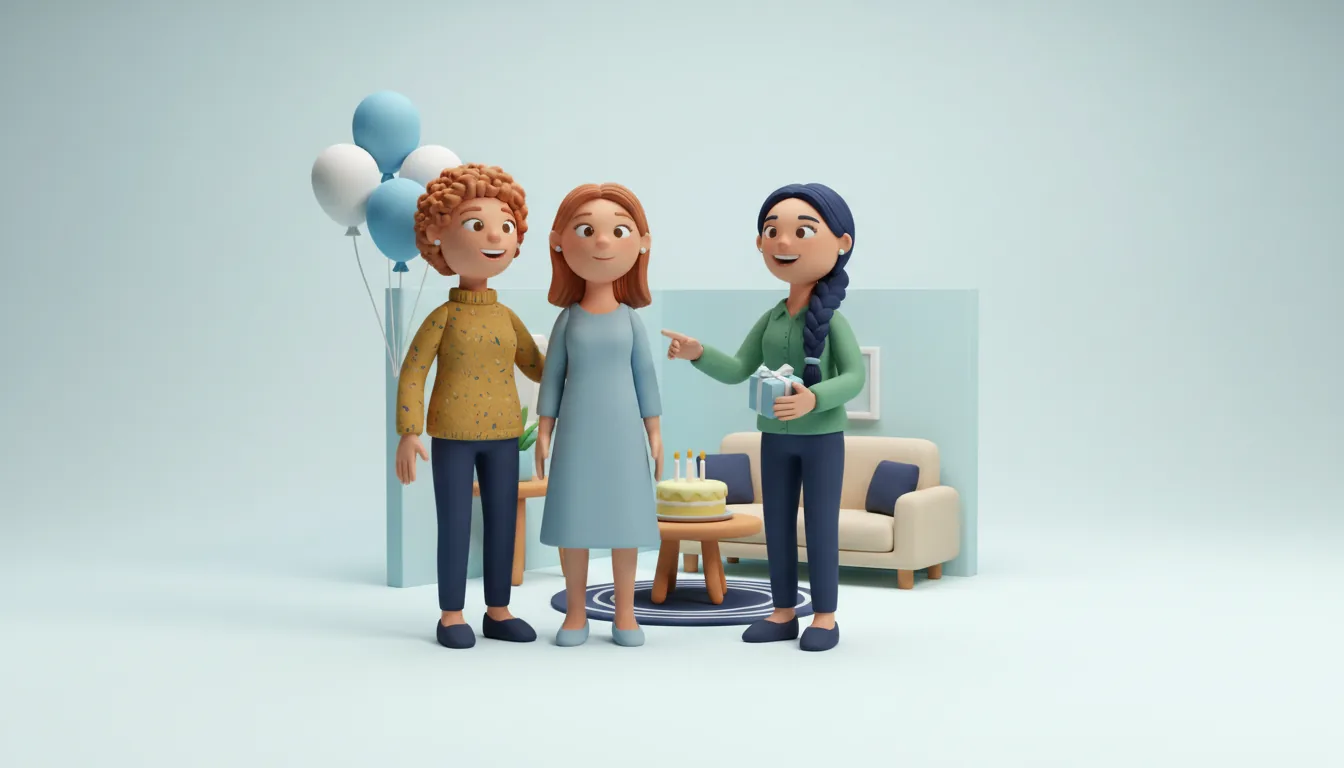
An example: when Maren turns forty, her friends throw a small party with a lemon cake and too many candles. Joy hugs her at the door and says, "You look amazing for forty!" Later, while they cut the cake, Nadia tells her, "I love that you don't care about matching your outfits." Maren laughs both times. On the drive home she is still turning the words over, unsure whether she was praised or poked.
What makes a compliment backhanded?
A normal compliment points at something good and stops there. A backhanded one adds a comparison, a condition or a surprise, and that extra piece carries the sting. "You look great" is a compliment. "You look great, have you lost weight?" suggests you didn't look great before.
Often the person saying it means the nice part and hasn't noticed the second part at all. Sometimes they notice it very well. The words alone rarely tell you which, so it helps to look at the person and the pattern, which we'll come to below.
The little words that give it away
Many backhanded compliments lean on the same few words. Once you know them, you hear them everywhere:
- "Actually." "This is actually really good!" The surprise is the insult.
- "For a..." "You're pretty funny for a quiet person." The praise only holds inside a smaller group.
- "At least." "At least the dessert turned out." It points at what didn't.
- "Finally." "You finally found a haircut that works." So the old ones didn't.
- "Brave." "That's a brave color for a kitchen." Brave here means risky.
- "I could never." "I could never live with so little space." It sounds like admiration and works as a judgment.
- "So much better than." "So much better than last year's!" It's praise with a memory attached.
Backhanded compliment examples
Backhanded compliments about looks
- "You look amazing for your age."
- "That dress is so slimming on you."
- "You look so much prettier with your hair down."
- "I wish I could pull off short hair. I'd never be that confident."
- "You clean up nice!"
- "You're so lucky you can eat whatever you want and still look fine."
Backhanded compliments about cooking and hosting
- "This is actually really good!"
- "Did you make this yourself? It tastes almost homemade."
- "I love how relaxed you are about hosting. Not everyone could serve dinner at nine."
- "So much better than the soup last time."
- "It's nice that you don't stress about fancy food."
Backhanded compliments about your home
- "It's so cozy! I could never live somewhere this small."
- "I love that you don't care about matching furniture."
- "Your place is so much nicer than I expected."
- "It must be so easy to clean with so little stuff."
- "You're brave to paint a wall that color."
Backhanded compliments about life choices
- "Good for you for not rushing into marriage."
- "It's great that you're finally getting your life together."
- "I admire how you don't care what people think about your car."
- "You're so brave to move back in with your parents at your age."
- "Renting is smart. You'll never have to deal with real repairs."
Why people give backhanded compliments
Many backhanded compliments are clumsy more than cruel. The usual reasons:
- They mean the praise and fumble the words. The comparison slips out because it's how they were thinking about it.
- They're comparing out loud. "For forty" may say more about how the speaker feels about their own age.
- Mixed feelings. Real admiration with a pinch of envy can come out as a compliment with a hook in it.
- Family habits. In some families, teasing is how people show affection, and plain praise feels awkward.
- Nerves. A direct compliment can feel too intimate, so they add a joke to soften it.
Then there's the smaller group who mean the sting. A person who is warm to your face and sharp behind your back has a deeper habit, and two-faced people looks at that pattern in more detail.
Clumsy or cutting? How to tell
One odd remark at a party tells you very little. A few questions help sort a slip from a dig:
- Does it happen once, or often? Repetition is the strongest sign.
- Is it always about the same thing? If every comment circles back to your weight or your house, it isn't random.
- Who is listening? Backhanded remarks made in front of others tend to be less innocent.
- How do they react to your face? A small satisfied smile after the words says a lot.
- How are they the rest of the time? A warm friend having a clumsy moment is very different from a rival who keeps score.
The same questions help with sarcasm, where a friendly tease and a dig can sound almost the same.
What to say back to a backhanded compliment
You don't need a clever comeback. Calm replies tend to work best:
- Take only the compliment. Smile and say "Thank you!" The sting stays with the person who brought it.
- Ask a light question. "For forty?" or "What do you mean?" makes them say the hidden part out loud, and many people quickly back off.
- Answer with humor. "I know, I surprised myself too." It shows the remark didn't land.
- Name it later, in private. "When you said the stew was actually good, it sounded like you expected it to be bad. Did you mean that?"
- Let it go. When it was clearly a slip from someone who loves you, letting it pass is often the kind choice.
With someone who does it again and again, a calm and direct sentence beats any comeback. If speaking up like that feels hard, being more assertive is a skill you can practice in small steps.
And when a compliment is plainly kind and you still don't know what to say, how to respond to a compliment has simple replies.
Do you give backhanded compliments without meaning to?
Most people have. A quick check: try saying the compliment with everything after "but," "for a" or "actually" removed. If it's still true and still kind, say only that part. Praise the thing itself, and leave out the comparison with last year, other people or what you expected.
Why some praise comes out crooked
Typeza sees personality type as part of how people give and take compliments. A remark that one person shrugs off can keep another awake. Here are six of the 16 types:
- Harmonizer: hears the sting, keeps smiling to protect the mood, and replays it later.
- Vitalizer: puts real heart into a party, so a remark like "at least the dessert worked" hits harder than the speaker guesses.
- Analyst: adds the qualifier because precision matters to them. "Good for a first try" is, in their mind, just accurate.
- Inspector: notices the one detail that's off and may mention it in the same breath as the praise.
- Strategist: gives praise with a warning attached, such as "Lovely garden. Shame about the shade in summer."
- Craftsman: judges by quality and keeps praise short. From them, "not bad" can be high praise.
Knowing a friend's type won't excuse a real dig, but it can stop you from hearing one where none was meant.
See how you and a friend give and take praise
Maren later asked Joy what she'd meant. Joy was horrified. She'd been thinking about her own birthday coming up, and the "for forty" just slipped out. If you're curious why one friend's words sting and another's never do, try the free friendship compatibility test. You begin alone. It puts 41 pairs of statements in front of you, and you tap the truer one for you each time. Your type is there the instant you finish, together with a bar per base trait and a free short profile of your strong points and soft spots. None of that needs an account.
Adding a friend means signing up for a free account, then passing along the invite link that appears with your result. Friends need to be 16 or older. When your friend has answered, both of you can read the relationship type that connects you, including where you naturally get each other and where a small remark can land the wrong way.
Questions people ask
Is a left-handed compliment the same thing?
Yes. "Left-handed compliment" is another phrase with the same meaning: praise that carries a hidden insult.
Why do people give backhanded compliments?
Usually by accident, from nerves, comparison or clumsy wording. Sometimes it's mixed feelings or envy. A pattern of them aimed at the same topic is more likely to be on purpose.
What is another word for a backhanded compliment?
Veiled insult, dig and passive-aggressive compliment all mean much the same thing. In slang, people say the speaker is throwing shade.
What are some funny backhanded compliments?
Among close friends, a teasing one can be fun, like "Your jokes are so bad they're good." The Southern "Bless your heart" is the famous one, sweet on the surface and often meant as "you poor thing."
Written by Virko Kask, founder of Typeza
Written with the help of AI tools.
One question for two, every week
A question to ask your partner, friend or family, and how different types tend to answer it.
Free. Unsubscribe any time.